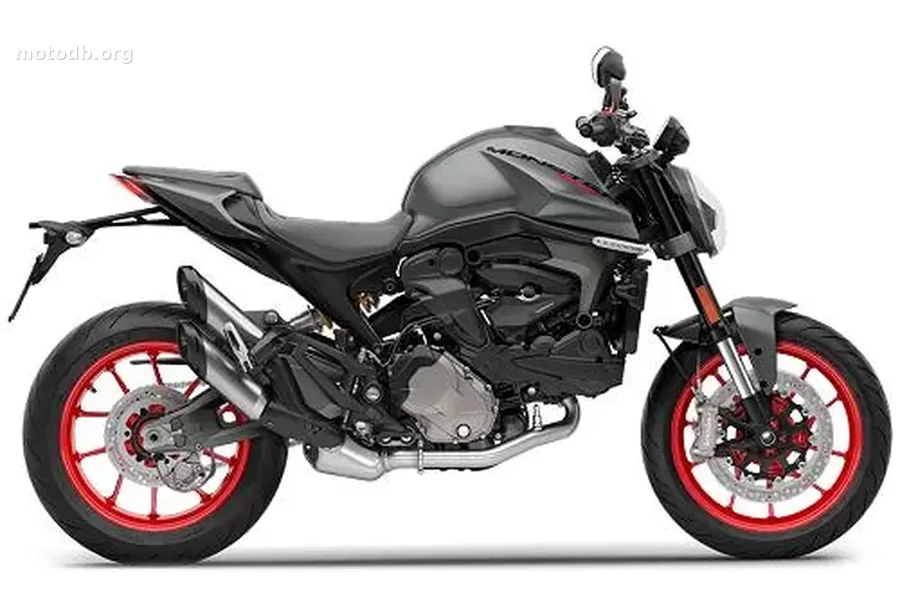
Key performance
Technical specifications
- Displacement
- 890 cc → 937 cc
- Power
- 111.0 ch @ 9000 tr/min (81.6 kW) → 111.0 ch @ 9250 tr/min (81.6 kW)
- Torque
- 91.1 Nm @ 7250 tr/min → 93.2 Nm @ 6500 tr/min
- Compression ratio
- 13.1 : 1 → 13.3 : 1
- Bore × stroke
- 96 x 61.5 mm → 94 x 67.5 mm
- Fuel system
- Injection Ø nc → Injection Ø 53 mm
- Starter
- électrique → —
- Euro standard
- Euro 5+ → —
- Rear suspension
- Mono-amortisseur, déb : 145 mm → Mono-amortisseur, déb : 140 mm
- Front brakes
- Freinage 2 disques Brembo Ø 320 mm, fixation radiale, étrier 4 pistons (M4.32 monobloc) → Freinage 2 disques Brembo Ø 320 mm, fixation radiale, étrier 4 pistons
- Front tyre pressure
- — → 2.30 bar
- Rear tyre pressure
- — → 2.50 bar
- Seat height
- 815.00 mm → 820.00 mm
- Seat type
- Selle biplaces → —
- Weight
- 175.00 kg → 188.00 kg
- Dry weight
- — → 166.00 kg
- New price
- 12 590 € → 12 290 €
Engine
- Displacement
- 937 cc
- Power
- 111.0 ch @ 9250 tr/min (81.6 kW)
- Torque
- 93.2 Nm @ 6500 tr/min
- Engine type
- Bicylindre en L à 90°, 4 temps
- Cooling
- liquide
- Compression ratio
- 13.3 : 1
- Bore × stroke
- 94 x 67.5 mm
- Valves/cylinder
- 4
- Camshafts
- 2 ACT
- Fuel system
- Injection Ø 53 mm
Chassis
- Frame
- monocoque en aluminium
- Gearbox
- boîte à 6 rapports
- Final drive
- Chaîne
- Front suspension
- Fourche téléhydraulique inversée Ø 43 mm, déb : 130 mm
- Rear suspension
- Mono-amortisseur, déb : 140 mm
Brakes
- Front brakes
- Freinage 2 disques Brembo Ø 320 mm, fixation radiale, étrier 4 pistons
- Rear brakes
- Freinage 1 disque Ø 245 mm, étrier 2 pistons
- Front tyre
- 120/70-17
- Front tyre pressure
- 2.30 bar
- Rear tyre
- 180/55-17
- Rear tyre pressure
- 2.50 bar
Dimensions
- Seat height
- 820.00 mm
- Fuel capacity
- 14.00 L
- Weight
- 188.00 kg
- Dry weight
- 166.00 kg
- New price
- 12 290 €
Overview
When an icon decides to reinvent itself, two camps immediately form: the guardians of the temple and the pragmatists. The Ducati Monster 937 provoked exactly this fracture, and that may be a sign that it was spot on.
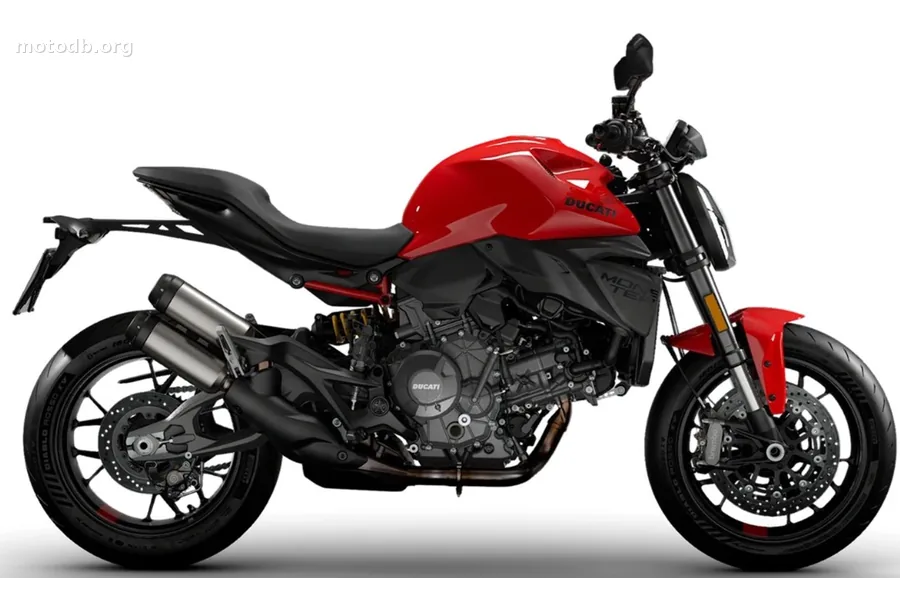
Thirty years after the first Mostro emerged from Bologna, the recipe remains faithful to itself in its broad principles, but radically different in execution. The aluminum monocoque frame replaced the trellis frame that had made purists drool since the original Ducati Monster 900. Scandal, they cry. Except that this same type of structure comes directly from the Panigale V4, and the 937 cm3 engine descends directly from the 950 SuperSport. We’ve seen worse legacies. In 1993, the recipe was identical: a frame borrowed from the 888 Superbike, an engine from the 900 SS. Ducati has not betrayed its Monster; it has simply changed internal suppliers.
What the numbers tell is eloquent. Eighteen kilograms evaporated compared to the Ducati Monster 821 it replaces, bringing it to 166 kg dry, fully fueled to 188 kg. The same value as the Triumph Street Triple RS, the undisputed benchmark in the naked segment. It’s not a coincidence; it’s an assumed positioning. The frame alone saves 4.5 kg, the rear frame 1.9 kg, the rims 1.7 kg, the swingarm 1.6 kg, the engine 2.4 kg. The hunt for grams was conducted piece by piece, with an engineer’s methodology. The result justifies the stylistic choices that made teeth grind.
Regarding the engine, the move from 821 to 937 cm3 is more than just a question of displacement. The 90° L-twin gains 2 horsepower to reach 111 hp at 9,250 rpm, but more importantly 93.2 Nm of torque available from 6,500 rpm, with a peak accessible 1,250 rpm earlier than on the 2021 Ducati Monster of the first generation. For an urban and touring roadster, this shift towards the mid-range concretely changes daily life. The compression ratio of 13.3:1 and the four valves per cylinder guarantee that the mechanics remain within Bologna’s sporting tradition, even if Euro 5 compliance guided some technical decisions. The bidirectional shifter, cornering ABS, traction control, and anti-wheeling complete a serious electronic package, managed from a 4.3-inch TFT screen with graphics borrowed from the Panigale V4.
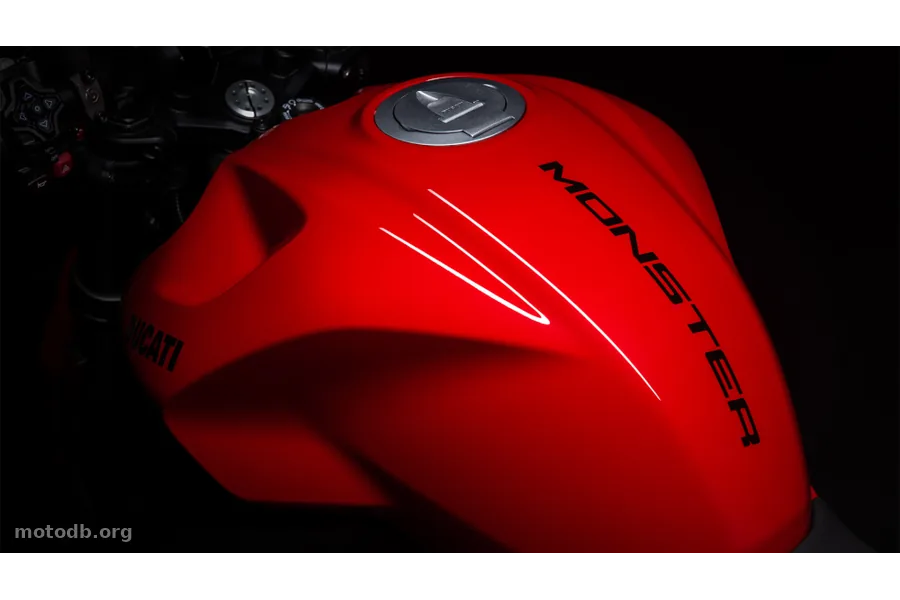
The riding position deserves attention, because it summarizes Ducati’s commercial strategy. Seat at 820 mm, handlebar pulled back 70 mm towards the rider, footpegs lowered and advanced to free the knees: the Ducati Monster 937 openly addresses a wider audience than just Sunday track riders. Ducati Monster A2 and recent license holders will find here a machine accessible in restricted power, without sacrificing character. To lower the seat even further to 800 or 775 mm, a spring kit is available as an option. The accessories catalog also includes Termignoni silencers, carbon parts, heated grips, and the Monster SP version with Öhlins suspensions and Brembo Stylema calipers for those who want to rediscover the DNA of the Ducati Monster 1200 S in a lightweight format.
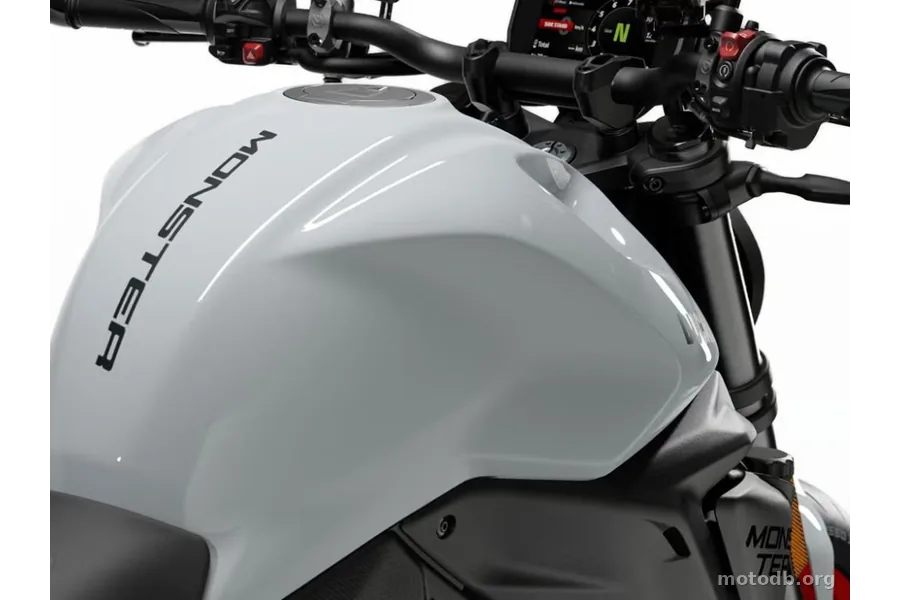
At €12,290, the Ducati Monster price positions itself in the high range of 900-1000 cm3 roadsters, facing the Z900 from Kawasaki or the MT-09 from Yamaha which play in the same yard with very different characters. Ducati sells less raw sensations here than mechanical refinement and a brand heritage that its Japanese competitors cannot buy. The Monster 937 has chosen its camp: that of new riders as well as old ones. It’s a risky bet for a motorcycle that has always lived off its reputation for temperamental character. It seems that Bologna has won, sales figures confirm it. The myth has softened, not been erased.
Standard equipment
- Assistance au freinage : ABS
- Poignées chauffantes
Practical info
- Véhicule accessible au permis A2 ou bridable à 47.5ch / 35 Kw
- La moto est accessible aux permis : A, A2
Indicators & positioning
Similar bikes
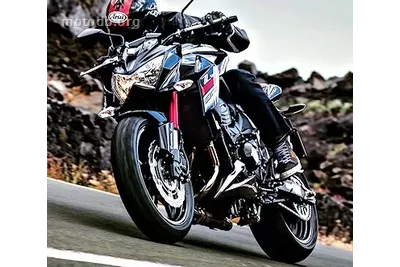
Z 900 50th Anniversary
Reviews & comments
No reviews yet. Be the first to share your opinion!