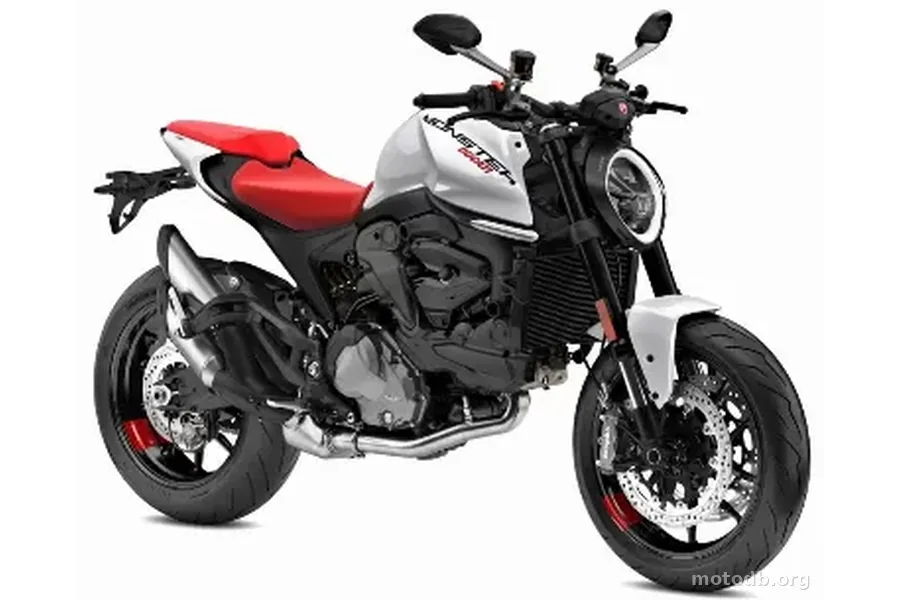
Key performance
Technical specifications
- Displacement
- 1198 cc → 937 cc
- Power
- 135.0 ch @ 8750 tr/min (98.5 kW) → 111.0 ch @ 9250 tr/min (81.6 kW)
- Torque
- 118.0 Nm @ 7250 tr/min → 93.2 Nm @ 6500 tr/min
- Engine type
- V2, four-stroke → Bicylindre en L à 90°, 4 temps
- Cooling
- Liquid → liquide
- Compression ratio
- 12.5:1 → 13.3 : 1
- Bore × stroke
- 106.0 x 67.9 mm (4.2 x 2.7 inches) → 94 x 67.5 mm
- Camshafts
- — → 2 ACT
- Fuel system
- Injection. 53mm throttle bodies with full Ride by Wire → Injection Ø 53 mm
- Valve timing
- Desmodromic valve control → —
- Starter
- Electric → —
- Frame
- Tubular steel Trellis frame attached to the cylinders head → monocoque en aluminium
- Gearbox
- 6-speed → boîte à 6 rapports
- Final drive
- Chain (final drive) → Chaîne
- Clutch
- Light action, wet, multiplate clutch with hydraulic control. Self-servo action on drive, slipper action on over-run. → —
- Front suspension
- 43mm fully adjustable usd forks → Fourche téléhydraulique inversée Ø 43 mm, déb : 130 mm
- Rear suspension
- Progressive linkage with fully adjustable monoshock. Aluminium single-sided swingarm → Mono-amortisseur, déb : 140 mm
- Front wheel travel
- 130 mm (5.1 inches) → —
- Rear wheel travel
- 152 mm (6.0 inches) → —
- Front brakes
- Double disc. ABS. Floating discs. Four-piston calipers. Radially mounted. → Freinage 2 disques Brembo Ø 320 mm, fixation radiale, étrier 4 pistons
- Rear brakes
- Single disc. ABS. Floating disc. Two-piston calipers. → Freinage 1 disque Ø 245 mm, étrier 2 pistons
- Front tyre
- 120/70-ZR17 → 120/70-17
- Front tyre pressure
- — → 2.30 bar
- Rear tyre
- 190/55-ZR17 → 180/55-17
- Rear tyre pressure
- — → 2.50 bar
- Seat height
- 785.00 mm → 820.00 mm
- Wheelbase
- 1511.00 mm → —
- Length
- 2200.00 mm → —
- Width
- 830.00 mm → —
- Height
- 1040.00 mm → —
- Fuel capacity
- 17.50 L → 14.00 L
- Weight
- 209.00 kg → 188.00 kg
- Dry weight
- 182.00 kg → 166.00 kg
- New price
- — → 12 290 €
Engine
- Displacement
- 937 cc
- Power
- 111.0 ch @ 9250 tr/min (81.6 kW)
- Torque
- 93.2 Nm @ 6500 tr/min
- Engine type
- Bicylindre en L à 90°, 4 temps
- Cooling
- liquide
- Compression ratio
- 13.3 : 1
- Bore × stroke
- 94 x 67.5 mm
- Valves/cylinder
- 4
- Camshafts
- 2 ACT
- Fuel system
- Injection Ø 53 mm
Chassis
- Frame
- monocoque en aluminium
- Gearbox
- boîte à 6 rapports
- Final drive
- Chaîne
- Front suspension
- Fourche téléhydraulique inversée Ø 43 mm, déb : 130 mm
- Rear suspension
- Mono-amortisseur, déb : 140 mm
Brakes
- Front brakes
- Freinage 2 disques Brembo Ø 320 mm, fixation radiale, étrier 4 pistons
- Rear brakes
- Freinage 1 disque Ø 245 mm, étrier 2 pistons
- Front tyre
- 120/70-17
- Front tyre pressure
- 2.30 bar
- Rear tyre
- 180/55-17
- Rear tyre pressure
- 2.50 bar
Dimensions
- Seat height
- 820.00 mm
- Fuel capacity
- 14.00 L
- Weight
- 188.00 kg
- Dry weight
- 166.00 kg
- New price
- 12 290 €
Overview
Forty-eight hours after first laying eyes on it, I’m still trying to figure out what to think of the Ducati Monster 2024. Not because the motorcycle lacks personality, but because it has too much, and not necessarily the kind you’re expecting. Bologna has decided to throw everything overboard. The trellis frame, the organic silhouette, the tucked position, the number in the name. Everything. What remains is a 90° L-twin engine of 937 cm3 and a reputation to defend. That’s not nothing, but it’s no longer enough to define a motorcycle.
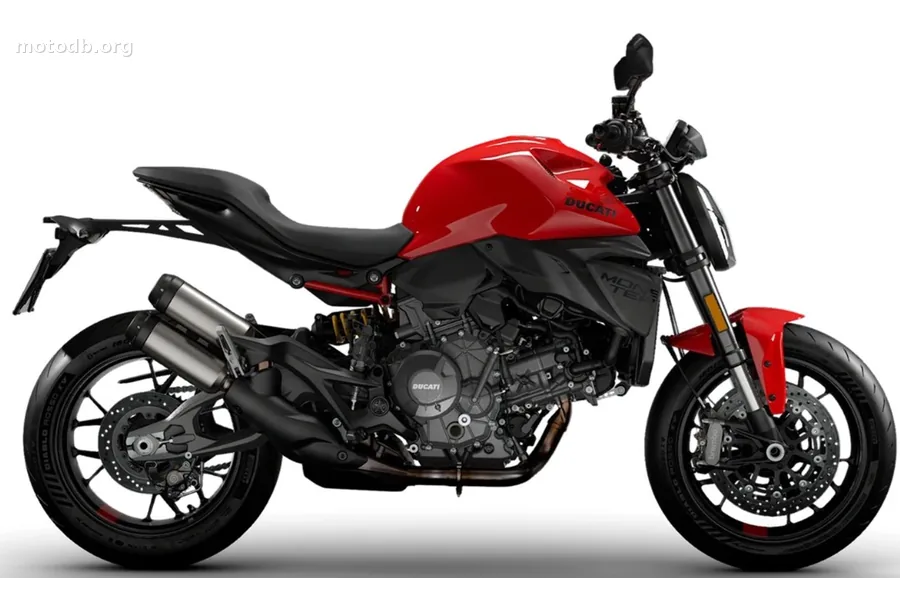
This Ducati Monster 937, which we call that for lack of an official designation, reprises the recipe that made the original 900 Mostro so successful, the one you can now find on the used Ducati Monster market at prices that are climbing. In 1993, Ducati had taken a Superbike frame and a more docile sport engine. Thirty years later, the same logic, different execution. The monocoque aluminum frame comes from the Panigale V4, the 937 cm3 twin is extracted from the 950 SuperSport. The transplant worked, and the result is surgical on the scales. Eighteen kilograms have evaporated compared to the Ducati Monster 821 it replaces. 166 kilograms dry weight, exactly the weight of a Triumph Street Triple RS, which everyone cites as the benchmark in the segment. It’s not a coincidence that Ducati targeted that specific figure.
The gains are measured everywhere with the rigor of an accountant. 4.5 kilograms on the frame, 1.9 on the rear subframe, 2.4 on the engine, 1.7 on the wheels. The tank loses 2.5 liters, bringing the capacity to 14 liters, and further contributes to the overall weight reduction. With 188 kilograms full of fuel, the slightly shortened wheelbase and the 43 mm inverted fork, which offers no adjustments, the Ducati Monster 2024 promises agility that its predecessors didn’t know. The Brembo four-piston calipers on 320 mm discs do the job with reassuring frankness. The steering angle goes to 36 degrees, which would make a Kawasaki Z 650 blush. A Monster that turns sharply in parking lots—that would have made the purists of the Ducati Monster 796 or Ducati Monster 696 versions smirk.
The engine, for its part, doesn’t pretend. 111 horsepower at 9,250 rpm, 93.2 Nm of torque available from 6,500 rpm, with a maximum accessible 1,250 revolutions earlier than on the 821. It’s not a quantified revolution, but a targeted evolution towards mid-range revs, where a versatile motorcycle spends most of its time. The three riding modes, traction control, wheelie control, the bidirectional quickshifter, cornering ABS and launch control are now standard. The 4.3-inch TFT screen reprises the interface of the Panigale V4. For those comparing with the Ducati Monster 1200 or Ducati Monster 1200 S, the technological gap has closed in the other direction: the small one has caught up with the big one.
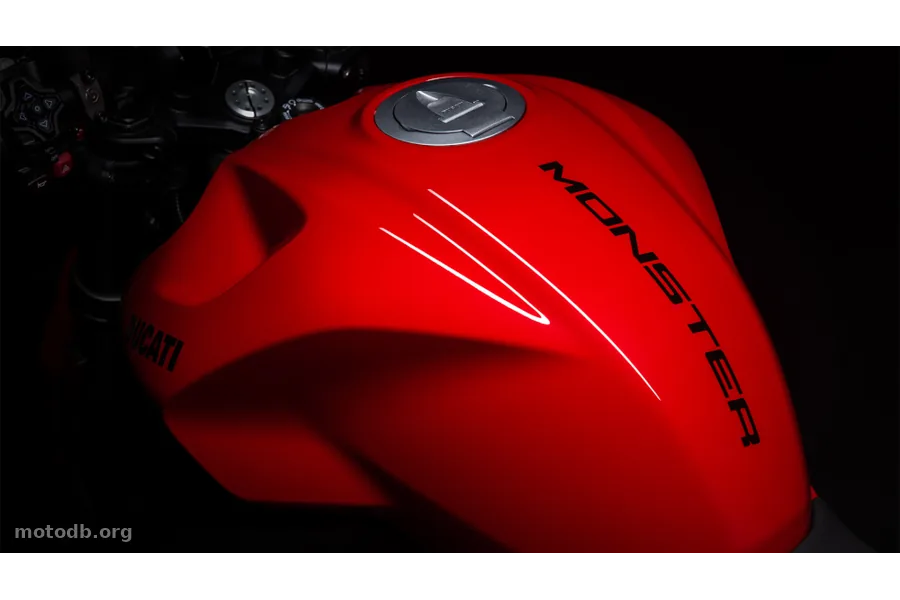
What Ducati fully embraces with this Ducati Monster 2024 is a shift towards a wider audience. The seat height is 820 mm, the handlebar moves 70 mm closer to the rider, the footpegs lower and advance. The position is more upright, less aggressive, designed for full days rather than the first ten minutes of a Sunday outing. A Monster SP version complements the range with Öhlins suspensions, Brembo Stylema calipers and Termignoni silencers for those who want to regain some radicality. The options catalog, for its part, plays the card of personalization, low seat at 800 mm, spring kit to lower it even further to 775 mm, heated grips included. The Ducati Monster base price is set at €12,290, which clearly positions it above an MT-07 but below a well-equipped Street Triple RS.
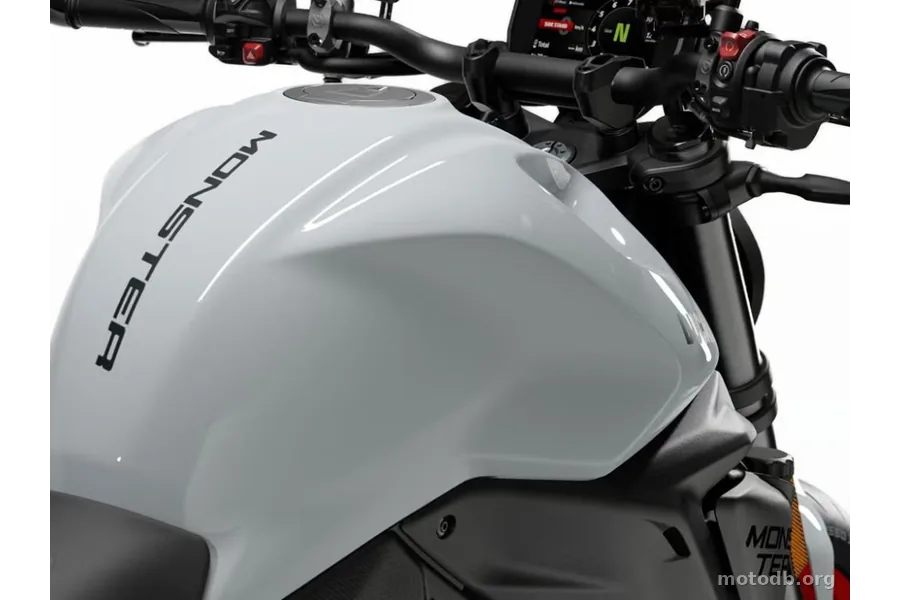
Fans of the tubular trellis and Latin curves will cry, and that’s understandable. When the Ducati Monster 796 replaced the 696, there was already a lot of noise. When you replace 30 years of soul forged in steel with a monocoque aluminum structure and sweeping turn signals, you change register. This Monster no longer seeks to convince converts; it targets those who previously compared with a Honda, a Yamaha or a Kawasaki. It’s an assumed strategic choice, readable in every development decision. MP3 killed the cassette. Music hasn’t disappeared.
Standard equipment
- Assistance au freinage : ABS en curvas
- Nombre de mode de conduite : 3
- Taille de l'écran TFT couleur : 10,92 cm / 4.3 pouces
- Jantes aluminium
- Shifter
- Indicateur de vitesse engagée
- Prise USB
- Aide au départ arrêté (Launch Control)
- Contrôle de traction
- Poignées chauffantes
- Contrôle anti wheeling
- Embrayage anti-dribble
Practical info
- Véhicule accessible au permis A2 ou bridable à 47.5ch / 35 Kw
- La moto est accessible aux permis : A, A2
Indicators & positioning
Similar bikes
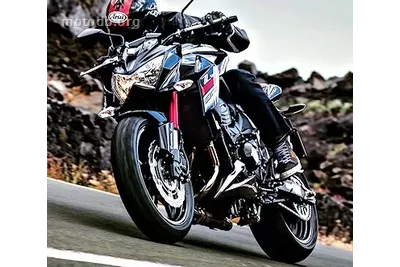
Z 900 50th Anniversary
Reviews & comments
No reviews yet. Be the first to share your opinion!