Key performance
Technical specifications
Engine
- Displacement
- 821 cc
- Power
- 109.0 ch @ 9250 tr/min (79.6 kW)
- Torque
- 86.0 Nm @ 7750 tr/min
- Engine type
- V2, four-stroke
- Cooling
- Air
- Compression ratio
- 12.8:1
- Bore × stroke
- 88.0 x 67.5 mm (3.5 x 2.7 inches)
- Valves/cylinder
- 4
- Camshafts
- 2 ACT
- Fuel system
- Injection. 53mm throttle bodies with full Ride by Wire
- Valve timing
- Desmodromic valve control
- Starter
- Electric
Chassis
- Frame
- Tubular steel Trellis frame attached to the cylinders head
- Gearbox
- 6-speed
- Final drive
- Chain (final drive)
- Clutch
- APTC slipper and self-servo wet multiplate clutch with control cable
- Front suspension
- 43mm upside-down forks
- Rear suspension
- Progressive linkage with adjustable monoshock. Aluminium double-sided swingarm
- Front wheel travel
- 130 mm (5.1 inches)
- Rear wheel travel
- 140 mm (5.5 inches)
Brakes
- Front brakes
- Double disc. Semi-floating discs, radially mounted Monobloc Brembo M4-32 callipers, 4-pistons, axiial pump with ABS as standard
- Rear brakes
- Single disc. 2-piston floating calliper with ABS as standard equipment
- Front tyre
- 120/70-ZR17
- Front tyre pressure
- 2.30 bar
- Rear tyre
- 180/55-ZR17
- Rear tyre pressure
- 2.50 bar
Dimensions
- Seat height
- 785.00 mm
- Wheelbase
- 1480.00 mm
- Length
- 2170.00 mm
- Width
- 800.00 mm
- Height
- 1055.00 mm
- Fuel capacity
- 16.50 L
- Weight
- 206.00 kg
- Dry weight
- 180.50 kg
- New price
- 11 490 €
Overview
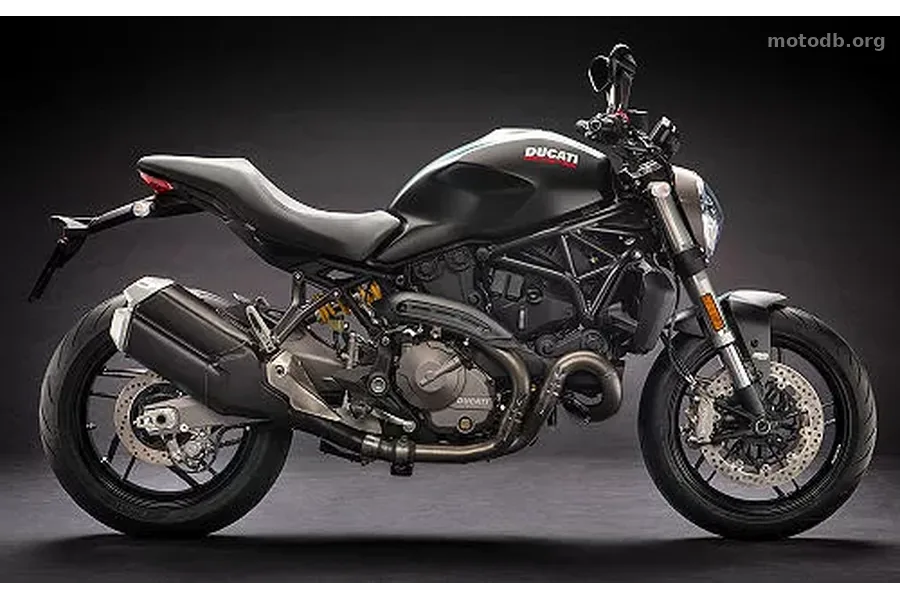
"A real Monster!". According to the Ducati museum’s history, a worker reportedly expressed his vision of a new roadster, seen in the workshops of Borgo Panigale. That was 25 years ago, and a few years later, the Monster 900 captured the emotions of a crowd of riders. So many variations have come and gone, and the Monster 821 is one that best carries the banner today. The 797 allows you to discover; the 1200 are for the furious. This middle 821 is the most homogeneous, combining a nice dose of prowess and design. It evolved in 2018, doing what was necessary to improve details that might have been lacking.
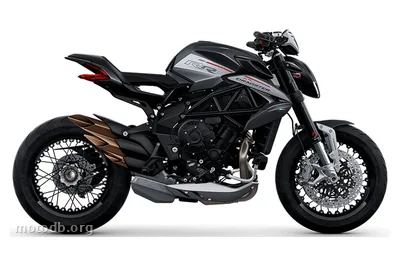
Ducati cultivates the image of this iconic motorcycle, always striving to link it to the first of the lineage. The spirit remains, even if many things have changed. Especially in the engine. But the Monster remains seductive, compact, mischievous, envied. From the previous chapter to this one, visual differences are present but not obvious. The manufacturer plays it safe on this register, highlighting what will appeal to enthusiasts. The line is recognizable in an instant, while bits of the Monster 1200 Rs are expressed here and there. In the shape of the exhaust pipes and the rear fairing. The rear expresses more force. The Monster 821 gains a new tank, one liter smaller. The instrument panel moves up a level, incorporating a TFT matrix like its more upscale siblings for a beautiful full-color display – allowing for a gear indicator and a fuel gauge. The headlight, round as it pleases, is fully LED. On the frame side, the minimalist tubular trellis remains unchanged, with its anchoring to the engine to take advantage of its rigidity. At the rear, it’s something else. The large plates where all the footrests were located have disappeared. The driver controls are now anchored to reduced plates, while passenger elements are attached to a new rear frame. Enthusiasts will continue their investigations on the hidden plastic parts, noting the new shape of the element overlying the tube escaping the rear cylinder and the smaller cover in the twin’s opening.
A Monster is lived more than it is ridden. The engine promises good health and vitality. Apart from the digestion of its breath by the modified exhaust pipes, nothing changes inside. Except for the torque, which loses a tenth of mkg. Everyone will find at their disposal the same power as yesterday, namely 109 horsepower (112 on the previous 821 but measured under different conditions) distributed by a desmodromic two-cylinder, 8-valve, and a few liters of coolant. The torque retains a more than sufficient 8.8 mkg. The power is transmitted via a 6-speed gearbox, which can now be assisted by an Up&Down quickshifter as an option. From the throttle to the final rendering, the electronic equipment is carried over. Present and active will be the 3-level ABS, the traction control with 8 settings, and the 3 Riding Modes that top it all (Urban, Touring, and Sport).
The Ducati Monster 821 will change mood via its Riding Modes; the driver will entrust the rigor of a road holding to the chassis. Alas, still no monobrach for the mid-Monster. But Kayaba suspension elements for the 43 mm inverted fork and Sachs for the mono-shock. Braking comes from Brembo, with M4.32 4-piston calipers for 320 mm front discs. A 245 mm disc and a two-piston caliper are found at the rear. Serious stuff, allowing for all tranquility during heavy decelerations.
The Monster 821 spent a few evenings with the 1200 and it shows. It has matured it, made it aware that it could demand more, and affirm a more present status as princess of the ball. It has gained a kilo in the trousers and lost a pichenette of torque. Too little to make any difference when riding. Today, here is a refined Monster, which will distribute as much pleasure with more skilled shapes.
M.B - Manufacturer images
Standard equipment
- Assistance au freinage : ABS de série
Practical info
- Véhicule accessible au permis A2 ou bridable à 47.5ch / 35 Kw
- La moto est accessible aux permis : A, A2
Reviews & comments
No reviews yet. Be the first to share your opinion!