Key performance
Technical specifications
Engine
- Displacement
- 989 cc
- Power
- 200.0 ch @ 13800 tr/min (147.1 kW)
- Torque
- 115.7 Nm @ 10500 tr/min
- Engine type
- 4 cylindres en L à 90°, 4 temps
- Cooling
- liquide
- Compression ratio
- 13.5 : 1
- Bore × stroke
- 86 x 42.56 mm
- Valves/cylinder
- 4
- Camshafts
- 2 ACT
- Fuel system
- Injection Ø 50 mm
Chassis
- Frame
- treillis tubulaire en tube d'acier
- Gearbox
- boîte à 6 rapports
- Final drive
- Chaîne
- Front suspension
- Fourche téléhydraulique inversée Öhlins FG353 PFF Ø 43 mm, déb : 120 mm
- Rear suspension
- Mono-amortisseur Öhlins, déb : 120 mm
Brakes
- Front brakes
- Freinage 2 disques Ø 320 mm, fixation radiale, étrier 4 pistons
- Rear brakes
- Freinage 1 disque Ø 240 mm, étrier 2 pistons
- Front tyre
- 120/70-17
- Rear tyre
- 200/55-17
Dimensions
- Seat height
- 830.00 mm
- Fuel capacity
- 15.00 L
- Dry weight
- 171.00 kg
- New price
- 55 000 €
Overview
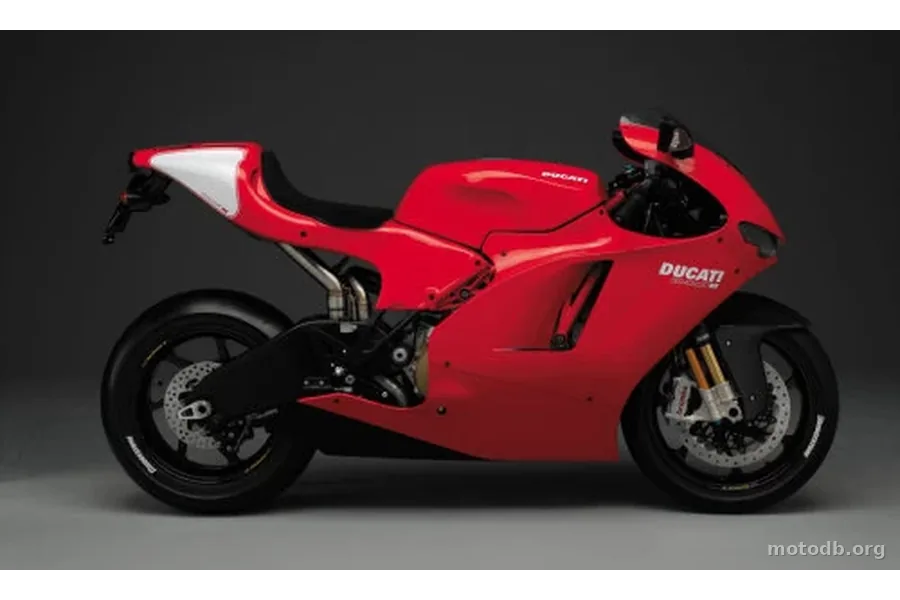
Mugello, June 1, 2006. Ducati takes advantage of the Italian round of the world championship to unveil an object that until now has belonged to pure fantasy. Riding a MotoGP on Sunday's back roads, with a license plate on the rear and homologated turn signals. No one had yet dared. Honda, Yamaha, and Suzuki contented themselves with stylistic replicas, CBRs and R1s that borrowed the silhouette of the prototypes without ever sharing their marrow. Bologna, for its part, chose the hard road.
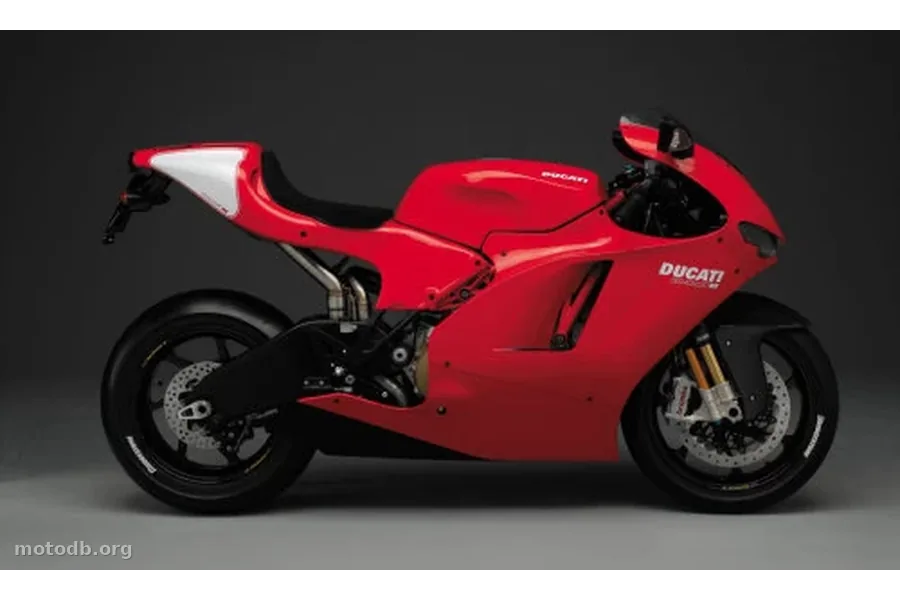
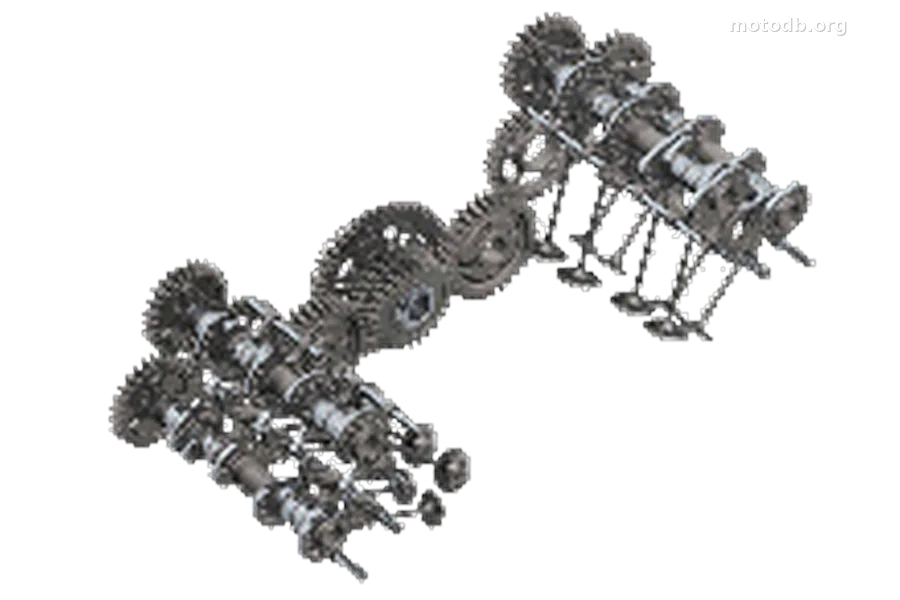
The Ducati Desmosedici 1000 RR takes the base of Loris Capirossi's prototype, a 90-degree V4 in L configuration, the architecture the brand has claimed as a signature since Stoner's arrival in Grand Prix. 989 cc, a short and oversquare bore of 86 mm for a stroke of 42.56 mm, a compression ratio of 13.5 to 1, titanium valves, titanium connecting rods, aluminum and magnesium alloy crankcases, desmodromic valvetrain driven by a gear cascade. The result delivers 200 horsepower at 13,800 rpm and 115.7 Nm at 10,500 rpm, enough to propel the 171 kg dry weight toward a claimed top speed of 310 km/h. The racing exhaust supplied in the kit exceeds 102 decibels, a level that immediately reminds you this mechanical package was not designed for strolling through city centers.
The tubular steel trellis frame adopts the GP6's geometry identically, with a swingarm mounted directly to the engine cases. The 43 mm Öhlins FG353 PFF fork up front and the Öhlins rear monoshock offer 120 mm of travel at each end. Braking relies on two 320 mm discs with radial mounting and four-piston monobloc calipers, plus a 240 mm two-piston disc at the rear. The magnesium Marchesini wheels are shod with Bridgestones of specific profile in 120/70 and 200/55. In short, nothing is generic, everything breathes dedicated componentry. In contrast, a Yamaha R1 of the period or a Kawasaki ZX-10R offers 180 horsepower for around 12,000 euros. The price gap is dizzying, but so is the design gap.
Let's talk about the price. 55,000 euros, for an announced production of 400 units per year, with priority given to 999 R owners. This is far from an accessible sportbike; it's even far from the Desmosedici seen as a profitable track tool. Compared to an MV Agusta F4 1000 Tamburini, already considered an exceptional sportbike, the ticket doubles. The target audience is not the sharp track rider looking for the best time/euro ratio, still less the tourer hungry for kilometers. 15-liter tank, seat at 830 mm, extreme riding position, everything points to a machine for the wealthy collector or the enthusiast ready to enter a very closed club. The seat height paradoxically remains contained for such a radical sportbike, which could almost be reassuring, if the rest of the ergonomics did not remind you that you are riding a prototype replica.
Ducati accompanies delivery with a three-year warranty including scheduled maintenance, a complete racing kit, a paddock stand, a cover, and stickers to transform the red livery into factory Capirossi version. Careful marketing attention, but the essential lies elsewhere. The Desmosedici RR is not a useful motorcycle, it is a demonstration. Bologna here signs the first truly homologated MotoGP, and the message to Tokyo leaves no doubt about the intention.
Practical info
- La moto est accessible aux permis : A
Indicators & positioning
Similar bikes
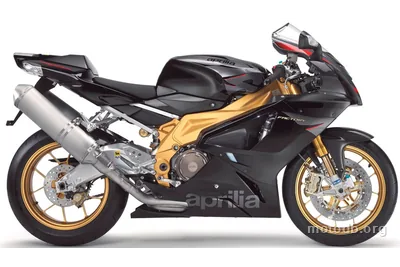
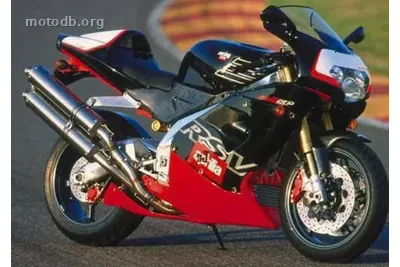
RSV 1000 R Factory
Reviews & comments
No reviews yet. Be the first to share your opinion!