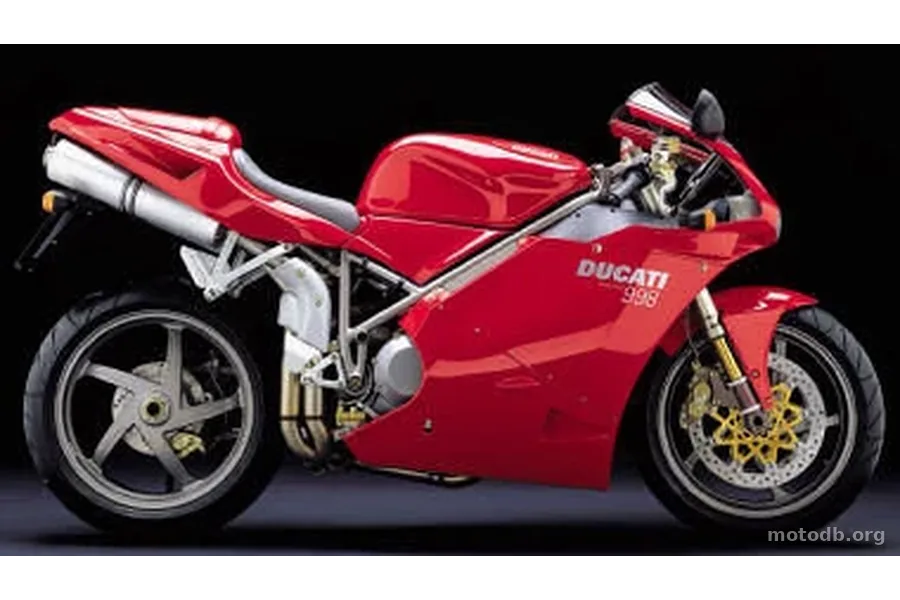
Key performance
Technical specifications
- Frame
- Treillis tubulaire en acier → Tubular ALS450 steel trellis
- Front suspension
- Fourche téléhydraulique inversée Ø 43 mm, déb : 125 mm → Showa 43 mm upside-down fully adjustable fork with TiN surface treatment
- Rear suspension
- Mono-amortisseur, déb : 128 mm → Progressive linkage with fully adjustable Showa monoshock
- Seat type
- Selle biplaces → —
- Weight
- 215.00 kg → 199.00 kg
- Dry weight
- 199.00 kg → 197.00 kg
Engine
- Displacement
- 998 cc
- Power
- 124.0 ch @ 9500 tr/min (90.5 kW)
- Torque
- 102.0 Nm @ 8000 tr/min
- Engine type
- V2, four-stroke
- Cooling
- Liquid
- Compression ratio
- 11.4:1
- Bore × stroke
- 100.0 x 63.5 mm (3.9 x 2.5 inches)
- Valves/cylinder
- 4
- Camshafts
- 2 ACT
- Fuel system
- Injection
- Valve timing
- Desmodromic valve control
Chassis
- Frame
- Tubular ALS450 steel trellis
- Gearbox
- 6-speed
- Final drive
- Chain (final drive)
- Front suspension
- Showa 43 mm upside-down fully adjustable fork with TiN surface treatment
- Rear suspension
- Progressive linkage with fully adjustable Showa monoshock
- Front wheel travel
- 125 mm (4.9 inches)
- Rear wheel travel
- 128 mm (5.0 inches)
Brakes
- Front brakes
- Double disc
- Rear brakes
- Single disc
- Front tyre
- 120/70-ZR17
- Front tyre pressure
- 2.10 bar
- Rear tyre
- 190/50-ZR17
- Rear tyre pressure
- 2.20 bar
Dimensions
- Seat height
- 780.00 mm
- Wheelbase
- 1420.00 mm
- Length
- 2095.00 mm
- Height
- 1090.00 mm
- Fuel capacity
- 15.50 L
- Weight
- 199.00 kg
- Dry weight
- 197.00 kg
- New price
- 17 000 €
Overview
How do you replace an icon? When Ducati unveiled the 999 in 2003, the question was on everyone's lips. Tamburini's 916 had set an aesthetic standard that no one dared challenge. So Bologna chose a clean break. The angular, almost cubist design of the Ducati 999 sent shockwaves through the dealerships. Some cried sacrilege. Others understood that beneath this divisive bodywork, refined in a wind tunnel with the rigor of an aeronautical engineer, lay a war machine. The bolt-on side panels that intrigue at first glance actually contribute to significantly improved aerodynamic penetration. Strange, yes. But devastatingly effective.
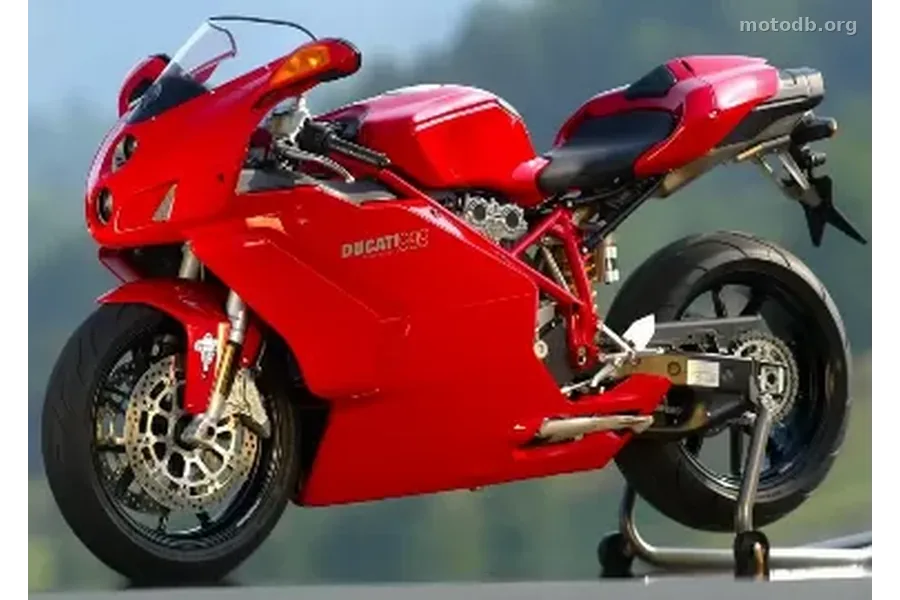
Settle onto the seat, just 780 mm off the ground, and the first observation is unavoidable: this 2004 Ducati 999 is no longer the instrument of torture that the 916 and 998 could be. The riding position is less hunched over the front, the wrists breathe behind repositioned clip-ons, and the torso finds a freedom of movement unheard of for an Italian sportbike of this caliber. On the single-seat version, you can even adjust the seat-tank assembly position by 10 mm. The footpegs offer five adjustment positions, the rake angle remains adjustable, and the mirrors unclip in a single motion for track days. Rarely has a production motorcycle flirted so closely with the specifications of a factory race machine. The digital dashboard completes the picture: it's 2004, and Ducati has taken a decisive technological turn.
The ALS450 steel trellis frame stays true to Bolognese tradition, but a conventional swingarm replaces the legendary single-sided unit. A choice that made purists gnash their teeth, offset by a gain in rigidity and a frankly reassuring stability through corners. On track, the Ducati 999 reveals a transformed temperament. Where the 998 demanded muscular riding, built on anticipation and physical conviction to tip the machine into a turn, the 999 responds with a spontaneity that changes the game. You can brake late, bully the bike into the corner entry, get back on the throttle hard on exit. It takes it without complaint. The precision remains surgical, typically Ducati, but the pleasure comes with less tension in the forearms.
The 998 cc Testastretta V-twin produces 124 horsepower at 9,500 rpm and, crucially, 102 Nm of torque at 8,000 rpm. Generous from the midrange, it takes on an entirely different dimension past 7,500 rpm, where the thrust becomes urgent and voracious all the way to the redline. The spec sheet claims a top speed of 275 km/h. The dual front disc brakes offer a reassuring feel and convincing power, even if pad endurance deserves a careful eye during extended track sessions. The six-speed gearbox does its job without particular fanfare, and the chain drive remains a logical choice for this category. The 15.5-liter tank demands regular stops, a point to watch during intensive track outings. The contained weight of 199 kg wet, on a 1,420 mm wheelbase, contributes to this newfound agility. Make no mistake, though: up against an Aprilia RSV 1000 R, the 999 retains that Ducati character that demands commitment. This is no docile Japanese bicycle. It's an Italian that agrees to collaborate, provided the rider holds up their end of the bargain.
At 17,000 euros new in 2004, the Ducati 999 was aggressively positioned given the improvements on board. The Ducati 999 S, with its twin boosted to 136 horsepower and Öhlins suspension, asked an additional 4,000 euros for a substantial qualitative leap. The Ducati 999 R, reserved for the most demanding riders, pushed the envelope even further. Today, finding a used Ducati 999 represents a serious opportunity for anyone seeking a characterful Italian sportbike, whether in sober black or the now-collector Fila livery. Some even convert them into a Ducati 999 cafe racer with varying degrees of success. Whether destined for the road, the track, or the garage as a piece of history, this phase 2 of the Bolognese superbike remains a machine of conviction. Not the most beautiful Ducati ever produced, surely. But perhaps the most accomplished of its generation on the dynamic front.
Practical info
- La moto est accessible aux permis : A
Reviews & comments
No reviews yet. Be the first to share your opinion!