Key performance
Technical specifications
Engine
- Displacement
- 996 cc
- Power
- 112.0 ch @ 8500 tr/min (81.8 kW)
- Torque
- 93.0 Nm @ 8000 tr/min
- Engine type
- V2, four-stroke
- Cooling
- Liquid
- Compression ratio
- 11.5:1
- Bore × stroke
- 98 x 66 mm
- Valves/cylinder
- 4
- Fuel system
- Injection Ø 50 mm
Chassis
- Frame
- treillis tubulaire en tube d'acier
- Gearbox
- 6-speed
- Final drive
- Chaîne
- Front suspension
- Fourche téléhydraulique inversée Ø 43 mm, déb : 127 mm
- Rear suspension
- Mono-amortisseur, déb : 130 mm
Brakes
- Front brakes
- Dual disc
- Rear brakes
- Single disc
- Front tyre
- 120/70-17
- Rear tyre
- 190/50-17
Dimensions
- Seat height
- 790.00 mm
- Wheelbase
- 1410.00 mm
- Fuel capacity
- 17.00 L
- Dry weight
- 198.00 kg
- New price
- 15 408 €
Overview
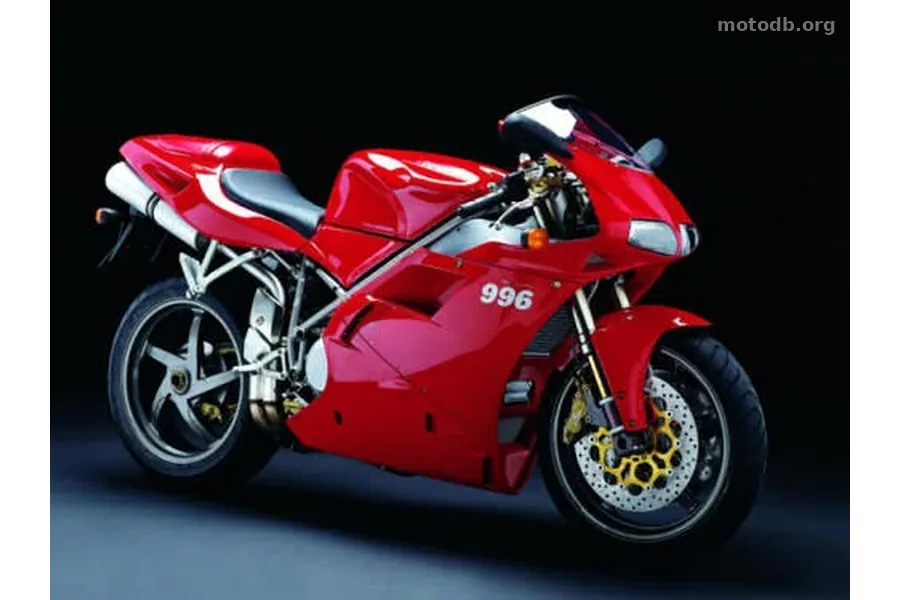
Who remembers the visual shock caused by the 916 when Massimo Tamburini unveiled its lines in 1994? That motorcycle redefined the codes of Italian sportbikes, and the year 2000 Ducati 996 is its direct heir. Born in 1998 from a targeted mechanical evolution, it retains everything that won over a generation of riders while adding a welcome dose of extra muscle. Carl Fogarty and his World Superbike titles are no strangers to this machine's aura. The 996 is not a revolution — it is a refinement.
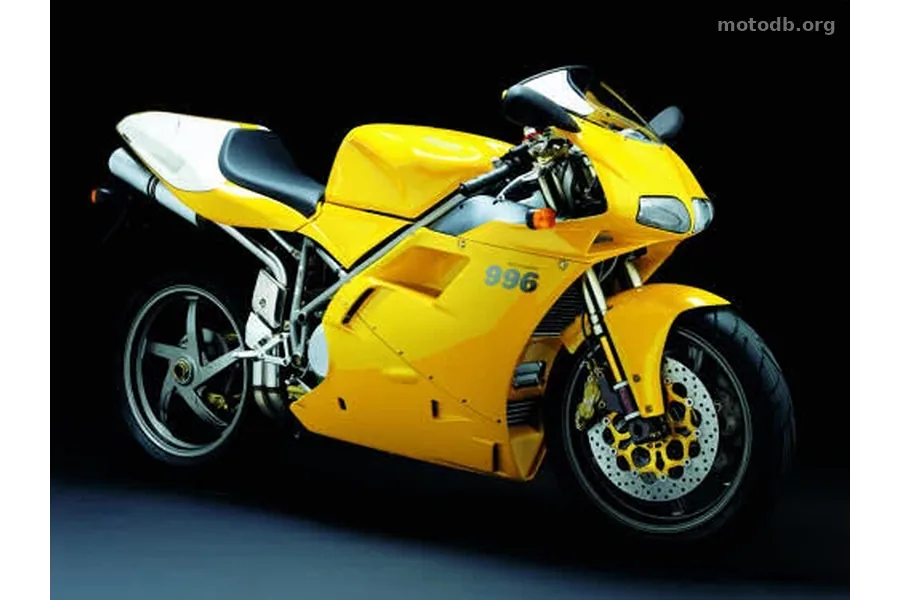
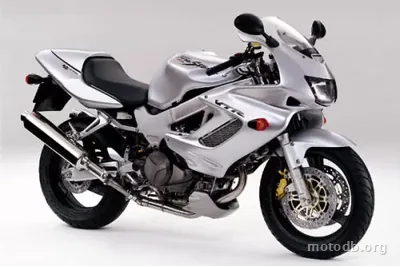
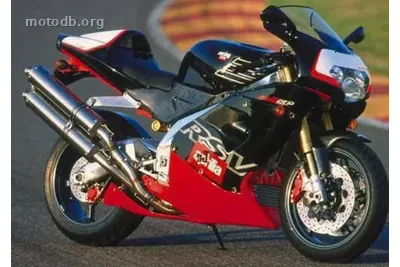
Beneath the sculpted bodywork, the desmodromic V-twin grows from 916 to 996 cc thanks to a generous 98 mm bore paired with a short 66 mm stroke. The result speaks for itself on the Ducati 996 spec sheet: 112 horsepower at 8,500 rpm and, more importantly, 93 Nm of torque available from 8,000 rpm. The gains are felt in the midrange, right where the rider gets back on the throttle exiting a corner. The 11.5:1 compression ratio and four valves per cylinder betray an engine built for performance, not Sunday cruising. The sound escaping from the underseat exhausts is hoarse, deep, almost feral. It is a sonic signature that neither a Honda VTR 1000 SP nor an Aprilia RSV Mille can replicate.
The chassis, meanwhile, hasn't moved a single millimeter. The tubular steel trellis frame, the 43 mm inverted fork with 127 mm of travel, the rear monoshock, the single-sided swingarm — everything comes straight from the 916. The 1,410 mm wheelbase and a dry weight held to 198 kg make for a motorcycle that is lively on lean. Once the Ducati 996 is tipped into a curve, it holds its line with surgical precision. The dual front disc brakes bite hard, and the Pirelli tires in 120/70-17 and 190/50-17 grip the tarmac. On track, the difference with its predecessor is measured in hundredths. On the road, it is measured in sensations.
You do, however, have to accept the deal. The seat perched at 790 mm, the low clip-ons, and the high footpegs impose a radical riding position that punishes the wrists after thirty minutes on an A-road. The 17-liter tank limits range, and the twin's low-end flexibility is not its strong suit in the city. The Ducati 996 is a demanding motorcycle that requires physical commitment and assertive riding to deliver its best. Beginners need not apply. Track riders and Italian sportbike enthusiasts know exactly what they are looking for.
On the used Ducati 996 market, prices vary by version. The 996 S, the 996 R, and the highly sought-after 996 SPS command prices that are steadily climbing. The standard model listed at 15,408 euros in 2000 now trades at varying levels depending on condition and mileage. The Ducati 996 Matrix, made famous by the 2003 film, helped cement the myth in popular culture. Whether chosen in Bologna red or in Ducati 996 yellow, this motorcycle remains one of the most desirable sportbikes of its generation. It forgives nothing, but it gives everything to the rider who knows how to handle it.
Practical info
- La moto est accessible aux permis : A
Indicators & positioning
Similar bikes
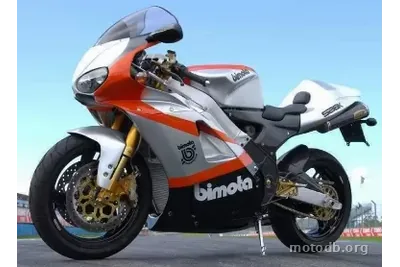
SB8K édition Gobert
Reviews & comments
No reviews yet. Be the first to share your opinion!