Key performance
Technical specifications
Engine
- Displacement
- 992 cc
- Power
- 100.0 ch (73.6 kW)
- Engine type
- Bicylindre en L à 90°, 4 temps
- Cooling
- combiné air / huile
- Bore × stroke
- 94 x 71.5 mm
- Valves/cylinder
- 2
- Camshafts
- 1 ACT
- Fuel system
- Injection
Chassis
- Frame
- Treillis tubulaire en acier
- Gearbox
- boîte à 6 rapports
- Final drive
- Chaîne
- Front suspension
- Fourche téléhydraulique inversée Ø nc
- Rear suspension
- Mono-amortisseur Öhlins et monobras
Brakes
- Front brakes
- Freinage 1 disque Ø 320 mm, étrier 4 pistons
- Rear brakes
- Freinage 1 disque
Dimensions
- Dry weight
- 175.00 kg
- New price
- 12 000 €
Overview
Imagine a supermotard that has swallowed a 992 cm³ L-twin, revised and corrected to spit out 100 horsepower on a chassis that weighs 175 kg dry. That is exactly Bologna’s proposition with this Hypermotard prototype, presented in 2006 as an open question to the public: do you want one, yes or no?
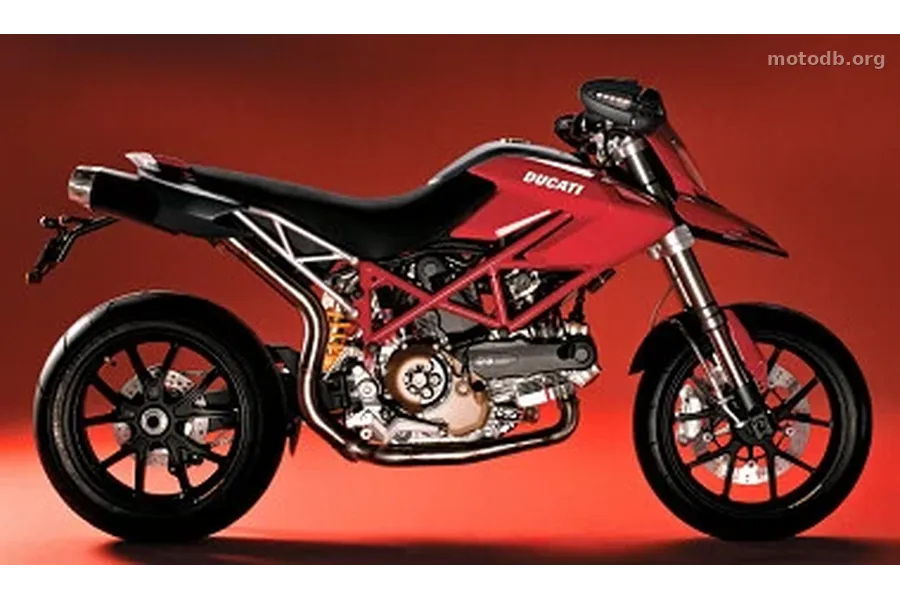
The answer is obvious. The supermoto concept usually plays the card of a unleashed single-cylinder, absolute lightness, and generous ground clearance. Ducati deviates from the path traced by the KTM 950 and consorts by imposing its DS twin into the equation. The result on paper is formidable: a 90-degree L-twin with a bore and stroke of 94 x 71.5 mm, offering 15 horsepower more than the Monster version it is derived from. On a motorcycle as compact and sharp, this surplus of power radically changes the nature of the beast. Where a Husqvarna or a KTM can stick to your skirts in tight corners, they lose speed as soon as the road opens up. 220 km/h in top speed is a figure that does not belong to the usual supermoto register.
The construction philosophy is readable at first glance. The tubular steel trellis frame, a house signature, encloses the twin and supports a rear suspension signed Öhlins, a hallmark for anyone who wants to display their intentions on a winding road. The single-sided swingarm, inherited from recent Monsters, gives the silhouette that taut and uncluttered line that makes your mouth water. The inverted fork completes the picture at the front, while a single 320 mm disc with a radial-mounted Brembo caliper ensures braking service. For a dry weight motorcycle of 175 kg, the installation is proportioned without excess.
The fairing is reduced to the bare minimum, testifying to an assumed bias. No fairing, no frills, just a front plate that integrates the headlight and mudguard, flanked by lateral shoulders on the tank. Marchesini rims complete the whole, giving the assembly the look of a prototype ready to flirt with controlled slides in the mountain passes. The displayed price of 12,000 euros positions the machine in a premium segment, above the Austrian alternatives, but with the promise of a personality that only the Ducati V-twin can offer.
The only downside remains that of the status. In 2006, the Hypermotard is only a prototype, and Ducati explicitly conditions its production to public feedback. It is an honest, almost militant approach, which betrays the factory's hesitation in the face of a niche segment. Supermoto enthusiasts who dream of a red badge on their machine now just have to make their voices heard.
Practical info
- La moto est accessible aux permis : A
Reviews & comments
No reviews yet. Be the first to share your opinion!