Key performance
Technical specifications
Engine
- Displacement
- 997 cc
- Power
- 102.0 ch @ 9600 tr/min (75.0 kW)
- Torque
- 87.3 Nm @ 7300 tr/min
- Engine type
- Bicylindre en V à 88°, 4 temps
- Cooling
- liquide
- Compression ratio
- 11 : 1
- Bore × stroke
- 94 x 71.8 mm
- Valves/cylinder
- 4
- Camshafts
- 2 ACT
- Fuel system
- injection Ø 50 mm
Chassis
- Frame
- cadre tubulaire en titane
- Gearbox
- boîte à 6 rapports
- Final drive
- Chaîne
- Rear suspension
- Mono-amortisseur, déb : 130 mm
Brakes
- Front brakes
- Freinage Beringer
- Rear brakes
- Freinage 1 disque Beringer
- Front tyre
- 120/70-18
- Front tyre pressure
- 2.40 bar
- Rear tyre
- 160/60-18
- Rear tyre pressure
- 2.60 bar
Dimensions
- Dry weight
- 186.00 kg
- New price
- 63 965 €
Overview
Imagine that a handcrafted object is presented to you, piece by piece, as a goldsmith works a precious metal. You weigh it, you turn it over, and you immediately understand that this object does not belong to the world of ordinary things. That’s exactly what the SS100 MKII evokes at first glance. Not a sensation of speed or brute power, but that of absolute rarity. Brough Superior doesn’t revive a brand; it reinstalls a title of nobility.
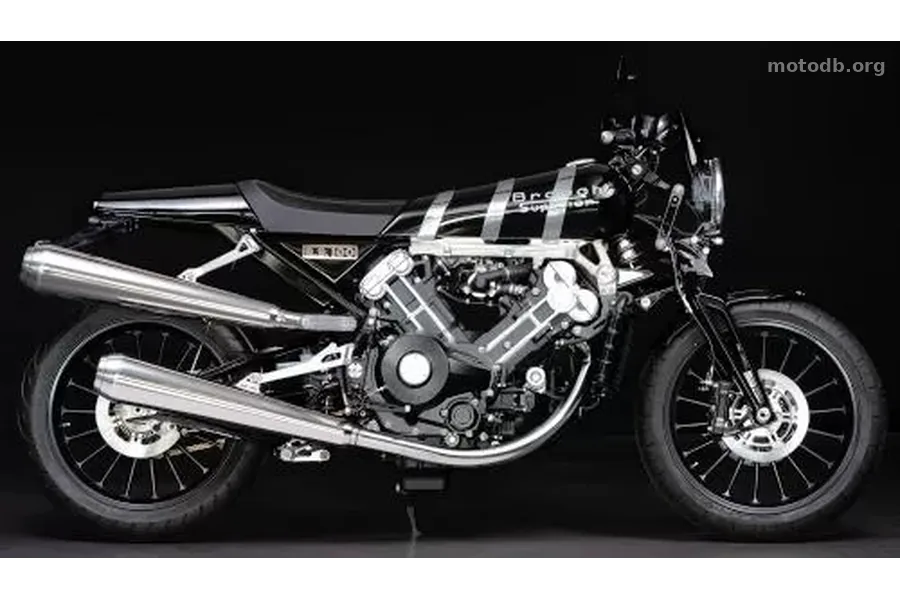
The name itself carries a heavy history. Among the profusion of British manufacturers of the early 20th century—BSA, Vincent, Velocette, and other AJS, engaged in a merciless industrial war—Georges Brough chose a different path. Fewer units, higher demands, machines that rivaled Rolls-Royce in their meticulous craftsmanship. T.E. Lawrence, Lawrence of Arabia, collected seven examples before dying on one of them. That kind of ambassador is not invented. When Mark Upham bought the brand in 2008, he entrusted the development to Boxer Design, a French design studio led by Thierry Henriette, who was already responsible for projects as sophisticated as the FB Mondial Nuda or the SSR 1000. A Frenchman to dress a British icon—that would have made a lord from the Nottingham club jump.
The engine is signed Akira, another French company, and that’s where the story takes an interesting technical turn. This 88-degree V-twin with a displacement of 997 cm3 doesn’t seek to mimic vintage mechanics with decorative fins. It is resolutely contemporary, with liquid cooling, dual overhead camshafts, four valves per cylinder, and electronic injection. In standard version, it delivers 102 horsepower at 9,600 rpm and 87.3 Nm of torque at 7,300 rpm, which is honest without being spectacular for a twin of this size. Ducati has extracted more power from similar displacements in its sport machines. But the target clientele here doesn’t time their highway acceleration runs. They appreciate. On request, an alternative mapping boosts power to 130 horsepower from 8,000 rpm, reserved for track use. Torque then climbs to values that will make the announced 200 km/h very accessible. One caveat, and it deserves to be mentioned: some hoses remain too visible in an ensemble where every machined part calls for admiration. A detail that catches the eye by contrast.
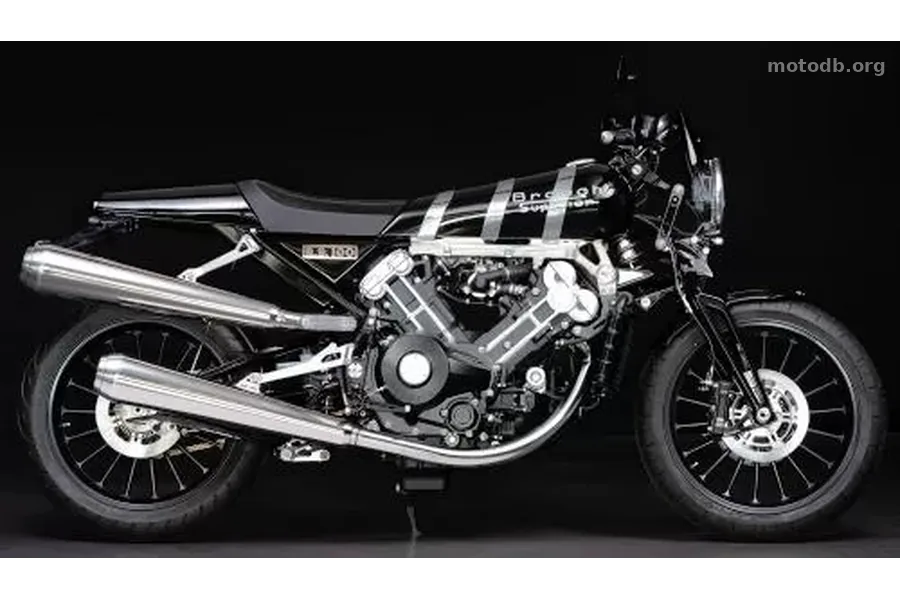
The tubular titanium chassis is the structural argument that distinguishes this machine from everything currently being built. The engine is stressed, which has allowed the frame to be reduced to its simplest expression, almost invisible, leaving the mechanics bare in all its machining precision. The long, streamlined aluminum tank is held by metal straps that are as much a saddle maker’s detail as a mechanical component. At the front, the Fior-type fork, with its double magnesium-aluminum triangles and titanium support elements, imposes a kinematic complexity that few manufacturers still dare to approach. The central Öhlins shock absorber works independently of the diving forces during braking, which fundamentally changes the dynamic behavior. At 186 kg dry weight, the SS100 is not light, but it is consistent with its ambitions. The rear follows the same logic of noble materials, magnesium-aluminum swingarm, Öhlins again, double upper and lower reinforcement.
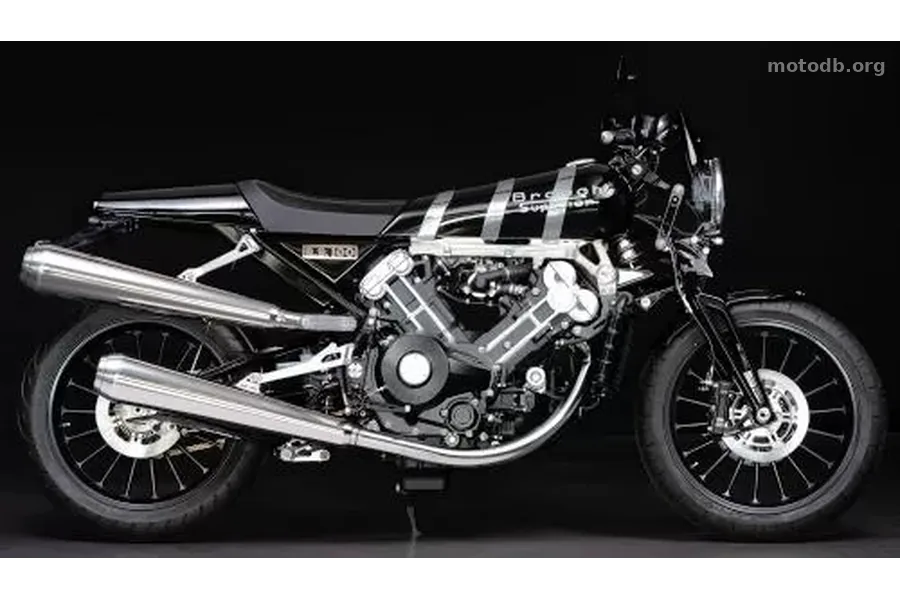
For braking, Brough abandoned Brembo in favor of Beringer and its 4D system, with 230 mm discs whose geometry evokes the drums of another era while displaying modern performance and a noticeably reduced gyroscopic inertia. Each caliper receives four pistons and three pads. It’s original, consistent with the spirit of the machine, and it contributes to this impression that every technical choice has been weighed not to reduce a cost or satisfy a convention, but to assert a point of view. Three finishes are available, from Traditional in black, gold, and silver to the Full Black integral version, which leaves the chassis in raw material, passing through the Titanium version. Each tells a different era of the brand's history. With production limited to 300 units and a listed price of €63,965, the question is not whether buyers exist. They exist, and the waiting list confirms it. The SS100 MKII does not claim to compete with a Japanese sportbike or a German roadster. It occupies a territory apart, that of collector's items that are driven, at the intersection of the museum and the open road.
Standard equipment
- Assistance au freinage : ABS
Practical info
- La moto est accessible aux permis : A
Indicators & positioning
Similar bikes
999 Scout Sixty Classic
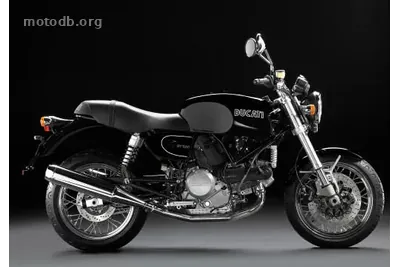
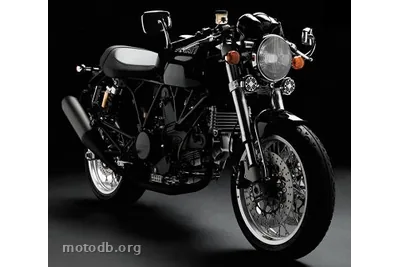
SportClassic GT 1000
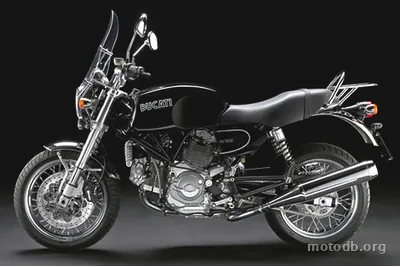
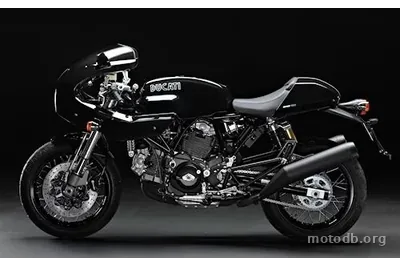
SportClassic GT1000 Touring
Reviews & comments
No reviews yet. Be the first to share your opinion!