Key performance
Technical specifications
Engine
- Displacement
- 997 cc
- Power
- 102.0 ch @ 9600 tr/min (75.0 kW)
- Torque
- 87.3 Nm @ 7300 tr/min
- Engine type
- Bicylindre en V à 88°, 4 temps
- Cooling
- liquide
- Compression ratio
- 11 : 1
- Bore × stroke
- 94 x 71.8 mm
- Valves/cylinder
- 4
- Camshafts
- 2 ACT
- Fuel system
- injection Ø 50 mm
Chassis
- Frame
- cadre tubulaire en titane
- Gearbox
- boîte à 6 rapports
- Final drive
- Chaîne
- Rear suspension
- Mono-amortisseur, déb : 130 mm
Brakes
- Front brakes
- Freinage Beringer
- Rear brakes
- Freinage 1 disque Beringer
- Front tyre
- 120/70-19
- Front tyre pressure
- 2.40 bar
- Rear tyre
- 200/55-17
- Rear tyre pressure
- 2.60 bar
Dimensions
- Fuel capacity
- 17.00 L
- New price
- 99 000 €
Overview
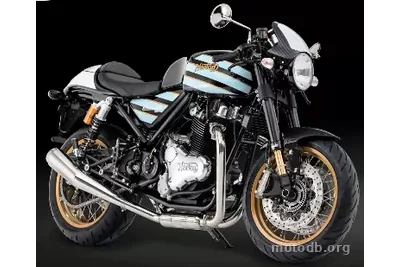
When a client knocks on the door of the Toulouse workshop of Brough Superior with an idea not found in the catalog, two options present themselves: politely decline, or roll up your sleeves and manufacture. The Boxer Design team chose the latter. The result bears a name steeped in history: Leaping Lena, and takes the form of a one-of-a-kind sidecar, grafted onto a Lawrence whose technical specifications already speak for themselves.
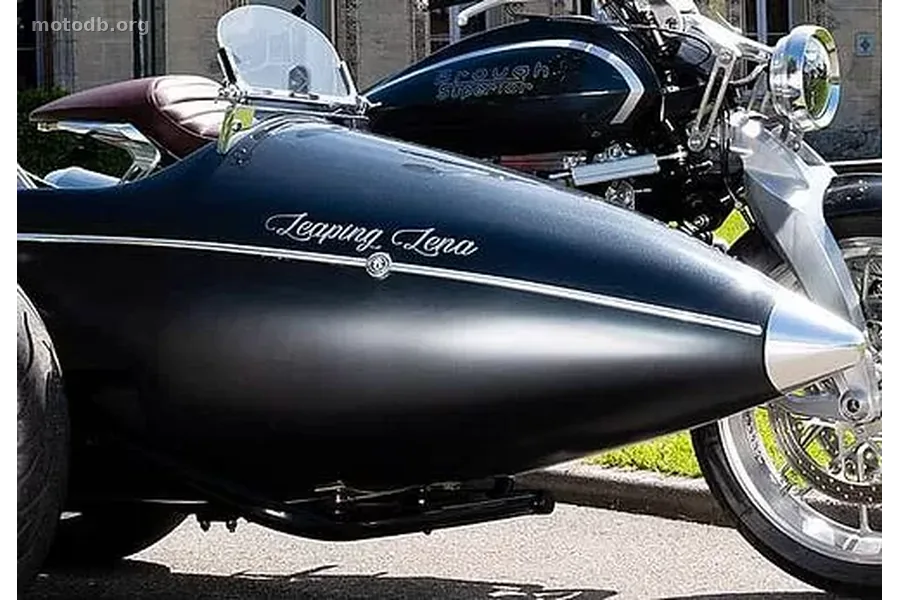
The base is familiar. The 88-degree V-twin engine with a displacement of 997 cc delivers 102 horsepower at 9600 rpm and 87.3 Nm at 7300 rpm, housed in a tubular titanium frame that alone justifies a good portion of the €99,000 price tag of the original motorcycle. The Beringer brakes, the 120/70-19 tires at the front and 200/55-17 at the rear, the six-speed gearbox, everything here is the result of a care that goes beyond simple mechanics to border on precision watchmaking. The Lawrence alone tops out at 180 km/h and handles like a musical instrument tuned to the right note. Attaching a sidecar to it was therefore a certain amount of audacity.
It was Remy Lavernhe who was in charge of designing the sidecar, and the result is worth taking a closer look at. The cell adopts a spindle profile, an ogival shape that evokes both the airships of the Belle Époque and certain racing torpedoes of the 1930s. Albert Castaigne, director of Brough Superior, sees a kinship with the Zeppelins, which is not an insignificant comparison for a rolling object. The craftsman nicknamed Eric then spent more than 120 hours transcribing this drawing into metal, working the titanium for the sub-chassis and aluminum sheets for the cabin. This type of figure says more than any marketing argument about what the word craftsmanship really means in this context.
The name chosen refers to 1932 and a feat that remained on the margins of speed history. That year, in Vienna, an Australian named Alan Bruce was the first to pass the 200 km/h barrier in a sidecar, riding a Brough Superior equipped with a 1000 JAP engine. His machine was called Leaping Lena. It carried a 65-kilo weight due to the lack of a passenger, and probably had nothing particularly attractive to look at. The contemporary descendant corrects this last point with absolute clarity. It is no longer about going fast, but about going well, in an object whose value is not easily quantified since there is only one example in the world.
This type of realization does not really have a direct competitor, and that is precisely what makes it interesting as much as its absolute singularity. The Leaping Lena is not compared to a Ural nor to any production sidecar. It belongs to a category that welcomes only unique pieces, ordered by enthusiasts whose relationship to the motorcycle is more about reasoned collecting than simple transportation. The target audience is neither the track rider nor the urban commuter; it is someone who understands why 120 hours of work on hand-hammered aluminum justifies a price that is impossible to announce. And who doesn't need to be explained twice.
Standard equipment
- Assistance au freinage : ABS
Practical info
- La moto est accessible aux permis : A
Indicators & positioning
Similar bikes
999 Scout Sixty Classic
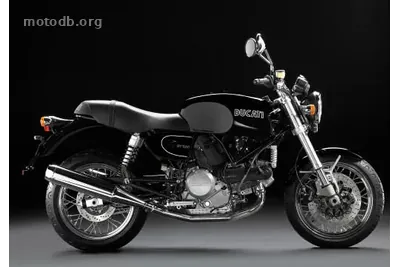
SportClassic GT 1000
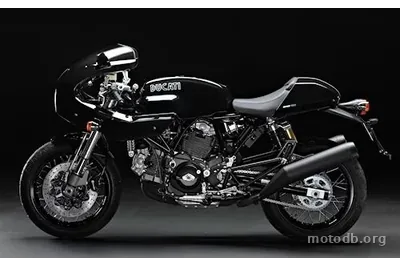
SportClassic 1000 Sport Speciale Edition
Reviews & comments
No reviews yet. Be the first to share your opinion!