Key performance
Technical specifications
Engine
- Displacement
- 1170 cc
- Power
- 110.0 ch @ 7750 tr/min (80.9 kW)
- Torque
- 115.7 Nm @ 6000 tr/min
- Engine type
- Bicylindre à plat, 4 temps
- Cooling
- combiné air / huile
- Compression ratio
- 12 : 1
- Bore × stroke
- 101 x 73 mm
- Valves/cylinder
- 4
- Camshafts
- 2 ACT
- Fuel system
- Injection Ø 50 mm
Chassis
- Frame
- Treillis en tubes d'acier avec moteur porteur
- Gearbox
- boîte à 6 rapports
- Final drive
- Cardan
- Front suspension
- Fourche téléscopique Ø 43 mm, déb : 125 mm
- Rear suspension
- Mono-amortisseur et monobras Paralever, déb : 120 mm
Brakes
- Front brakes
- Freinage 2 disques Ø 320 mm, étrier 4 pistons
- Rear brakes
- Freinage 1 disque Ø 265 mm, étrier 2 pistons
- Front tyre
- 120/70-17
- Front tyre pressure
- 2.50 bar
- Rear tyre
- 180/55-17
- Rear tyre pressure
- 2.50 bar
Dimensions
- Seat height
- 805.00 mm
- Fuel capacity
- 17.00 L
- Weight
- 220.00 kg
- New price
- 14 000 €
Overview
Currently, every sporty machine almost invariably comes with an active control system. Hypersport models are brimming with electronics; the NineT Racer takes a more measured approach, incorporating traction control (ASC) in 2020. In total, the most radical model in the Heritage family can now rely on this "stability control," ABS, and, in another area but still for safety, the ‘Dynamic Brake Light’ introduced in 2019 – an active braking warning system to alert following vehicles to the intensity of deceleration. Beyond the technical aspects, let's move on to the cosmetic details. A new ‘Spezial’ color scheme has recently appeared in the options catalog. A beautiful combination of black and gold, offering this NineT a certain depth and further emphasizing its philosophy.
When embracing the neo-retro aesthetic, you might as well dive in headfirst under the bubble and with a firm grip on the throttle. BMW excels in this area. Drawing on the success of the NineT since 2014, the Heritage range now comprises no fewer than five models: the original 1200 NineT, the Scrambler, the Pure, the Urban G/S, and, for a sporty feel, the Racer. Gentlemen of the Joe BAR Team and enthusiasts of the 1970s, your descendants are here.
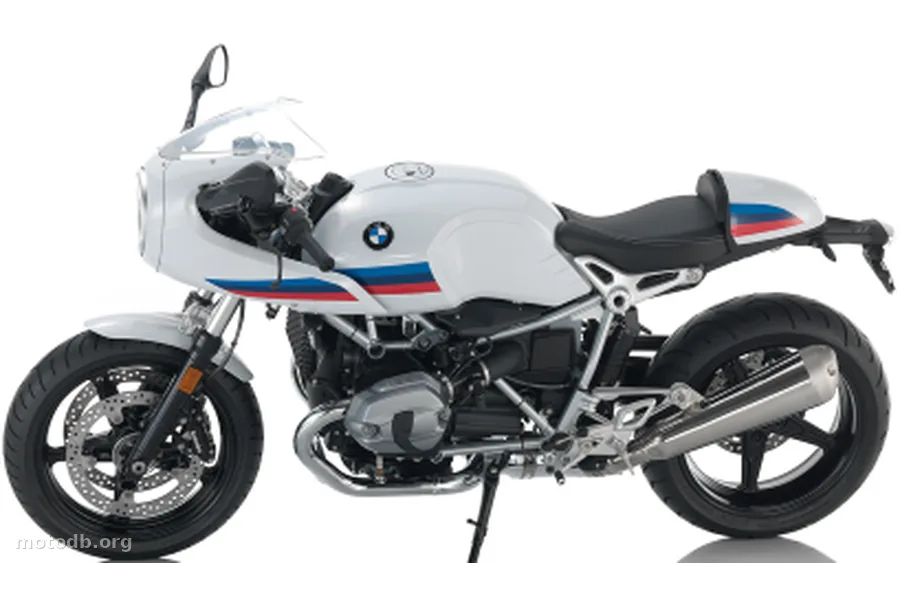
We know BMW’s immense power and executive style with the violent S 1000 RR. With the NineT 1200 Racer, it’s a different melody. It’s the renaissance of sport as it once was. And what a look! No need to add salt or spices; the dish is presented in the most beautiful way. Captivating charm, a speckled color scheme that catches your eye, a splash of racing paint to honor BMW Motorsport’s racing department, and we’re immersed in the atmosphere. This Racer revives the beautiful era of 1970s racing motorcycles, subtly reminiscent of the R 90 S, and recalls the Ninety concept presented in 2013. We suspected that this style study would lead to a successor.
An old-fashioned fork, a seat cowl, a racing livery – you’re in tune with the old-school sport. A short summary of the situation that only allows you to glimpse the 1200 Racer. Beneath this attire, the technical underpinnings are those of the NineT Scrambler, with a shortened wheelbase and more road-oriented tires. But before delving into the technology, let’s take a look around to discover its specific features.
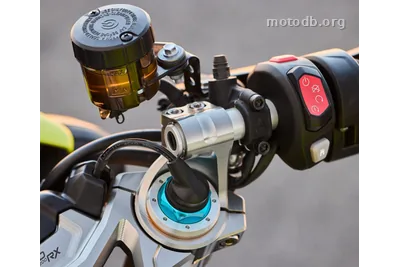
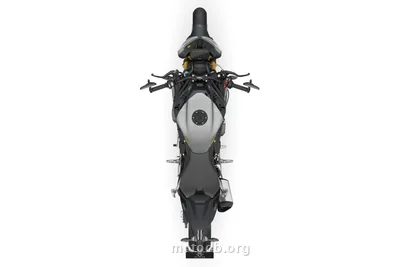
Because a mere dress-up would be too lightweight to justify itself. The BMW has refined a few elements to maintain a certain standing. Including a riding position that must be typical. The NineT Racer extends the rider with a pair of rear-set controls and handlebars merging with the upper fork yoke. A beautiful piece of forged aluminum, openwork between the column and the fork tubes. To complete the spirit and boost the ego, the rear section is transformed. Originally, the seat is single-seater, complemented by the aluminum seat cowl. As with any NineT, the rear frame consists of a removable passenger frame; it is thus possible to mount a passenger. Or to give free rein to your imagination to elaborate a customized rear end.
We won’t get sporty brake fluid and clutch reservoirs. To console ourselves, the instrumentation goes vintage; and it’s pleasing. Anyway, an Airbus-style cockpit would have no place here. The analog is honored, with two beautiful round meters and two needles to monitor speed and engine RPM. The rest, we don’t care when pleasure has banished all other considerations. But if the return to reality brings you back to the onboard information, each instrument features a digital window. Still quite practical for checking the time, the gear engaged, the remaining range, the daily mileage, the maintenance interval, as well as the average speed and consumption.
A neo-retro machine is more or less today's technology with the ecstasy of yesteryear. And when you see the front end of the NineT Racer, you can let doubt creep in. Is it presumptuous to install a classic fork on a racing motorcycle like this? An inverted fork would certainly affirm the sportiness of the machine even more! Radial calipers would also be in order. But… wouldn’t that betray the vintage spirit? Shouldn’t a motorcycle that evokes the passion of yesteryear rightly be equipped with solutions similar to those of the era it champions? The freedom allows for this kind of questioning, debate, lightness or openness. Because if we stuck to the facts, we would only see a matter of economy. Let everyone judge; let everyone grasp this 43mm classic fork. Neither inverted nor Telelever, just adequate to hold axial 4-piston brake calipers. At the rear, we find the traditional Paralever with cardan. Take this opportunity to gauge the duo of colors applied to the mechanical parts: black for the swingarm, fork tubes, rims, levers and engine – gray or metal for the cylinder head covers, frame tubes and foot controls.
Whether it’s for the brand’s first motorcycle (R32), the aforementioned R90S, or our NineT Racer, the mechanics remain faithful to its fundamentals: an air-cooled flat-twin engine. To stay in the retro style and avoid all the hassle of hoses and a radiator for cooling, you won't find the latest generation of flat-twin here. Honor the proven 1170 cm3 and its 110 horsepower. It has what it takes to have fun and display the bare minimum of technology: injection, Euro4 standards, double ACT, 4 valves per cylinder, 6-speed gearbox and a beautiful peak torque of 11.8 mkg. Enough to give it rhythm, with the look and intrepidity of a café-racer. There would almost be enough to present alongside an HP2 Sport... but just present. The exhaust line does its part to complete the ensemble. No double silencer as on the other NineT; just an old-fashioned bazooka, as it should be.
With this Racer, BMW skillfully completes its Heritage range with a revival sport. It doesn’t burden itself with the plethora of equipment of current missiles; simply ABS, and optional traction control. However, it’s less premium than the standard NineT. No inverted fork, a steel tank instead of aluminum, optional spoked rims. But BMW has thought of everything for the well-heeled: a list of options worthy of a cinema outing – between the ticket and the film, we’re going to be tempted by popcorn, an ice cream and a coke. Or rather a Slim, a Raider and a Mikojet.
M.B - media constructeur
Standard equipment
- Assistance au freinage : ABS de série
Practical info
- La moto est accessible aux permis : A
Indicators & positioning
Similar bikes
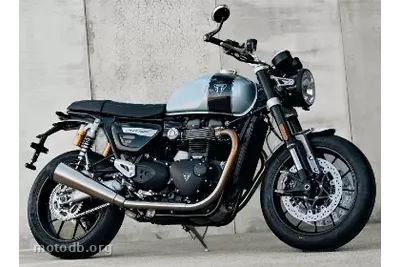
Speed Triple 1200 RR Breitling
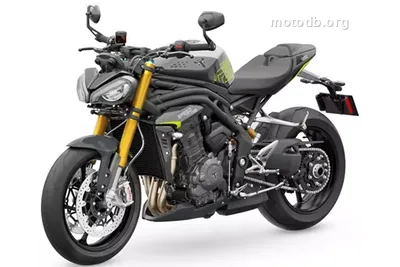
Speed Triple 1200 RS
Reviews & comments
No reviews yet. Be the first to share your opinion!