Key performance
Technical specifications
Engine
- Displacement
- 1170 cc
- Power
- 95.0 ch @ 6500 tr/min (69.9 kW)
- Torque
- 109.8 Nm @ 6000 tr/min
- Engine type
- Bicylindre à plat, 4 temps
- Cooling
- par air
- Compression ratio
- 12 : 1
- Bore × stroke
- 101 x 73 mm
- Valves/cylinder
- 4
- Camshafts
- 2 ACT
- Fuel system
- Injection ø 50 mm
- Starter
- électrique
Chassis
- Frame
- périmétrique en tubes d'acier, moteur à fonction porteuse
- Gearbox
- boîte à 6 rapports
- Final drive
- Cardan
- Front suspension
- Fourche téléhydraulique inversée Ø 45 mm, déb : 90 mm
- Rear suspension
- Mono-amortisseur et monobras, déb : 90 mm
Brakes
- Front brakes
- Freinage 2 disques Ø 310 mm, fixation radiale, étrier 4 pistons
- Rear brakes
- Freinage 1 disque Ø 265 mm, étrier 2 pistons
- Front tyre
- 100/90-19
- Rear tyre
- 150/80-16
Dimensions
- Seat height
- 754.00 mm
- Seat type
- Selle biplaces
- Fuel capacity
- 14.00 L
- Weight
- 227.00 kg
- New price
- 15 000 €
Overview
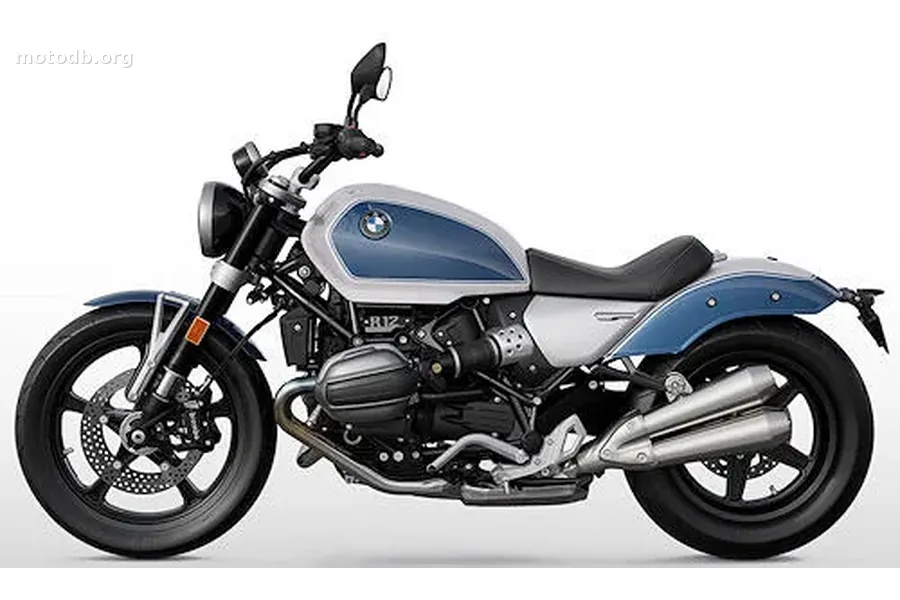
A new custom model joins the BMW Heritage lineup. A family largely represented by the large 1800 custom and its variations. But this R12 is not a miniature R18 as one might think. It is actually a NineT transposed into a custom style. An engine more suited to looks than cruising.
It undeniably has presence. Not the long, low-rider style, but a visual character contained within a relatively compact size for the category. Its weight of 227 kilos confirms this, whereas the norm is above 300 kilos. One drawback, however, is its strong consanguinity with the NineT roadster, which prevents it from truly differentiating itself. It only truly captures the eye with a little time, distance, and aromatics. What are the highlights compared to each other? Wheels, a tank, a seat, and a rear fender unique to each.
The R12 opts for a mechanical solution that will delight fans of the old air-cooled Boxer engine. Old, old… more or less. It had its heyday with the R1200 GS, the RT, up to the HP2 Sport; but it has been more than 10 years since a new generation of liquid-cooled flat-twin took over. Let's not compare it to the engine of the first R12, from 1937 – which sent 18 hp from its 745 cm3. The flat engine has managed to endure until today, with mixed air/oil cooling, which gives it a more refined, more classic appearance, reinforced by redesigned cylinder heads in a more vintage style.
Inside, injection sends the power into 1170 cm3, the gases pass through 4 valves per cylinder and double ACT cylinder heads, and the R12 benefits from 95 horsepower at 6,500 rpm. BMW deliberately reduced the power of the R12 compared to the NineT (109 hp), even though it is exactly the same engine. The same approach applies to the torque of 11.2 kg-m, slightly lower and obtained earlier, at 6,000 rpm. A way to demonstrate a softer road approach. But the custom has plenty to have fun on the road.
It will indeed offer a much more dynamic ride than the larger R18. With 120 kilos less, the R12 looks like a sportster. It could even tease it a little with its slightly higher watts (4 hp more). Not too much provocation, though. Otherwise, the R18 can return a serious slap with its large torque.
The 1200 Boxer breathes through an airbox now located under the seat and expels through a double exhaust with conical tips. Again, we would have preferred a more classic silencer and one not shared with the NineT. Its temperament is supervised by two riding Modes, Rock or Roll. The first allows the most direct throttle response and a more permissive traction control. If the bike turns a little like a potato at idle, that's normal: BM programmed it to be "limping," and give it an old-fashioned tremor. The other Mode gives a less "aggressive" throttle and a more versatile DTC. An electronic engine torque feedback control is also present, to digest any rear wheel deviations during abrupt deceleration.
The R12 receives a completely new frame, still in tubular trellis steel but now monoblock, with a rear section bolted – the old main frame was in two parts. On the custom, this structure is slightly different. The rake and wheelbase are longer, the steering head angle more open; and with a handlebar closer to the rider, footpegs forward, and asymmetrical wheels (19 inches at the front and 16 at the rear), the machine announces a more relaxed riding position and a softer ride than with the roadster. Although lacking adjustment, the front end is very serious with its 45 mm inverted fork and four-piston Brembo radial calipers on 310 mm discs. The Paralever monobracing is also found at the rear, with a 265 mm disc and 2 pistons to calm it down. The suspensions have been brought up to the standards of the custom world, with only 90 mm of travel. But this allows the overall height to be lowered, and de facto, the seat is only 754 mm from the ground.
The instrumentation of this R12 is very simple. A single speedometer, with a needle, numbers all around, a few light bulbs and a small digital window. Basta. But you can have more: BMW offers a tachometer as an option; or even a small 3.5-inch vertical TFT screen (too modern and out of place to our taste). As long as we're in the digital world, let's see what the R12 has in store. ABS cornering, traction control, engine torque regulation, USB-C and 12V sockets, LED headlights and turn signals, Keyless Ride for keyless starting and fuel cap opening. The options are kept in reserve, with a quickshifter, hill start assist, adaptive cornering headlight, Connect Ride Control to interface with a smartphone, intelligent emergency call, cruise control and tire pressure monitoring. The corner also has a host of Option 719 parts and other stylish parts to enhance the bike.
The NineT now has a custom brother. This allows to offer two styles and two types of riding on the same base. The R12 is less well-equipped with a steel tank instead of aluminum, few suspension adjustments, less elaborate wheels and a reduced power but this allows it to be advanced at a more accessible price. At 14,990 euros, the difference is 3,300 euros.
M.B. - Photos constructeur
Standard equipment
- Assistance au freinage : ABS
- Nombre de mode de conduite : 2
- Jantes aluminium
- Amortisseur de direction
- Indicateur de vitesse engagée
- Prise USB
- Démarrage sans clé
- Contrôle de traction
- Contrôle du frein moteur
Practical info
- Véhicule accessible au permis A2 ou bridable à 47.5ch / 35 Kw
- La moto est accessible aux permis : A, A2
- Pays de fabrication : Allemagne
Indicators & positioning
Similar bikes
Speed Triple 1200 RR Breitling
Speed Triple 1200 RS
Reviews & comments
No reviews yet. Be the first to share your opinion!