Key performance
Technical specifications
- New price
- 30 390 € → 33 120 €
Engine
- Displacement
- 1198 cc
- Power
- 162.0 ch @ 9500 tr/min (119.2 kW)
- Torque
- 127.5 Nm @ 7700 tr/min
- Engine type
- Bicylindre en L à 90°, 4 temps
- Cooling
- liquide
- Compression ratio
- 11.5 : 1
- Bore × stroke
- 106 x 67.9 mm
- Valves/cylinder
- 4
- Camshafts
- 2 ACT
- Fuel system
- Injection
Chassis
- Frame
- Treillis tubulaire en acier + platines latérales en alu
- Gearbox
- boîte à 6 rapports
- Final drive
- Chaîne
- Front suspension
- Fourche téléhydraulique inversée Marzocchi Ø 43 mm
- Rear suspension
- Mono-amortisseur Extreme Tech
Brakes
- Front brakes
- Freinage Brembo
- Rear brakes
- Freinage 1 disque Brembo
- Front tyre
- 120/70-17
- Rear tyre
- 190/55-17
Dimensions
- Fuel capacity
- 18.00 L
- Dry weight
- 175.00 kg
- New price
- 33 120 €
Overview
Rimini does nothing like everyone else. While Japanese manufacturers pile on versions and colors to keep their lineups alive, Bimota, this small Adriatic workshop, prefers to refine, fine-tune, sculpt. The DB11 fits into this artisanal logic: it doesn’t reinvent the wheel, it polishes it until it shines.
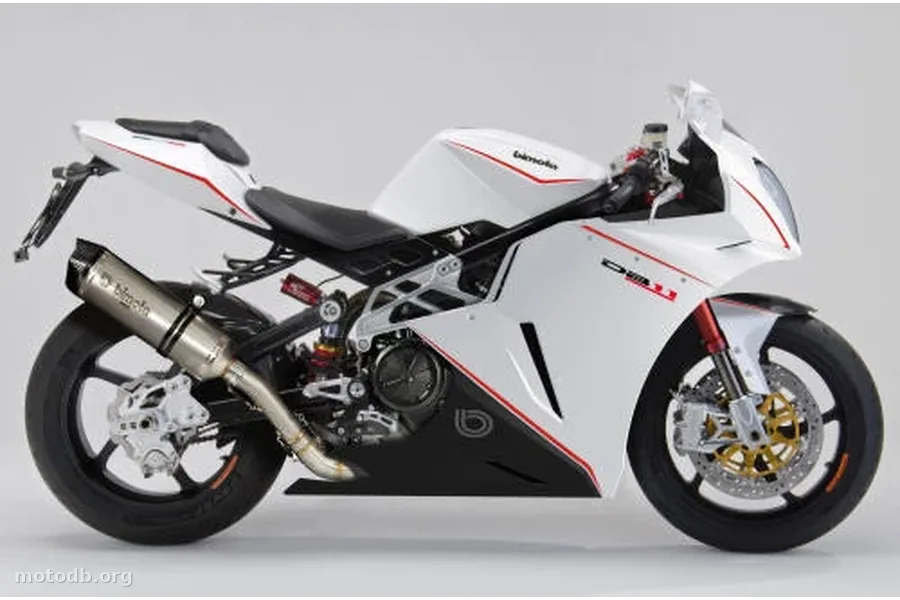
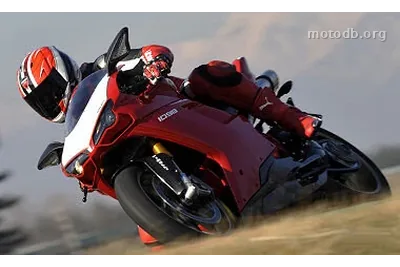
Visually, the break with the DB8 is subtle but real. The fairings round out, the front optical unit abandons the tormented shapes of previous generations for something more soothing, almost classic. The whole gains fluidity what it loses in raw aggression. Carbon is omnipresent, not just to look pretty, but because €33,120 allows for this kind of requirement. This price positioning places the DB11 in a sphere where the competition can be counted on the fingers of one hand: Vyrus, MV Agusta F4, a few Italian exotics that live on the fringes of the mass market. It is clearly not aimed at the Monday morning commuter.
Under the panels, the technical philosophy remains faithful to the Bimota DNA. The frame combines a chromium-molybdenum steel trellis with lateral plates in aluminum, an architecture that combines torsional rigidity and fine mass management. The 43 mm Marzocchi inverted fork and the Extreme Tech mono-shock are benchmarks in the industry. The Brembo calipers bite with the precision expected at this level. All this, we know it, we know it. What is more intriguing is the choice of engine.
Because the DB11 rightly bears the name "1198", but the L-twin housed in its frame is not that of the Bolognese Superbike. It is the engine from the Diavel that propels the machine, a decision that says a lot about Bimota's intentions. The Diavel engine runs differently, it pushes lower in the range, with a torque of 127.5 Nm available from 7,700 rpm. The 162 horsepower, for their part, only arrive at 9,500 rpm, which remains very accessible for a hypersportive. As a result, on a motorcycle that only weighs 175 kg dry, the thrust is constant, linear, and the announced top speed of 290 km/h is nothing of an empty promise. This engine gives the DB11 a more versatile character than one would initially suppose. It is not exclusively a track beast.
The target audience is clearly the collector-rider, the one who seeks a rare motorcycle to ride on the road on weekends and to store the rest of the time in an air-conditioned garage. The DB11 lacks versatility to seduce the great globetrotter, and its light weight will not compensate for the absence of advanced electronics compared to the latest Japanese and European superbikes that carry dozens of sensors. But that is not the field on which Bimota plays. Here, one buys know-how, a signature, an object built by hand in confidential quantities. The 18-liter tank hints at escapades of a few hundred kilometers before stopping, and that is sufficient for this type of use.
Practical info
- La moto est accessible aux permis : A
Reviews & comments
No reviews yet. Be the first to share your opinion!