Key performance
Technical specifications
Engine
- Displacement
- 1198 cc
- Power
- 220.0 ch @ 11000 tr/min (161.8 kW)
- Torque
- 134.4 Nm @ 7750 tr/min
- Engine type
- Bicylindre en L à 90°, 4 temps
- Cooling
- liquide
- Compression ratio
- 12.8 : 1
- Bore × stroke
- 106 x 67.9 mm
- Valves/cylinder
- 4
- Camshafts
- 2 ACT
- Fuel system
- Injection Ø 50 mm
Chassis
- Frame
- treillis en tubes d\'acier
- Gearbox
- boîte à 6 rapports
- Final drive
- Chaîne
- Front suspension
- Fourche téléhydraulique inversée présurisée Öhlins TTX20 Ø 43 mm, déb : 120 mm
- Rear suspension
- Mono-amortisseur Öhlins TTX36, déb : 127 mm
Brakes
- Front brakes
- Freinage 2 disques Ø 320 mm, fixation radiale, étrier 4 pistons
- Rear brakes
- Freinage 1 disque Ø 218 mm, étrier 2 pistons
- Front tyre
- 120/75-17
- Rear tyre
- 190/65-17
Dimensions
- Fuel capacity
- 23.90 L
- Dry weight
- 168.00 kg
- New price
- 120 000 €
Overview
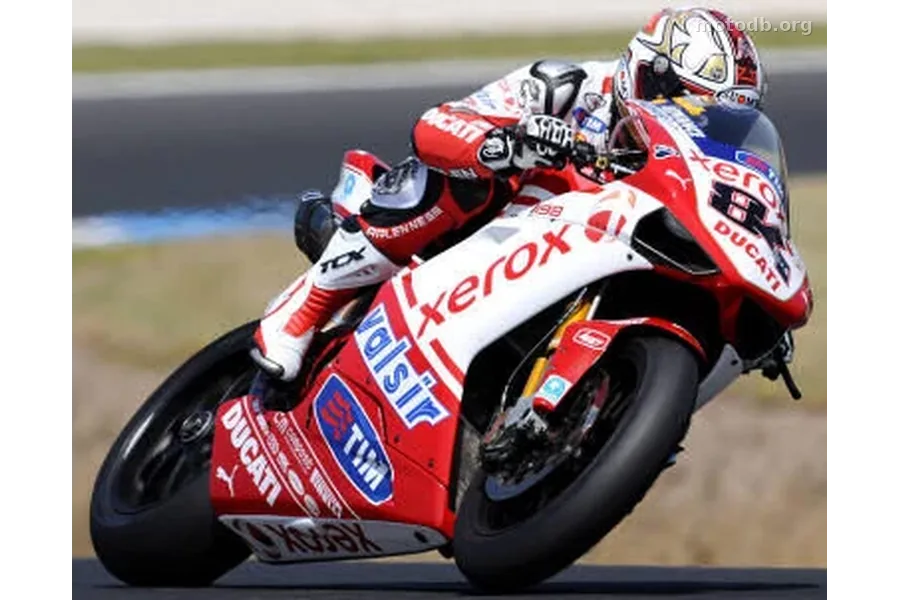
Philip Island, January 2010. The lap times are dropping, and dropping in the right direction. Noriyuki Haga, Michel Fabrizio, and that L-twin spitting out 220 horsepower from 1198cc set the tone before the season has even officially begun. Bologna worked through the winter in silence, not to revolutionize everything, but to refine what was already formidable. The technical staff has changed, the men in the saddle are the same, and the philosophy remains identical: leave nothing on the table.
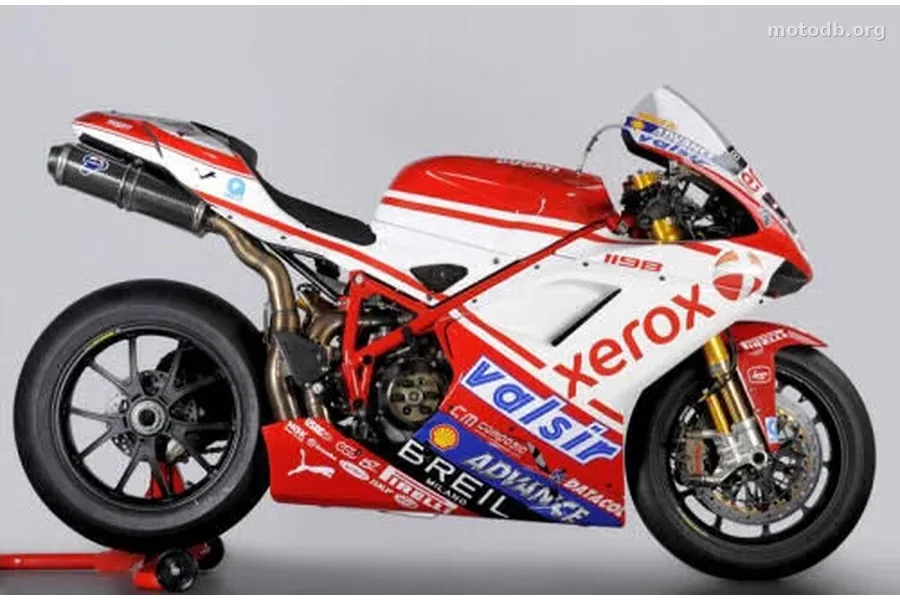
What Ducati presents under the designation 1198 F10 Superbike is not a road bike pushed into competition. It is the opposite: a race machine dressed for the SBK paddock, whose connection to the production series is limited to a handful of homologated components. The 90-degree V-twin, a direct descendant of the Desmoquattro that Bologna has been developing since 1988, officially claims 200 horsepower at the factory gate. In practice, 220 horsepower at 11,000 rpm is a measured reality, backed by 134 Nm of torque available from 7,750 rpm. At 168 kilograms dry, the power-to-weight ratio places the machine in a category where Iwata's R1, formidable as it was in 2009, struggles to answer on every circuit configuration.
The equipment list reads like a catalogue of the best available in homologated technology. The Öhlins suspension is at the level of what is found in MotoGP: 43mm TTX20 inverted fork up front, TTX36 rear shock, both fully adjustable with surgical precision. Radial four-piston calipers bite on 320mm discs, and the whole package sits on a steel tube trellis frame whose torsional rigidity is calibrated to absorb 310 km/h top speeds without the rider having to negotiate with physics. The Magneti Marelli electronics manage power delivery, traction, and engine braking: parameters that the trackside engineer adjusts between sessions, making this machine as demanding in data as it is in pure riding.
The carbon fiber bodywork is not merely aesthetic, even if the visual result is polished. Every gram saved on the outer structure is a gram reinvested elsewhere, in frame rigidity or the capacity of the 23.9-liter tank. At 120,000 euros, the target clientele does not concern itself with budget: these are ambitious privateer teams, builders looking to field a competitive machine in national or world Superbike, and a handful of collectors who understand what an intensive development season represents in terms of expertise concentrated into a single object.
Haga has been chasing the title for too long to settle for second place. Fabrizio is hungry and it shows in every flying lap. The 1198 F10 is not a motorcycle for learning; it is a motorcycle for winning, and it only makes sense in the hands of those who have already dialed in their riding to the tenth. For everyone else, less radical versions exist. This one has a single objective: the top of the timing sheet.
Reviews & comments
No reviews yet. Be the first to share your opinion!