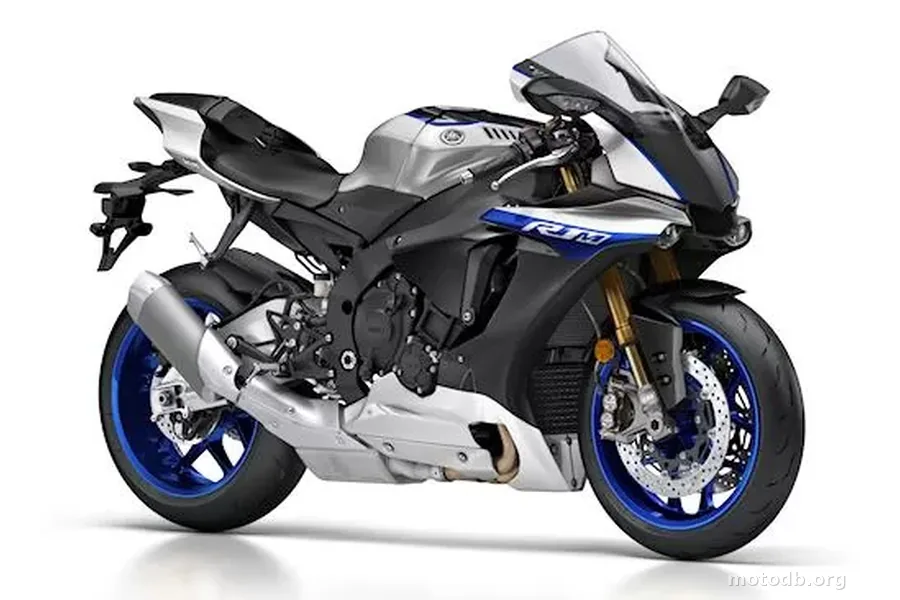
Key performance
Technical specifications
Engine
- Displacement
- 998 cc
- Power
- 200.0 ch @ 13500 tr/min (147.1 kW)
- Torque
- 112.8 Nm @ 11500 tr/min
- Engine type
- 4 cylindres en ligne, 4 temps
- Cooling
- liquide
- Compression ratio
- 13 : 1
- Bore × stroke
- 79 x 50.9 mm
- Valves/cylinder
- 4
- Camshafts
- 2 ACT
- Fuel system
- Injection
Chassis
- Frame
- périmétrique Diamond en aluminium
- Gearbox
- boîte à 6 rapports
- Final drive
- Chaîne
- Front suspension
- Fourche téléhydraulique inversée Öhlins Ø 43 mm, déb : 120 mm
- Rear suspension
- Mono-amortisseur Öhlins, déb : 120 mm
Brakes
- Front brakes
- Freinage 2 disques Ø 320 mm, fixation radiale, étrier 4 pistons
- Rear brakes
- Freinage 1 disque Ø 220 mm, étrier simple piston
- Front tyre
- 120/70-17
- Front tyre pressure
- 2.50 bar
- Rear tyre
- 200/55-17
- Rear tyre pressure
- 2.90 bar
Dimensions
- Seat height
- 860.00 mm
- Fuel capacity
- 17.00 L
- Weight
- 201.00 kg
- Dry weight
- 180.00 kg
- New price
- 23 999 €
Overview
You’ve likely seen this R1M before, in photos of a racetrack or parked with the aura of a museum piece. It’s not something you buy; it’s something you acquire. At €24,000, you’re not purchasing a simple motorcycle, but a key to a very exclusive club, that of the track riders for whom compromise is a dirty word. Yamaha took the already aggressive R1 as a base, this 998 cm³ with its unique crossplane character, and outfitted it for electronic warfare. The result? A machine that displays 200 horsepower at 13,500 rpm, but whose true strength lies in its brain more than in its titanium connecting rods.
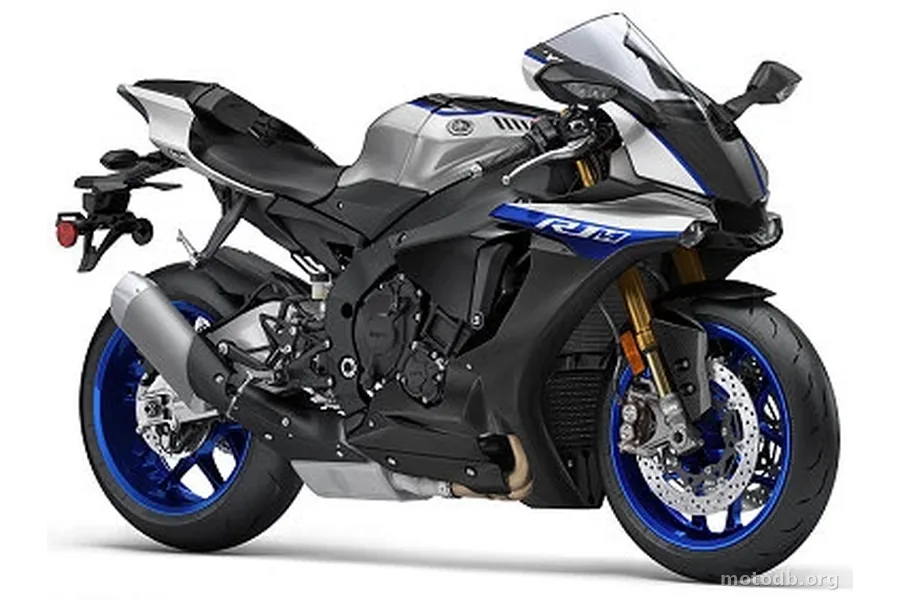
Where a standard Japanese motorcycle plays the accessibility card, the M focuses entirely on exclusivity and pure technology. Its semi-active Öhlins ERS 2 suspensions are the heart of the system. Connected to the 6-axis IMU, they recalibrate 125 times per second, anticipating braking, acceleration, and lean angle. This is far from manual adjustment of the old school; here, the motorcycle thinks with you, or even for you. Coupled with a bi-directional quickshifter finally worthy of the name and a reworked anti-wheelie system, the whole thing gives a sensation of surgical precision. The competition, such as the Panigale V4 S or the BMW M 1000 RR, offers similar solutions, but Yamaha imposes its own style: a more organic, less binary feel, where the electronics seem to amplify sensations rather than filter them.
However, not everything is perfect in this kingdom of carbon. Why, for heaven's sake, does this version, supposedly the ultimate lightweight, weigh 201 kg fully fueled, a kilo more than the standard R1? The excuse of the polished aluminum tank and carbon fiber trim doesn't suffice. We nitpick, of course, but at this level of price and requirement, every gram counts. Fortunately, once in motion, the doubt evaporates. The chassis, of remarkable precision, and the 200 rear tire, a quasi-slick Bridgestone rubber developed specifically, transform each corner into a stylistic exercise. It’s a motorcycle that demands concentration and talent, but which, in return, offers feedback of absolute richness.
Yamaha understands this well: acquiring an R1M is subscribing to a program far beyond the object itself. The invitation to the Yamaha Racing Experience (YRE) is not a gimmick, but a necessity. How else to exploit all this technology without a thorough briefing? The stage allows you to decipher the onboard telemetry, adjust the machine with technicians, and launch it on the track under the eye of former riders. It is there that the M reveals its true nature: it is not meant to shine in the city or for Sunday rides. It is a pure performance tool, designed for those who time their sessions, analyze their data, and seek the limit safely. For the touring rider or beginner, it would be unreadable and exhausting. For the confirmed track rider seeking the quintessence of Japanese engineering coupled with cutting-edge electronics, it remains a disturbing reference of efficiency.
Standard equipment
- Assistance au freinage : ABS de série
Practical info
- La moto est accessible aux permis : A
Reviews & comments
No reviews yet. Be the first to share your opinion!