Key performance
Technical specifications
Engine
- Displacement
- 998 cc
- Power
- 200.0 ch @ 13500 tr/min (147.1 kW)
- Torque
- 113.8 Nm @ 11500 tr/min
- Engine type
- 4 cylindres en ligne, 4 temps
- Cooling
- liquide
- Compression ratio
- 13 : 1
- Bore × stroke
- 79 x 50.9 mm
- Valves/cylinder
- 4
- Camshafts
- 2 ACT
- Fuel system
- Injection
Chassis
- Frame
- périmétrique Diamond en aluminium
- Gearbox
- boîte à 6 rapports
- Final drive
- Chaîne
- Front suspension
- Fourche téléhydraulique inversée Öhlins Ø 43 mm, déb : 120 mm
- Rear suspension
- Mono-amortisseur Öhlins, déb : 120 mm
Brakes
- Front brakes
- Freinage 2 disques Ø 320 mm, fixation radiale, étrier 4 pistons
- Rear brakes
- Freinage 1 disque Ø 220 mm, étrier simple piston
- Front tyre
- 120/70-17
- Front tyre pressure
- 2.50 bar
- Rear tyre
- 200/55-17
- Rear tyre pressure
- 2.90 bar
Dimensions
- Seat height
- 860.00 mm
- Fuel capacity
- 17.00 L
- Weight
- 202.00 kg
- New price
- 25 999 €
Overview
This isn't just a motorcycle; it's a measuring instrument. When Yamaha removes the R1M from the catalog, it doesn't target the garage collector; it targets the track and lap times. This machine, at €26,000, is a ticket to the very exclusive club of exceptional superbikes, where every gram and every Newton-meter is scrutinized with the rigor of a racing engineer.
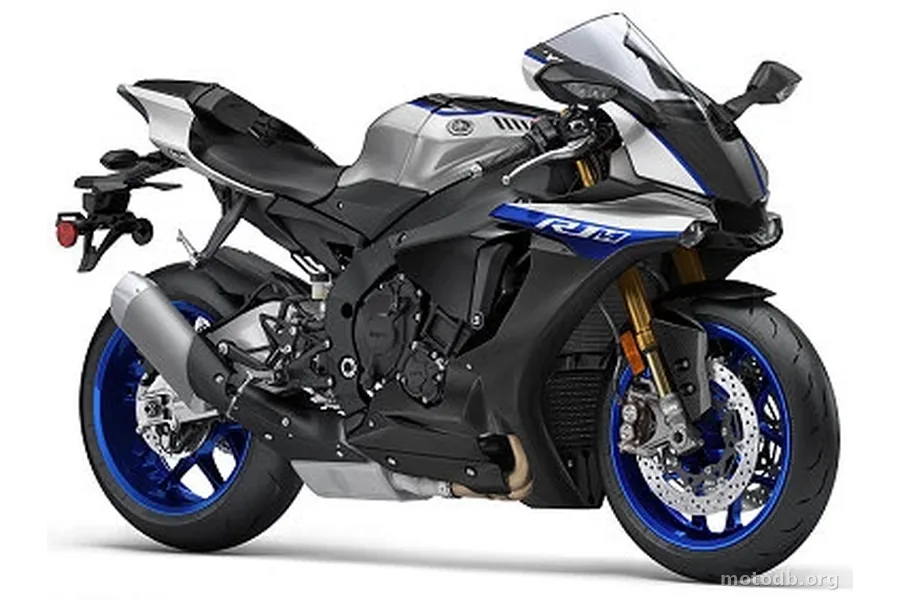
The base is that of the 2020 R1, already honed to survive the Euro5 standard without losing a breath of its 200 horsepower at 13,500 rpm. But the M is the “all carbon and Öhlins” option. The fairing is almost entirely made from this noble fiber, and even the rear fairing is included, an evolution that seems logical but that Yamaha was slow to apply. The result is a black predator look and a numbered badge on the cover, to recall that you don't have a motorcycle, but an example of a limited series.
The real magic, however, lies in the suspensions. Öhlins has grafted a semi-active system onto it, a pressurized NPX fork that fights oil cavitation for more consistent damping. This is serious, pure circuit. You can let the electronics adjust in real time, or dive into the menus to fine-tune each parameter without tools. This luxury has a price, an extra kilogram on the scale, bringing the wet weight to 202 kg. For a motorcycle that runs on agility, this is a point of discussion, but the gain in precision is tangible.
The second battlefield is electronics. It incorporates all the artifices of the R1, the cornering-linked ABS, the engine braking management, the launch control assistant. But the M adds two piloting tools that make the methodical track rider dream. The YRC Setting application allows you to compose your own modes, disable certain aids, and become the architect of your machine. The Y-TRAC, a telemetry system, then allows you to dissect your session on Google Maps, analyzing engine speed, lean angle, and interventions of the aids. This is a motorcycle that doesn't just transport you; it teaches you.
Ultimately, the R1M is a radical proposition. It is not for beginners, nor even for dilettante road riders. It targets the driver who sees the road or the track as a laboratory, who wants to exploit every detail of this 998 cm3 engine and its 113.8 Nm of torque. At this price, one expects flawless perfection, and Yamaha responds with an almost clinical machine. The only regret, perhaps, is the cancellation of the Yamaha Racing Experience, those track sessions that were supposed to accompany the purchase. But even without that, the R1M remains a statement. It’s the motorcycle that says you don't ride to get somewhere, but to understand how.
Standard equipment
- Assistance au freinage : ABS de série
Practical info
- La moto est accessible aux permis : A
Reviews & comments
No reviews yet. Be the first to share your opinion!