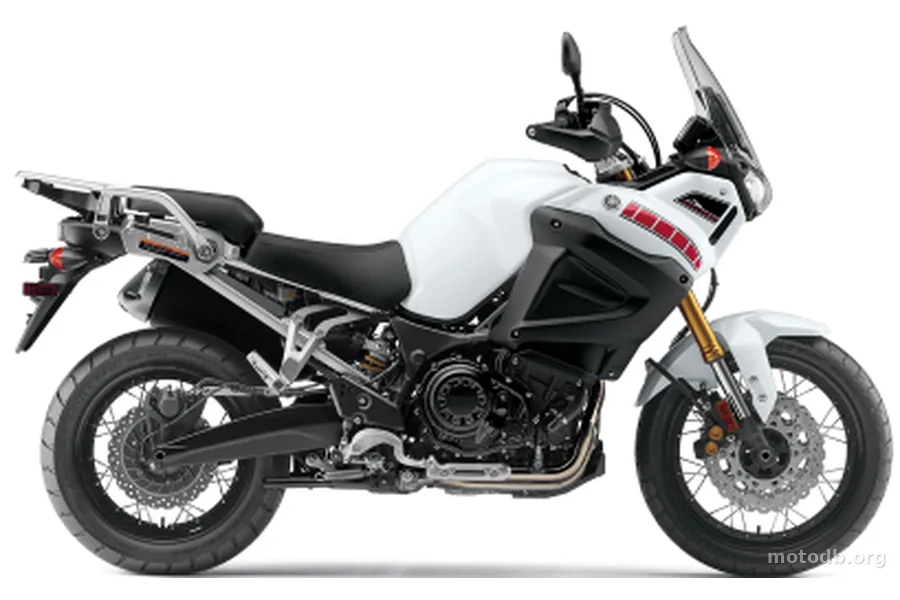
Key performance
Technical specifications
Engine
- Displacement
- 1199 cc
- Power
- 112.0 ch @ 7250 tr/min (82.4 kW)
- Torque
- 116.7 Nm @ 6000 tr/min
- Engine type
- Bicylindre en ligne, 4 temps
- Cooling
- liquide
- Compression ratio
- 11 : 1
- Bore × stroke
- 98 x 79.5 mm
- Valves/cylinder
- 4
- Camshafts
- 2 ACT
- Fuel system
- Injection
Chassis
- Frame
- Structure en tubes d'acier
- Gearbox
- boîte à 6 rapports
- Final drive
- Cardan
- Front suspension
- Fourche téléhydraulique inversée Ø 43 mm, déb : 190 mm
- Rear suspension
- Mono-amortisseur, déb : 190 mm
Brakes
- Front brakes
- Freinage 2 disques en pétale Ø 310 mm, étrier 4 pistons
- Rear brakes
- Freinage 1 disque en pétale Ø 282 mm, étrier 2 pistons
- Front tyre
- 110/80-19
- Front tyre pressure
- 2.25 bar
- Rear tyre
- 150/70-17
- Rear tyre pressure
- 2.50 bar
Dimensions
- Seat height
- 845.00 mm
- Fuel capacity
- 23.00 L
- Weight
- 257.00 kg
- New price
- 12 999 €
Overview
It’s starting to show its age, the Super T. Yamaha continues to have faith in it, but the competition is proving more reactive. At BMW, KTM, and Triumph, they’re not backing down.
Indeed, when was the last time this machine was updated? 2014, if I’ve got it right. Facing an outgunned competition, Yamaha’s trail-GT had chosen to evolve discreetly.
Don’t look for stylistic differences. In terms of design, it’s limited to barely perceptible changes: LED turn signals and new headlight protectors. On board, you’re greeted by a fully digital instrument panel with the added display of the engaged gear. On the 1200 Super-T "evo," the equipment is enriched... and diminished. The center stand and top-case mount have disappeared. Conversely, the seat gains comfort, the windscreen is manually adjustable in 4 positions, and a cruise control system makes an appearance. For 2017, compliance with Euro4 standards is noted.
In terms of power, 2 horsepower are added to the stable. Nothing dramatic, and that’s not the most interesting aspect. The interest comes from engine modifications (camshaft, pistons, widened intake and exhaust ports, new exhaust) aimed at making the engine more flexible. The twin now delivers 112 horsepower and nearly 12 mkg of torque. Add to that the D-mode system, which offers two improved maps, for the city or more sporty riding, and you get a more pleasant machine to ride.
Super Ténéré 1200 XTZ first generation: Yamaha’s large trail-GT. Tall, majestic, with Touareg accents and a desire for space. Yamaha has certainly invested a number of years to offer its loyal customers a machine carrying the torch of the 90s adventurer. But today’s XTZ 1200 has little in common with the 750 touring bike born in 1989. It smelled of warm sand and the enchanting perfumes of rally-raids... Today it flirts with grand touring. Its name still evokes the famous African desert, but will it set its wheels between the ruts of the Atlas? Rather in the showrooms of the BMW R 1200 GS. The abundance of technology and onboard equipment speak for themselves.
But before delving into the entrails of the largest XT, let’s be charmed for a few moments by this sand ship. Nostalgics will have guessed, subtly hidden, a touch of the spirit of the machines in Gaulish colors that raced towards the pink lake. The cat’s eyes are intimidating, mysterious, and above all far from the strange gaze of the smaller 660 Ténéré touring cousin. And if its build seems imposing, with its broad shoulders and its compact frame (briefly, not very well suited to dodging dune traps), the Yam staff has nevertheless developed this machine for several types of travel: asphalt roads version Europe or dirt version dust.
The ancestor had a parallel twin – the XTZ 2010 will do the same. Except that the numbers have grown, considerably. To launch into the second decade of the third millennium, Yam released a completely new 1199 cm3 engine. Calibrated at 270°, balanced by 2 balance shafts and equipped with a dry sump, this large engine didn’t bet everything on power.
And what do you find in trails now? Electronics, in abundance. Not just to regulate the mixture based on the 2 lambda probes. No, there’s MotoGP technology in there, like in the hypersportive R1. The YCC-T hand-operated throttle control has been grafted onto the right-hand controls, along with a traction control system. In plain terms, an electronic throttle controlled by a system that measures wheel rotation speeds. As soon as the semolina starts to spin, the Traction Control intervenes in 3 modes: 1) TCS1 (standard): it engages when the rear wheel slips. 2) TCS2: it reduces the effect of the Traction Control and allows for slight wheelspin. 3) Off mode: completely disconnected. In addition to the Traction Control, different maps are available: a) Sport “S”: instant response for more performance b) Touring “T”: provides more flexibility
In terms of traction, the brand with the tuning forks hasn’t done things by halves. In terms of braking, there’s a lot of hardware there too. No radial mount (not really necessary for a trail…) for the brake calipers, but a nice nod to the sport – they look like the ones on the R1 from 2002-2003. For fun, the discs are petal-shaped, alias wave type. For efficiency, ABS is standard, coupled with a linked braking system. When you brake the front, the coupling is automatically distributed between the front and rear, taking into account the speed, the weight of the crew, and the effort exerted on the lever. When you brake the rear, it doesn’t engage the front brake, to allow the pilot to maintain control of the front end, especially in off-road riding.
For the chassis of its 1200 trail, Yam didn’t choose aluminum and maintains its confidence in a steel frame, more suited to wandering on roads. Up front, there’s a good, hefty 43 mm inverted fork, adjustable in rebound, compression, and preload. The rear damper doesn’t have compression adjustment, but its adjustment knob is very accessible. The center of gravity and weight distribution have been carefully adjusted… But at the level of weight, it still gets stuck. 257 kg on this phase II; 4 less than the first generation, but it remains substantial. A handful of gravel less than an old Varadero, but thirty kilos more than in Germany or Austria.
Like many machines designed to carve up the road, the Super Ténéré is equipped with a shaft drive. We won’t get the superb monobrach of the concept presented in Tokyo; but we’re going to console ourselves with the reduced maintenance of this type of transmission. Remains to be seen whether this shaft drive will be able to rival the formidable Paralever of the GS. Spoke wheels are welcome, especially if you think about (voluntarily) leaving the road for the path. Yam has provided its protection, with an aluminum engine guard (standard in 2010 with the First Edition) and raised radiators in the side panels, like the Honda Varadero, which itself had borrowed the idea from the VTR 1000 F. Less exposed, protected by imposing covers, the heat exchangers will not fear a suicidal pebble or a somnambulist fennec.
Trail from end to end, the XTZ 1200 is designed for both standing and seated riding thanks to the position of the handlebars and the structure of the footrests. The standard handguards are of course part of the package, the rear part of the frame is reinforced to accommodate all the necessary paraphernalia, and we don’t forget the little essential niceties that are really annoying when they’s absent: 12 V socket, adjustable seat height (845 to 870 mm), adjustable windscreen, and acceptable range with this 23-liter tank. A larger capacity might not have been a luxury… For luggage and accessories, you’re now going to have to dig into the options.
Yam offers a large trail in its range to compete with the 1250 GS, 1200 Crosstourer, KTM 1090 Adventure, and other touring bikes - The former 900 TDM could not carry out this mission, neither in its strings, nor in its temperament. This Super Ténéré touring bike must fight in a segment where the competition is engaged in the main battle of today. To offer adventure better than the KTM Adventure or travel in the manner of the BMS GS, or both... The bet is bold, But Yamaha is not the type to play its cards if it doesn’t have a very good game to follow.
M.B - Photos manufacturer
Standard equipment
- Assistance au freinage : ABS + combiné
Practical info
- La moto est accessible aux permis : A
Indicators & positioning
Similar bikes
Multistrada 1200 S Pikes Peak
HP2 Megamoto 1200 PIKES PEAK edition
Reviews & comments
No reviews yet. Be the first to share your opinion!