Key performance
Technical specifications
Engine
- Displacement
- 659 cc
- Power
- 48.0 ch @ 6000 tr/min (35.3 kW)
- Torque
- 58.3 Nm @ 5250 tr/min
- Engine type
- Monocylindre, 4 temps
- Cooling
- liquide
- Compression ratio
- 10:1
- Bore × stroke
- 100 x 84 mm
- Valves/cylinder
- 4
- Camshafts
- 1 ACT
- Fuel system
- injection
Chassis
- Frame
- Tubulaire en acier, type diamant
- Gearbox
- boîte à 5 rapports
- Final drive
- Chaîne
- Front suspension
- Fourche telescopique Ø 43 mm, déb : 225 mm
Brakes
- Front brakes
- Freinage 1 disque Ø 298 mm, étrier 2 pistons
- Rear brakes
- Freinage 1 disque Ø 245 mm, étrier simple piston
- Front tyre
- 90/90-21
- Rear tyre
- 130/80-17
Dimensions
- Seat height
- 865.00 mm
- Fuel capacity
- 15.00 L
- Weight
- 185.00 kg
- Dry weight
- 169.00 kg
- New price
- 6 699 €
Overview
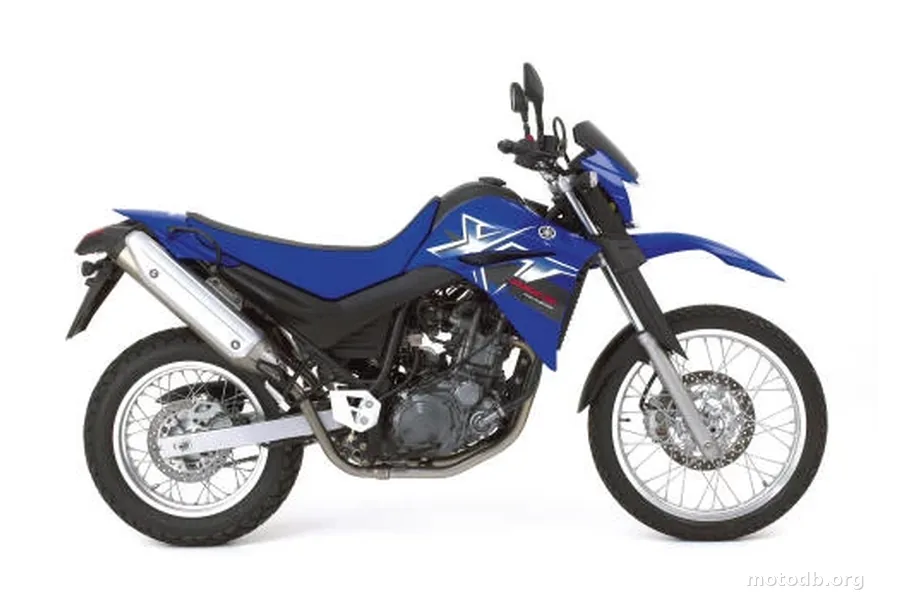
The XT 660 is quietly fading away. It no longer generates excitement and only interests a handful of enthusiasts; those who love trails and single-cylinder engines. And the conclusion of its story will be decided by Euro4 standards. A legendary piece of Yamaha history is coming to an end. And what an adventure! The first XT was born in 1976; both a versatile machine and a legendary icon, it has traveled on all terrains for 4 decades, evolving with changing tastes and technology. Originally a 500, it underwent a major evolution in 89, increasing to 600 cc while changing its design but not its character. Yesterday, the XT 600 E disappeared on the altar of pollution, making way for the XT 660 R. This engine is well known as it is an adaptation of the XTZ 660 block (nothing to do with the current Dakar-style machine). The cylinder head now has 4 valves instead of 5. Internal components are, of course, optimized, and cooling is now liquid-cooled. As the XT enters the 21st century, it is entitled to fuel injection, guaranteeing more flexibility and a wider operating range, but above all, essential for complying with older Euro 2 anti-pollution standards. The frame is a classic steel tube design with a new drawing, containing engine oil in its upper section. The motorcycle's bodywork has been refreshed but remains within the tones of the lineage. The multi-reflector optical unit and the two exhaust pipes bring a touch of aggression, while the mudguard is more unique: one part is raised just below the headlight (as on all trails), while the other half licks the wheel to protect the engine from projections. A new dashboard is also included, fully digital, but still no tachometer. Suspension travel remains unchanged, the XT still allowing you to go exploring in the countryside, although the city will always be the terrain where it will be most used. On that subject, good news: the 660 is equipped with a coded key immobilizer. The braking system is more robust with a large 298 mm front disc; almost a supermotard. With all these improvements, the XT gains prestige but not weight: 13 kg of added bulk. One of Yamaha’s flagship models was set for 10 years.
On the road, engine behavior remains faithful to the lineage: hardworking, with traction faithful to the single-cylinder architecture but without real excitement. Despite fuel injection, don’t venture too low in the rev range. It knocks, it stumbles, and the engine picks up again without much mercy. A single remains a single. It is still more flexible than the 600, and it climbs serenely up to the approach of its top speed. There's no need to reach high speeds on this machine to get excited. Too optimistic corner entry? The XTR will get you out of that. A very good weight distribution, a rigid chassis, and narrow tires: a good cocktail that allows the motorcycle to turn in a flash. Plus, with a wide handlebar and a large front wheel, you can correct a hazardous trajectory. The machine does not benefit from the latest technologies like the R1, such as a cast aluminum chassis or a shirtless engine; but it demonstrates a beautiful overall consistency. Maneuverable and accessible, it protects the vertebrae thanks to the long-travel suspension and their ability to erase road irregularities; without compromising efficiency. A rigorous trail bike, the XTR suffers mainly from a lack of character. We expect more from a large single. And in the history, the price has risen. Too much, perhaps. For the same price, you can look at a Honda CB 500 X, a Kawa ER-6n, a Yam MT-07, or a Suz 650 SV.
Euro4 standards are about to sweep away this singular chapter in Yamaha’s history. The XT 660 R is ending its career this year.
M.B.
Practical info
- Véhicule accessible au permis A2 ou bridable à 47.5ch / 35 Kw
- La moto est accessible aux permis : A, A2
Reviews & comments
No reviews yet. Be the first to share your opinion!