Key performance
Technical specifications
Engine
- Displacement
- 689 cc
- Power
- 75.0 ch @ 9000 tr/min (55.2 kW)
- Torque
- 67.7 Nm @ 6500 tr/min
- Engine type
- Bicylindre en ligne, 4 temps
- Cooling
- liquide
- Compression ratio
- 11.5 : 1
- Bore × stroke
- 80 x 68.6 mm
- Valves/cylinder
- 4
- Camshafts
- 2 ACT
- Fuel system
- Injection
Chassis
- Frame
- type Diamant en tubes d'acier
- Gearbox
- boîte à 6 rapports
- Final drive
- Chaîne
- Front suspension
- Fourche téléscopique Ø 41 mm, déb : 130 mm
- Rear suspension
- Mono-amortisseur Öhlins, déb : 130 mm
Brakes
- Front brakes
- Freinage 2 disques Ø 282 mm, étrier 4 pistons
- Rear brakes
- Freinage 1 disque Ø 245 mm, étrier simple piston
- Front tyre
- 120/70-17
- Rear tyre
- 180/55-17
Dimensions
- Seat height
- 815.00 mm
- Fuel capacity
- 14.00 L
- Weight
- 186.00 kg
Overview
Do you remember the first time you saw a XSR 700? That blend of retro and modern, that chassis seemingly from another era but powered by a highly responsive CP2 twin-cylinder engine. Yamaha launched this machine with the idea that it would be a base for customizers, a playground. And the first to answer the call are the Germans of JvB-moto, with their "Super 7." This is far from a simple aesthetic kit; it's a profound reinterpretation.
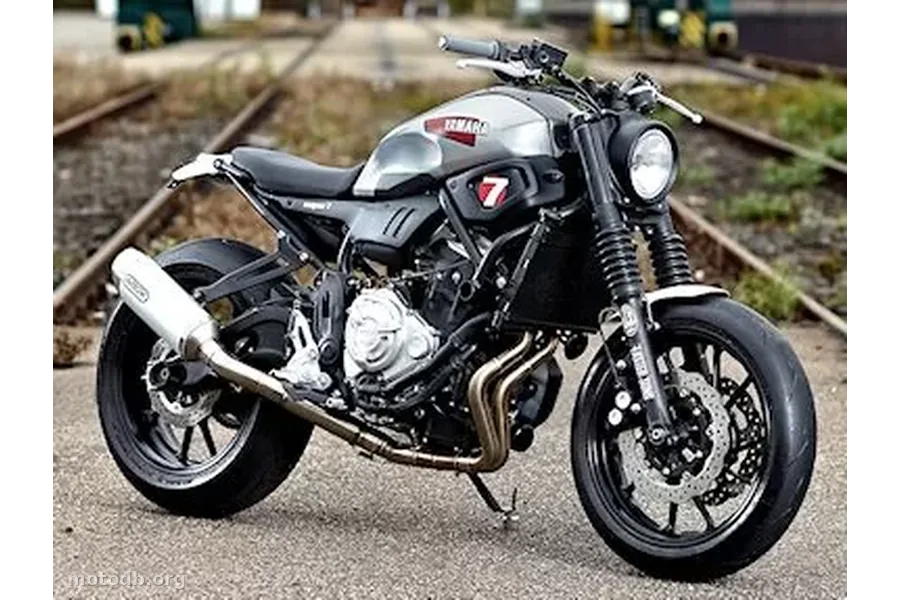
Jens vom Brauck, the boss of JvB, is no newcomer to the world of Yamaha custom builds. His "Infrared" VMAX had already made an impression. For the XSR, his approach is radical: stripping down. He wants the machine to breathe, to reveal its skeleton, to feel its heart beat. The result is an almost austere motorcycle, where every superfluous element has been removed. The false rear frame is removed, revealing a shortened line and a minimalist seat that completely changes the silhouette. The idea is brilliant: to cut and weld nothing of the original chassis, but to strip it bare. It's an intelligent customization, which respects the base but transforms it deeply.
The mechanics remain the famous CP2 unit of 689 cc, with its 75 horsepower at 9000 rpm and generous torque of 67.7 Nm at 6500 rpm. In a frame that weighs 186 kg fully fueled, it's already a lively proposition. But JvB goes further. They install a mono Öhlins shock at the rear, retain the 41 mm telescopic fork but modify it, and fit Pirelli Dragon Supercorsa tires. The objective is clear: to keep the agility and lightness promised, but with a higher level of control and grip. The LSL handlebar, mounted on custom risers, and the streamlined tank to show the raw alloy, complete this feeling of a pure machine, without frills.
What is really interesting about this Yard Built project is the business philosophy. JvB does not just offer a unique motorcycle. They manufacture and sell all the parts developed for this "Super 7." The specific front headlight, the side covers, the seat, the mudguard, the rear light, the LED turn signals, the mounting bracket for the Arrow exhaust... Everything is available in a kit so that every XSR 700 owner can bolt on their own version. It's an accessible, almost democratic customization. We go from the status of an exhibition motorcycle to that of a realizable project.
The Super 7 from JvB-moto is therefore a strong statement. It proves that the XSR 700, with its diamond steel tube frame and temperamental engine, is an incredibly fertile customization platform. It targets the rider who wants a unique machine, with a minimalist aesthetic and increased performance, without embarking on a total reconstruction. It's for those who want a retro motorcycle but not nostalgic, agile but not just urban, personalized but not overpriced. It shows the way: customization can be an evolution, not a revolution.
Standard equipment
- Assistance au freinage : ABS de série
Practical info
- Véhicule accessible au permis A2 ou bridable à 47.5ch / 35 Kw
- La moto est accessible aux permis : A, A2

Reviews & comments
No reviews yet. Be the first to share your opinion!