Key performance
Technical specifications
Engine
- Displacement
- 998 cc
- Power
- 230.0 ch (169.2 kW)
- Torque
- 112.4 Nm @ 11500 tr/min
- Engine type
- In-line four, four-stroke
- Cooling
- Liquid
- Compression ratio
- 13.0:1
- Bore × stroke
- 79.0 x 50.9 mm (3.1 x 2.0 inches)
- Valves/cylinder
- 4
- Camshafts
- 2 ACT
- Fuel system
- Injection. Fuel Injection with YCC-T and YCC-I
- Valve timing
- Double Overhead Cams/Twin Cam (DOHC)
- Lubrication
- Wet sump
- Ignition
- TCI: Transistor Controlled Ignition
- Starter
- Electric
Chassis
- Frame
- Aluminum Deltabox, diamond
- Gearbox
- 6-speed
- Final drive
- Chain (final drive)
- Clutch
- Multiplate assist and slipper clutch
- Front suspension
- 43mm KYB® inverted fork; fully adjustable
- Rear suspension
- KYB® piggyback shock, fully adjustable
- Front wheel travel
- 119 mm (4.7 inches)
- Rear wheel travel
- 119 mm (4.7 inches)
Brakes
- Front brakes
- Double disc. ABS. Hydraulic. Four-piston calipers.
- Rear brakes
- Single disc. ABS.
- Front tyre
- 120/70-ZR17
- Rear tyre
- 190/55-ZR17
Dimensions
- Seat height
- 855.00 mm
- Wheelbase
- 1405.00 mm
- Ground clearance
- 130.00 mm
- Length
- 2055.00 mm
- Width
- 691.00 mm
- Height
- 1166.00 mm
- Fuel capacity
- 17.03 L
- Weight
- 201.00 kg
- New price
- 159 000 €
Overview
Twenty-five candles for the R1, and Yamaha decides to blow them out with a flamethrower. The 2023 Yamaha R1 GYTR, dubbed "25th Anniversary Limited Edition" in its Pro version, no longer plays in the production sportbike league. It takes its place directly on the World Superbike starting grid, barely a notch below the factory machines. For those wondering what a Yamaha R1 GYTR costs in this configuration, hold on to the handlebars: 159,000 euros. Yes, the price of an apartment in some provincial cities for a motorcycle produced in only 25 units, two of which are reserved for the French market.
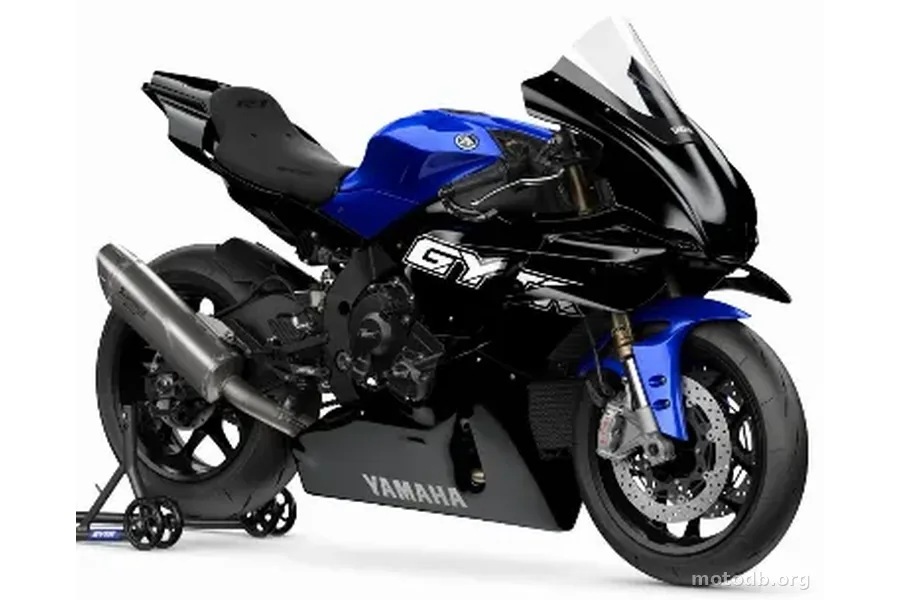
The 998cc inline four-cylinder has undergone a radical overhaul that would make an independent tuner turn pale. Reworked camshafts, uprated valve springs, revised cylinder head, competition spark plugs, full Akrapovic exhaust system, and engine management entrusted to a dedicated Magneti-Marelli ECU. The result: the Yamaha R1 GYTR's power climbs to 230 horsepower, with 112.4 Nm of torque at 11,500 rpm. All governed by the GPES electronic module, which offers a level of adjustability worthy of a factory team's pit stand. Traction control, anti-wheelie, launch control, engine braking management, engine maps: everything is dialed in with surgical precision. The Suter racing clutch and six-speed gearbox complete a mechanical package built for the stopwatch.
On the chassis side, the swingarm comes directly from the WSBK program. The Marchesini forged aluminum wheels are fitted with Pirelli Diablo Superbike SC2 slicks in race dimensions, 125/70 at the front and 200/60 at the rear. Braking relies on Brembo P4 EVO CNC-machined calipers with titanium pistons — the same components found on World Championship bikes. The Öhlins suspension, an FGR 400 inverted fork at the front and a TTX36 shock with pneumatic preload at the rear, represents the very best available outside the factory paddock. The Yamaha R1 GYTR's spec sheet lists 201 kg wet, a 1,405 mm wheelbase, and a seat height perched at 855 mm. The 17-liter fuel tank has been redesigned to lower the center of gravity, a detail that speaks volumes about the engineers' level of obsession. The bodywork is entirely carbon fiber: fairing, airbox, dashboard bracket, intake duct, rear subframe.
This project didn't come out of nowhere. Yamaha had already experimented with this approach on the 2019 R1 GYTR, then with the Razgatlioglu Replica and the VR46 Tribute gifted to Rossi for his retirement. The 2023 version pushes the envelope further than all its predecessors. The engineers from the GYTR Pro department worked closely with the Endurance and Superbike teams to develop every component. Since then, enthusiasts have been watching for the 2024, 2025, and even 2026 Yamaha R1 GYTR, hoping that Iwata will continue this lineage of exceptional machines. On the used Yamaha R1 GYTR market, the rare examples change hands at prices that defy logic — when their owners agree to part with them at all.
Let's be clear about the intended audience. This machine is aimed neither at the weekend rider nor the occasional track day enthusiast. It demands a seasoned pilot, capable of exploiting 230 horsepower on track and understanding the fine-tuning adjustments at their disposal. Each buyer is in fact invited to a track day with Yamaha technicians to set up the bike to suit their riding style. The price of the Yamaha R1 GYTR Pro puts it up against no direct production rival. Neither the Ducati Panigale V4 SP2 nor the BMW M 1000 RR offers this level of factory-built, turnkey preparation. The only shortcoming noted on an otherwise impeccable spec sheet: the absence of adjustable rearset footpegs on a 159,000-euro motorcycle remains a mystery that even the most ardent defenders of the tuning fork brand will struggle to justify.
Standard equipment
- Jantes aluminium
- Shifter
- Amortisseur de direction
- Indicateur de vitesse engagée
- Aide au départ arrêté (Launch Control)
- Contrôle de traction
- Contrôle anti wheeling
- Carénage carbone
- Jantes forgées
- Contrôle de glisse
- Contrôle du frein moteur
- Limitateur de vitesse dans les stands
Practical info
- La moto est accessible aux permis : A
Reviews & comments
No reviews yet. Be the first to share your opinion!