Key performance
Technical specifications
Engine
- Displacement
- 998 cc
- Power
- 210.0 ch (154.5 kW)
- Engine type
- 4 cylindres en ligne, 4 temps
- Cooling
- liquide
- Compression ratio
- 13 : 1
- Bore × stroke
- 79 x 50.9 mm
- Valves/cylinder
- 4
- Camshafts
- 2 ACT
- Fuel system
- Injection
Chassis
- Frame
- périmétrique Diamond en aluminium
- Gearbox
- boîte à 6 rapports
- Final drive
- Chaîne
- Front suspension
- Fourche téléhydraulique inversée Öhlins Ø 43 mm, déb : 120 mm
- Rear suspension
- Mono-amortisseur Öhlins, déb : 120 mm
Brakes
- Front brakes
- Freinage 2 disques Ø 320 mm, fixation radiale, étrier 4 pistons
- Rear brakes
- Freinage 1 disque Ø 220 mm, étrier simple piston
- Front tyre
- 120/70-17
- Rear tyre
- 200/55-17
Dimensions
- Fuel capacity
- 17.00 L
- Weight
- 190.00 kg
- New price
- 39 500 €
Overview
Twenty examples. Not one more. When Yamaha decided to celebrate two decades of its R1 in 2019, the Iwata manufacturer didn't settle for a commemorative plaque or a special paint scheme. From its workshops emerged a Yamaha R1 GYTR built exclusively for the track, a machine with no headlight, no turn signals, and not the slightest concession to the road. The message was crystal clear: this motorcycle would know only the smooth asphalt of racetracks and the warmth of tire warmers.
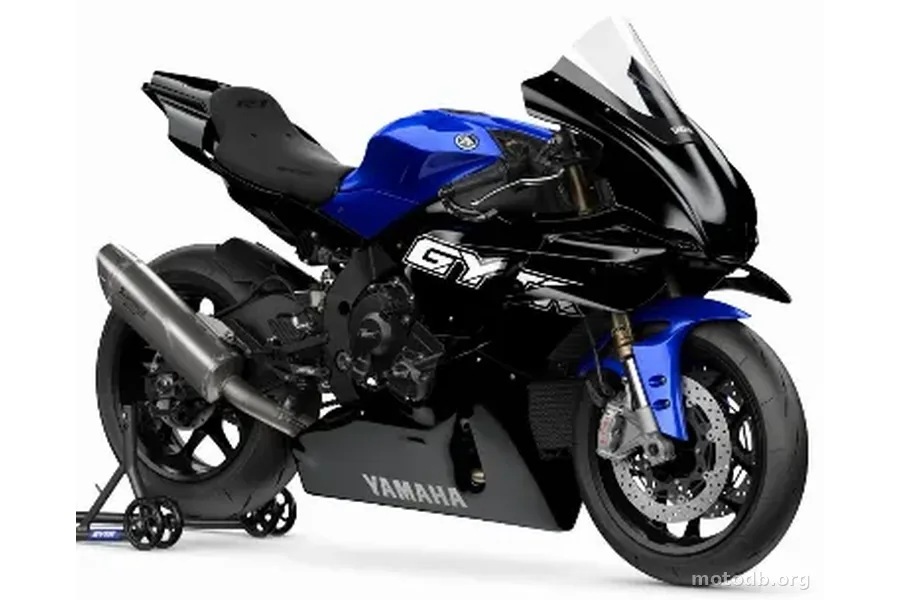
The phenomenon wasn't isolated. BMW had struck hard with the HP4 Race, Aprilia offers its Factory Works machines, Suzuki had tried its hand with the GSX-R Ryuyo. But the Yamaha R1 GYTR 2019 plays a different tune. Its foundation remains the 998 cc crossplane inline four-cylinder, with its 79 mm bore and 50.9 mm stroke, 13:1 compression ratio, and four valves per cylinder. The engine hadn't undergone any extensive internal preparation. Yamaha delivered the powerplant in a near-stock state, leaving buyers to push the work further according to their ambitions. With the titanium Akrapovic Evolution 2 exhaust system fitted as standard, the Yamaha R1 GYTR's output nonetheless climbs toward 210 horsepower for a contained weight of 190 kg wet, including the 17-liter tank. Enough to chase 300 km/h at the end of a straight without straining.
Where this R1 GYTR truly stands apart is in the chassis department. Öhlins supplies the entire suspension package: a 43 mm FGRT 219 inverted fork up front, a TTX36 GP shock at the rear, plus a steering damper — all adjustable down to the finest parameters. Braking relies on two 320 mm discs at the front with four-piston radial calipers and a 220 mm disc at the rear. The aluminum Diamond perimeter frame stays true to the production R1, but the full carbon fairing and lightened triple clamp speak to a methodical weight-saving effort. Each example bears a number engraved on that very triple clamp, a discreet reminder of the project's exclusivity. The clip-ons feature a complete race-spec control setup, with a dedicated wiring harness, specific ECU and CCU, and a quick-action throttle. No more ignition key, no more excess. This is a track rider's tool, conceived by engineers who live by the stopwatch.
The livery is no afterthought either. Yamaha reprised the colors of the team victorious at the 2018 Suzuka 8 Hours, themselves inspired by the very first YZF-R1 of 1998. A pointed nod to the model's racing lineage. As for direct competition, the BMW HP4 Race operated in an even more radical sphere with its carbon frame, but at an outrageous price tag. The Yamaha R1 GYTR 2019, listed at 39,500 euros, offered a more accessible compromise for anyone dreaming of a factory-spec superbike ready to run in customer racing or demanding track days. The twenty units were snapped up within hours during online reservations, and each buyer received an invitation to the Yamaha Racing Experience to learn how to exploit the machine's full potential.
One question remains that many still ask today: what is the price of a Yamaha R1 GYTR on the used market? With only twenty examples produced, values can only climb. More recent versions — the Yamaha R1 GYTR 2023, 2024, or even the rumors surrounding a R1 GYTR 2025 and 2026 — keep the flame alive. Yamaha has also expanded the concept with the R1 GYTR Pro, even more competition-focused. But this 2019 edition holds a special status, that of the opening salvo of a radical philosophy. Twenty motorcycles for twenty years of R1. The math checks out, and so does the symbolism.
Standard equipment
- Assistance au freinage : ABS de série
Practical info
- La moto est accessible aux permis : A
Reviews & comments
No reviews yet. Be the first to share your opinion!