Key performance
Technical specifications
Engine
- Displacement
- 998 cc
- Power
- 165.9 ch @ 11500 tr/min (122.0 kW)
- Torque
- 111.8 Nm @ 9000 tr/min
- Engine type
- 4 cylindres en ligne, 4 temps
- Cooling
- liquide
- Compression ratio
- 12 : 1
- Bore × stroke
- 79 x 50.9 mm
- Valves/cylinder
- 4
- Camshafts
- 2 ACT
- Fuel system
- Injection
Chassis
- Frame
- périmétrique en alu
- Gearbox
- boîte à 6 rapports
- Final drive
- Chaîne
- Front suspension
- Fourche téléhydraulique inversée Öhlins Ø 43 mm, déb : 120 mm
- Rear suspension
- Mono-amortisseur Öhlins, déb : 120 mm
Brakes
- Front brakes
- Freinage 2 disques Ø 320 mm, fixation radiale, étrier 4 pistons
- Rear brakes
- Freinage 1 disque Ø 220 mm, étrier simple piston
- Front tyre
- 120/70-17
- Front tyre pressure
- 2.50 bar
- Rear tyre
- 190/55-17
- Rear tyre pressure
- 2.90 bar
Dimensions
- Seat height
- 835.00 mm
- Fuel capacity
- 17.00 L
- Weight
- 214.00 kg
- New price
- 18 999 €
Overview
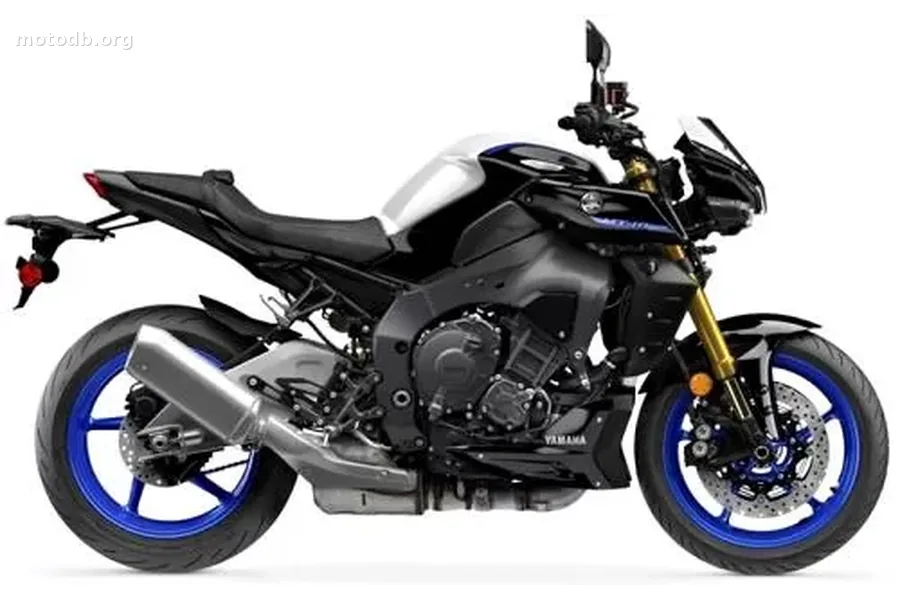
What justifies spending nearly 19,000 euros on a Yamaha MT-10 SP 1000 when the standard version already gets the job done? The answer comes down to one word: Öhlins. And not just any setup. We're talking semi-active suspension here, the kind of equipment usually found on track-focused sportbikes or GTs priced significantly higher. Yamaha chose to top its roadster lineup with a genuine piece of chassis technology, and the result is worth a closer look.
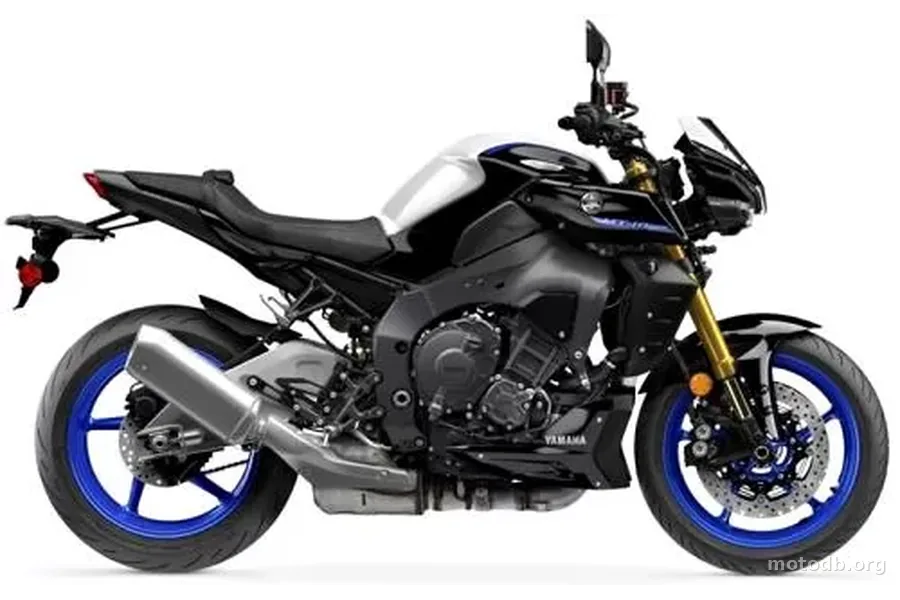
The 998 cc inline four-cylinder, derived directly from the R1, pumps out 165.9 horsepower at 11,500 rpm with 111.8 Nm of torque available from 9,000 rpm. On paper, it sits in the same waters as the Kawasaki Z H2 or the Ducati Streetfighter V4, but with a different philosophy. Where Ducati plays the Italian brutality card and Kawasaki bets on forced induction, Yamaha relies on a naturally aspirated four-cylinder with formidable linearity. The engine spins with a restrained fury, always ready to lunge toward the redline, and the 250 km/h top speed is a mere formality. All of this contained within 214 kg wet weight, which remains very respectable for a machine of this size.
The 43 mm Öhlins inverted fork and the rear mono-shock, also Öhlins-signed, form the real selling point of this SP. Six operating modes are available: three automatic, where the electronics adjust rebound and compression in real time based on riding style, and three manual for those who prefer to lock in their settings. Sport mode stiffens everything to maximize stability under hard riding, comfort mode soaks up road imperfections without flinching, and the intermediate mode is perfectly suited to long highway journeys. This wealth of adjustment places the MT-10 SP above the fray in terms of dynamic behavior. Up against an Aprilia Tuono V4, the benchmark of the segment, the Japanese machine no longer has anything to be embarrassed about when it comes to rolling chassis.
Braking has also improved with this phase 2 evolution. A Brembo radial master cylinder bites into two 320 mm front discs via radially mounted four-piston calipers. Cornering ABS, paired with a six-axis inertial measurement unit, keeps things in check during lean. The electronics catalog is nothing short of exhaustive: four engine maps, a bidirectional quickshifter, lean-sensitive traction control, wheelie control, two-level engine brake management, and cruise control. Everything is managed through a 4.2-inch TFT display. It's a lot, but every function earns its place.
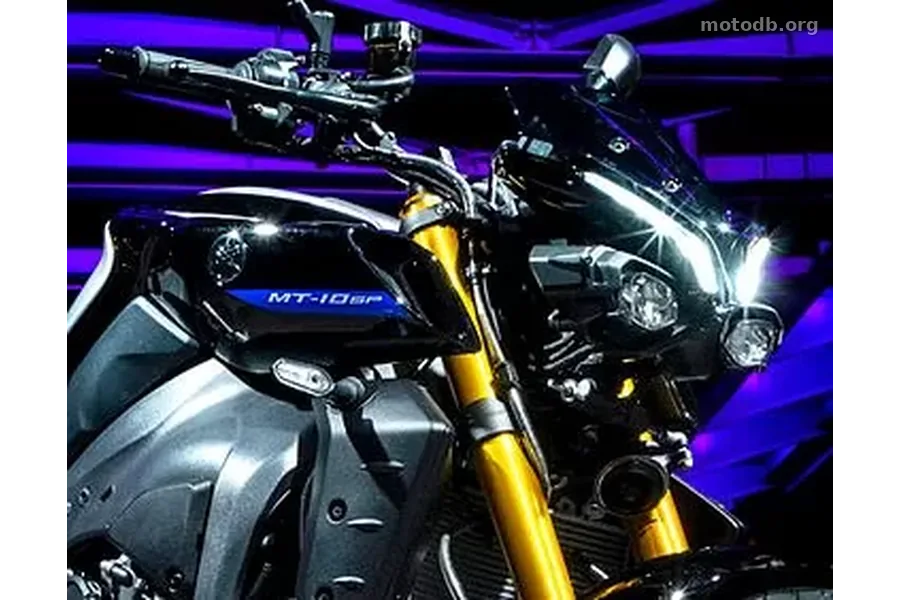
On the style front, the SP stands out with a livery inspired by the R1M, in shades of blue, aluminum grey, and gloss black. A belly pan and braided steel brake lines round out the equipment, for a weight penalty limited to two kilos over the standard. The MT-10's design continues to divide opinion, with that front end featuring stacked headlights that give it an almost animal-like stare. Yamaha has nonetheless cleaned up the lines on this generation, making the overall look less visually cluttered. What is the price of the Yamaha MT-10 SP 1000 in France? Count on 18,999 euros, a price tag justified by the semi-active Öhlins equipment, virtually unheard of at this price point in the category. For the demanding rider who wants a roadster capable of devouring A-roads in the morning and stringing together tight corners in the afternoon, without giving up a minimum of comfort or cutting-edge electronics, the SP remains a perfectly coherent choice. Not the wildest in its class, but probably the most versatile.
Standard equipment
- Assistance au freinage : ABS
Practical info
- La moto est accessible aux permis : A
Reviews & comments
No reviews yet. Be the first to share your opinion!