Key performance
Technical specifications
Engine
- Displacement
- 889 cc
- Power
- 119.0 ch @ 10000 tr/min (87.5 kW)
- Torque
- 93.0 Nm @ 7000 tr/min
- Cooling
- liquide
- Compression ratio
- 11.5 : 1
- Bore × stroke
- 78 x 62.1 mm
- Valves/cylinder
- 4
- Camshafts
- 2 ACT
- Fuel system
- Injection
- Starter
- électrique
- Euro standard
- Euro 5+
Chassis
- Frame
- périmétrique en aluminium
- Gearbox
- boîte à 6 rapports
- Final drive
- Chaîne
- Front suspension
- Fourche téléhydraulique inversée réglable de 41 mm, déb : 130 mm
- Rear suspension
- Mono-amortisseur, déb : 122 mm
Brakes
- Front brakes
- Freinage 2 disques Advics Ø 298 mm, fixation radiale, étrier 4 pistons
- Rear brakes
- Freinage 1 disque Nissin Ø 245 mm, étrier simple piston
- Front tyre
- 120/70-17
- Rear tyre
- 180/55-17
Dimensions
- Seat height
- 825.00 mm
- Seat type
- Selle biplaces
- Fuel capacity
- 14.00 L
- Weight
- 193.00 kg
- New price
- 10 699 €
Overview
The Yamaha MT-09 celebrated its 10th anniversary with a revamped silhouette and enhanced ambitions. Being one of the brand's key models might require a certain maturity... Except it doesn't care at all. The dark side of Japan swirls within it, all the more so as it doesn't hesitate to show it.
The MT-09 has always had a bold style. Surely too much in its 3rd generation! It has always championed a restrained, streamlined approach, both assertive and essential. For this 4th chapter, the doctrine follows this ideology with a few artifices; which we deem welcome. The rear structure is dressed in a somewhat sporty fairing, the reservoir and radiator scoops soften in the style of the Tracer 9, and the front fork...... has mellowed out.
Or rather, added syrup to its saké-bolted, eviscerated cocktail. The 900 MT has finished with its Klingon toaster face to present itself with a mouse-like expression. But a bit of a junkie, the beast is. The lighting identity changes both at the front and at the rear, with a mini-LED bi-function unit on the nose and a two-story taillight at the rear.
Yet, it is not a technical revolution, a stylistic shock, or a shift to a new era of motorcycling. But we feel that Yamaha is readjusting its design direction, towards a slightly less twisted style. It's not yet Italian beauty or aristocratic delirium in the English style; the brand will not suddenly emerge from the dark side into which the MT-09 III became entrenched. More than removing this luminous wart and the face will orient towards an appreciable nervousness.
The nerves are mostly in the belly, though. The 3-cylinder engine gained displacement and power with the MT-09’s 3rd opus. A good dose of 119 horsepower to growl in all circumstances, with character, impact, and a slight feeling of docility. It has been praised for a decade, and for good reason. Yam has just tweaked it a bit to meet Euro5+.
The change is more significant in the riding Modes. There are now five. Three with factory-set parameters, Street, Sport, and Rain; and two additional ones that the user will program at will. From the dashboard or with their smartphone, once paired and equipped with the MyRide app. Enough to calibrate power management as well as traction, slip, engine braking, and wheelie controls. The inertial measurement unit is there to improve the potential of some riding aids. A new feature in the assists: the rear slip regulator (BSR). A system that digests the level of torque during heavy braking, in addition to the anti-dribble clutch. We also note an improvement to the quickshifter. Its 3rd generation makes it more "natural," and it doesn't function when the engine speed is too low or too high. The MT-09 also gains the SP's cruise control.
The color TFT instrumentation has made significant progress. Yamaha took a long time to offer it a decent size, while competitors were putting on a good show. But here it is. The dashboard has gone to 5 inches diagonally, with a completely redesigned instrumentation, four display themes, and the ability to interface with the phone. For YRC settings as we have seen; and to listen to music, manage calls, have a GPS navigator (Garmin StreetCross system) and customize the screen with image submissions.
It is that the manufacturer of Iwata has notably focused on the riding space for its new models. On the new MT-09, there are new controls on a redesigned multi-function switch, impulse indicators, automatic warning lights (ESS) in case of heavy braking, a USB socket under the seat, new foot controls, separate rider and passenger seats, the radial Brembo master cylinder from the XSR 900, adjustable footpegs on two heights, and a more engaging riding position. In their standard position, the footpegs move 3 cm upwards and 1 cm rearwards. Add to that a lower handlebar (also adjustable on two positions), an increased steering head angle, a reshaped tank to better move on the motorcycle, and you are more ready to attack.
There's a weird thing at the top of this tank. Grilles like sound system equipment. Would Yam have put Bose underneath? Not really. Firstly, the manufacturer already makes very good HiFi equipment and instruments. Secondly, it is actually about appreciating the sound of the airbox. As on the MT-10 (initiator of the process), these acoustic amplification grilles bring the vibrant melody of engine intake directly under the helmet.
The MT-09 frame being almost completely new (complete redesign in 2021), no one touches it. Around it, a few progressions. New settings for the 41mm inverted Kayaba fork, a modification for the rear suspension linkages, and the brand new Bridgestone S23 sport tires to hold the pavement. They are wrapped around lightweight SpinForged rims, which undergo less centrifugal force but still the measured force of the 4-piston calipers. They know how to do a good job but a small upgrade would suit them given how the motorcycle has evolved in recent years.
The fourth-generation MT-09 improves a little everywhere, especially to suit a nervous, tenacious audience, seeking sensations and a quirky spirit. Yam seems to want to soften in its design but not really in its attack. It has also realized that it was time to raise its quality level in certain areas. We expect adrenaline to sweat from the throttle.
The big advantage of the Y-AMT system is that it is not necessary to tamper with the gearbox or engine. As a technical complement, it "grafts" onto the clutch and selector controls - this allowing it to do the job in place of the foot or the rider. And can very well be installed in the short term on other models. Offering it as an option on the Tracer 9 or any other CP3 model is realizable immediately. Adapting it to the majority of the range will depend more on demand than on technology.
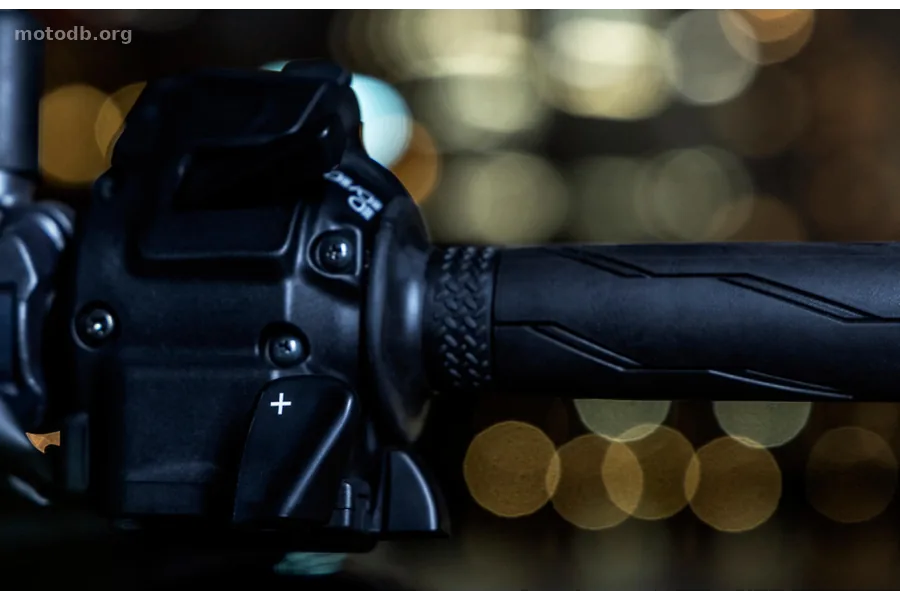
The Y-AMT offers several choices to the rider. In M mode, gear changes are commanded by switches on the left-hand multi-function switch. Since the clutch lever has disappeared, it is enough to switch + or - with the thumb and index finger. The system takes care of the rest, at a remarkable speed. There are also two D modes, to let the transmission manage itself completely. The "D" is a Relax program, more in line with urban and/or touring riding. The "D+" is more sporty, giving more revs before changing gear.
For particularly aggressive riders, the left boot no longer has to move from the footrest or slide under the selector during lean-angle maneuvers. But we are already in a very high rhythm.
M.B- Manufacturer Media
Standard equipment
- Assistance au freinage : ABS
- Nombre de mode de conduite : 5
- Taille de l'écran TFT couleur : 12,70 cm / 5 pouces
- Jantes aluminium
- Shifter
- Indicateur de vitesse engagée
- Régulateur de vitesse
- Bluetooth
- Prise USB
- Contrôle de traction
- Contrôle anti wheeling
- Jantes forgées
- Contrôle de glisse
- Embrayage anti-dribble
- Repose-pieds réglables
- Contrôle du frein moteur
Practical info
- Véhicule accessible au permis A2 ou bridable à 47.5ch / 35 Kw
- La moto est accessible aux permis : A, A2
- Pays de fabrication : Japon
Reviews & comments
No reviews yet. Be the first to share your opinion!