Key performance
Technical specifications
No spec differences between these two model years.
Engine
- Displacement
- 996 cc
- Power
- 100.0 ch @ 8000 tr/min (73.6 kW)
- Torque
- 95.1 Nm @ 6500 tr/min
- Engine type
- Bicylindre en V à 72°, 4 temps
- Cooling
- liquide
- Compression ratio
- 10.5:1
- Bore × stroke
- 98 x 66 mm
- Valves/cylinder
- 4
- Camshafts
- 2 ACT
- Fuel system
- Injection Ø 45 mm
Chassis
- Frame
- double poutre tubulaire
- Gearbox
- boîte à 6 rapports
- Final drive
- Chaîne
- Front suspension
- Fourche téléhydraulique inversée Ø 41 mm, déb : 120 mm
- Rear suspension
- Mono-amortisseur sous le moteur, déb : 120 mm
Brakes
- Front brakes
- Freinage
- Rear brakes
- Freinage 1 disque
- Front tyre
- 120/70-17
- Rear tyre
- 180/55-17
Dimensions
- Fuel capacity
- 17.50 L
- Dry weight
- 185.00 kg
- New price
- 15 000 €
Overview
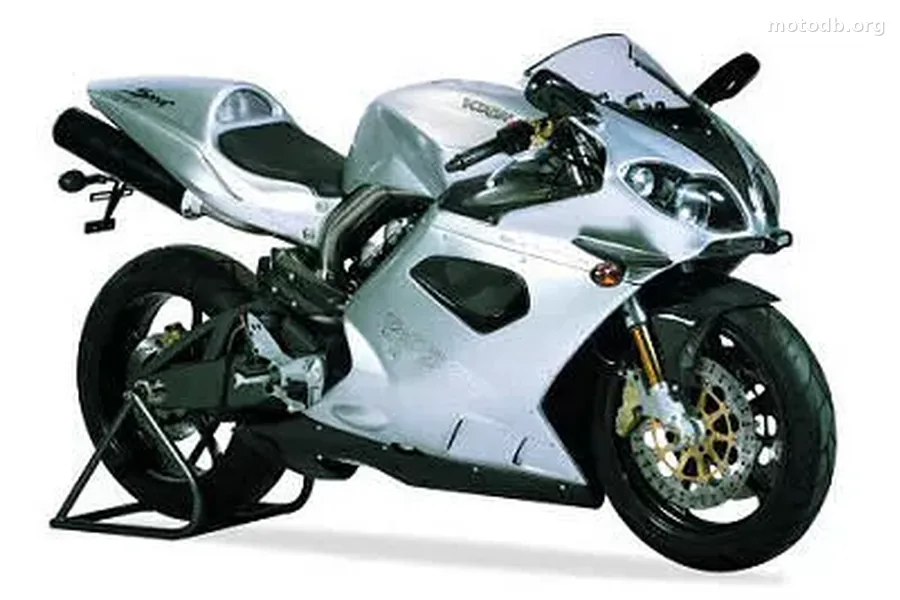
Imagine the Voxan stand at the 1999 Paris Motor Show: a French motorcycle, built in an Auvergne factory, daring to stand up to the Japanese and Italians without complexes. Thierry Henriette and his team then presented the VB1, for "Voxan Boxer Number 1," and the public looked on with that mixture of astonishment and curiosity reserved for seductive anomalies.
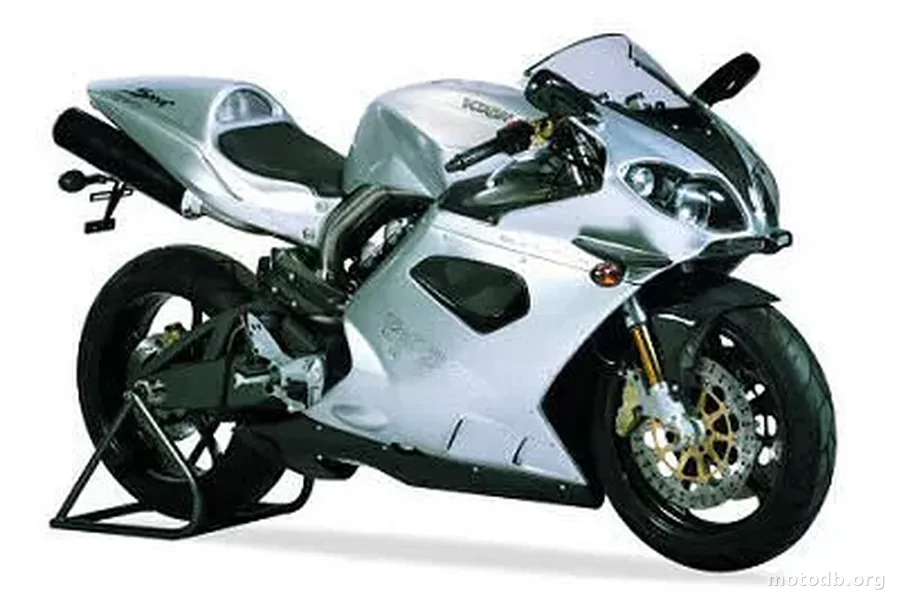
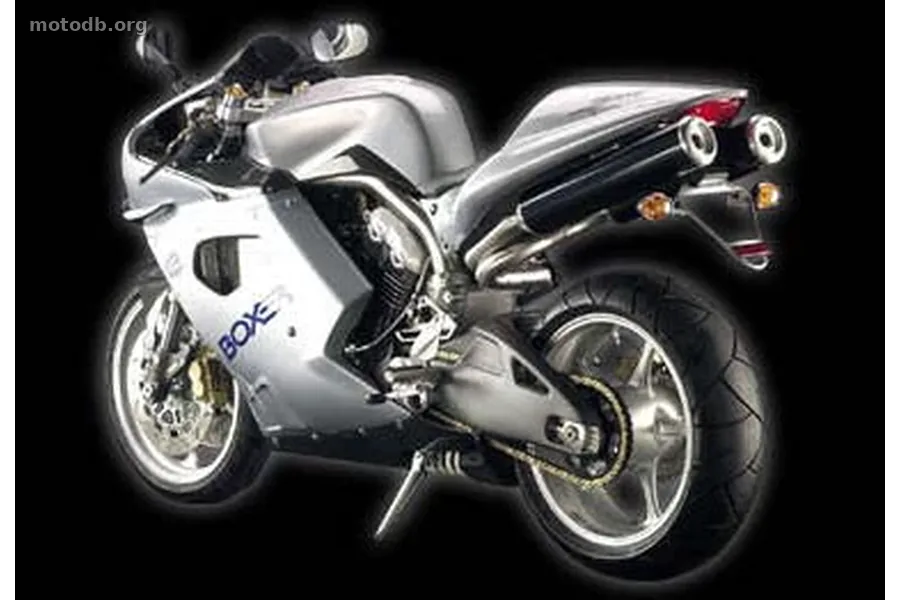
Because seductive, it undeniably is. Four headlights embedded in a compact and aggressive head, a low-slung bubble screen, carbon fiber fairings, flanks with a taut design like a blade, a sharp rear point. The two large-volume silencers housed under the seat directly recall the Ducati 996 and its signature exhaust line. This is neither an accident nor a discreet homage: it is an assumed claim. The VB1 feeds on the codes of Italian sport to build something that remains obstinately, assertively, French.
Under the bodywork, the 72-degree V2 of 996 cc develops 100 horsepower at 8000 rpm and 95 Nm of torque at 6500 rpm, the same internals as the Café Racer from which it is derived. Except that here, restricted collectors and an overly long gearing strangle what could be a beautiful fury. The engine truly expresses itself between 6500 and 8000 rpm, in a frank and communicative range, but the rest of the spectrum lacks generosity. At 185 kg dry and with a 17.5-liter tank, the machine is not heavy on paper, and its announced 250 km/h remain accessible. The six-speed gearbox, the 41 mm inverted fork and the central mono-shock do the job, but the tubular double-beam chassis imposes its rigidity on the rider without leaving him much room for negotiation in the chain of corners.
On board, no compromises or hypocritical comfort. The high and hard seat, the bracelets nestled under the fork legs, the torso projected forward: the position is that of a pure sportbike, and the rider quickly understands that he must use his body to help the motorcycle in direction changes, because it does not pivot, it steers. This is not a defect in itself, it is a bias, but you must be aware of it before buying. The target audience is clearly not the beginner or daily commuting: the heat given off by the pots, the demanding position and the sound level make it a weekend companion reserved for experienced riders who seek an experience, not a tool.
Displayed at 15,000 euros at its launch, the VB1 positioned itself in a segment where Ducati and Aprilia had already planted their flags. Faced with a 996 or an RSV Mille, it did not offer the same level of dynamic refinement or the same reputation for track performance. What it did offer, however, was something rarer: an unparalleled visual identity and the pride of a tricolor mechanical system in a segment dominated by the southerners. Work of art or production motorcycle, the boundary remains blurred on the VB1. It is probably its greatest quality, and its main defect.
Practical info
- La moto est accessible aux permis : A
Indicators & positioning
Similar bikes
Lawrence Ultimate
999 Scout Bobber Sixty NEON
Reviews & comments
No reviews yet. Be the first to share your opinion!