Key performance
Technical specifications
- Displacement
- 885 cc → 888 cc
- Power
- 84.0 ch @ 8400 tr/min (61.3 kW) → 93.9 ch @ 8750 tr/min (68.5 kW)
- Torque
- 80.0 Nm @ 5500 tr/min → 87.0 Nm @ 7250 tr/min
- Compression ratio
- 10.6:1 → 11.3:1
- Bore × stroke
- 76.0 x 65.0 mm (3.0 x 2.6 inches) → 78.0 x 61.9 mm (3.1 x 2.4 inches)
- Fuel system
- Carburettor. 3 x 36mm flat side CV → Injection. Multi-point sequential electronic fuel injection
- Lubrication
- Wet sump → —
- Ignition
- Digital CDI → —
- Frame
- Trellis, steel → Tubular steel, bolt on subframe
- Clutch
- Wet, multiple discs, cable operated → Wet multi-plate
- Front suspension
- 43 mm Kayaba telescopic fork, adjustable for compression and rebound damping → Marzocchi 45mm upside down forks, non-adjustable
- Rear suspension
- Kayaba monoshock, adjustable preload → Marzocchi rear suspension unit, manual preload adjustment, 170mm rear wheel travel
- Front wheel travel
- 235 mm (9.3 inches) → —
- Rear wheel travel
- 200 mm (7.9 inches) → —
- Front brakes
- Double disc. Two-piston calipers. → Double disc. Brembo radial-type monobloc, with 4 pistons. Multi-mode ABS, Optimized Cornering ABS.
- Rear brakes
- Single disc. Two-piston calipers. → Single disc. Brembo with single pistons. Multi-mode ABS, Optimized cornering ABS.
- Front tyre
- 100/80-19 → 100/90-19
- Rear tyre
- 140/80-17 → 150/70-R17
- Seat height
- 851.00 mm → 810.00 mm
- Wheelbase
- 1560.00 mm → 1556.00 mm
- Width
- — → 930.00 mm
- Height
- — → 1460.00 mm
- Fuel capacity
- 25.00 L → 20.00 L
- Dry weight
- 209.00 kg → 194.00 kg
Engine
- Displacement
- 888 cc
- Power
- 93.9 ch @ 8750 tr/min (68.5 kW)
- Torque
- 87.0 Nm @ 7250 tr/min
- Engine type
- In-line three, four-stroke
- Cooling
- Liquid
- Compression ratio
- 11.3:1
- Bore × stroke
- 78.0 x 61.9 mm (3.1 x 2.4 inches)
- Valves/cylinder
- 4
- Fuel system
- Injection. Multi-point sequential electronic fuel injection
- Valve timing
- Double Overhead Cams/Twin Cam (DOHC)
- Starter
- Electric
Chassis
- Frame
- Tubular steel, bolt on subframe
- Gearbox
- 6-speed
- Final drive
- Chain (final drive)
- Clutch
- Wet multi-plate
- Front suspension
- Marzocchi 45mm upside down forks, non-adjustable
- Rear suspension
- Marzocchi rear suspension unit, manual preload adjustment, 170mm rear wheel travel
Brakes
- Front brakes
- Double disc. Brembo radial-type monobloc, with 4 pistons. Multi-mode ABS, Optimized Cornering ABS.
- Rear brakes
- Single disc. Brembo with single pistons. Multi-mode ABS, Optimized cornering ABS.
- Front tyre
- 100/90-19
- Rear tyre
- 150/70-R17
Dimensions
- Seat height
- 810.00 mm
- Wheelbase
- 1556.00 mm
- Width
- 930.00 mm
- Height
- 1460.00 mm
- Fuel capacity
- 20.00 L
- Dry weight
- 194.00 kg
Overview
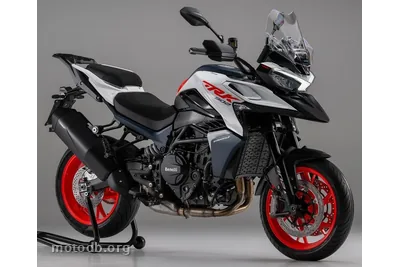
They simply call it the "Tiger 900," without fuss. Don't be fooled by this apparent simplicity; it's a trap set by the engineers at Hinckley. Behind this streamlined designation lies the cornerstone of a remarkably extensive range, designed to cover all terrains, from smooth asphalt to rocky trails. This base Triumph Tiger 900, far from being a stripped-down model, lays the foundations for a revised and corrected philosophy.
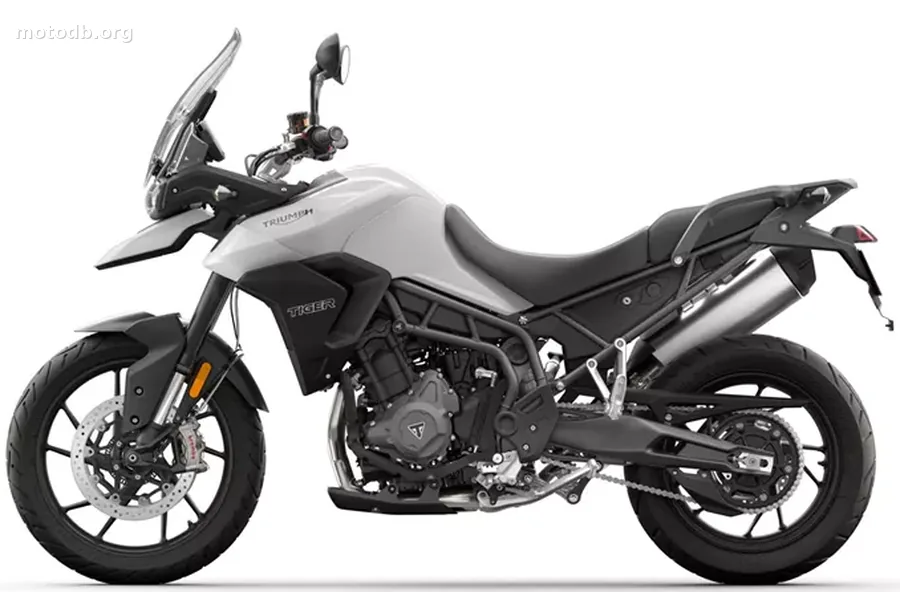
The heart of the transformation beats in the form of an 888 cm3 inline three-cylinder engine. The power output displays a familiar figure, 95 horsepower, but the magic happens elsewhere. Torque climbs to 87 Nm, available lower in the rev range, from 7250 rpm. This muscular fullness, coupled with a reworked firing sequence of 1-3-2, gives this engine a more raspy voice and much meatier acceleration. This is where the real progress lies compared to the previous 800. The engine, housed in a redesigned trellis frame, contributes to a noticeable weight loss. With a dry weight of 192 kilograms, this Tiger 900 sheds nearly 7 kg, a figure that will be immediately felt in handling.
The cycle parts play fair. The 45 mm Marzocchi inverted fork and rear shock are in their simplest version here, with only preload being adjustable. The brakes, on the other hand, are of exceptional quality for this category, with Brembo Stylema monobloc calipers at the front that inspire absolute confidence. The equipment, while targeted, is not meager. There is a 5-inch color TFT screen, two riding modes (Road and Rain), traction control, and full LED lighting. It’s understated, but effective. For fully adjustable suspensions, cornering ABS, or handguards, you will need to turn to a Triumph Tiger 900 GT Pro or a Rally Pro, the price of which takes off accordingly.
Speaking of price. At 11,800 euros, this Tiger 900 positions itself as a direct challenger to the segment’s benchmarks. It offers a coherent package, with a three-cylinder engine with a unique character and a lightweight chassis that promises agility. It is aimed at the globetrotter looking for a versatile and reliable machine, capable of swallowing up kilometers on the highway as well as tackling a track, without extreme off-road pretensions. It’s an excellent base, an honest motorcycle that leaves the door open to more refined versions of the range for those who want the latest in electronics and equipment.
In conclusion, this 2020 Triumph Tiger 900 is much more than a simple restyling. It’s a deep overhaul that corrects the small flaws of the previous generation, with a more playful engine and a generally lighter motorcycle. Its road test will undoubtedly confirm these promises on paper. For a new purchase, it represents a serious argument, but used options, as can be found on Le Bon Coin for example, could be a golden opportunity to access this quality technical platform without breaking the bank. Whether you are attracted to the Rally version for adventure or the GT for the road, it all starts with this solid and effective base.
Reviews & comments
No reviews yet. Be the first to share your opinion!