Key performance
Technical specifications
Engine
- Displacement
- 955 cc
- Power
- 149.0 ch @ 10700 tr/min (109.6 kW)
- Torque
- 100.0 Nm @ 8200 tr/min
- Cooling
- liquide
- Compression ratio
- 12 : 1
- Bore × stroke
- 79 x 65 mm
- Valves/cylinder
- 4
- Camshafts
- 2 ACT
- Fuel system
- Injection
Chassis
- Frame
- multitubulaire en alu
- Gearbox
- boîte à 6 rapports
- Final drive
- Chaîne
- Front suspension
- Fourche téléhydraulique Ø 45 mm, déb : 120 mm
- Rear suspension
- Mono-amortisseur, déb : 140 mm
Brakes
- Front brakes
- Freinage 2 disques Ø 320 mm, étrier 4 pistons
- Rear brakes
- Freinage 1 disque Ø 220 mm, étrier 2 pistons
- Front tyre
- 120/70-17
- Front tyre pressure
- 2.50 bar
- Rear tyre
- 190/50-17
- Rear tyre pressure
- 2.90 bar
Dimensions
- Seat height
- 815.00 mm
- Fuel capacity
- 21.00 L
- Weight
- 219.00 kg
- Dry weight
- 188.00 kg
- New price
- 13 500 €
Overview
In 2002, when a manufacturer blows out its hundred candles, it doesn't settle for a cake and a handful of confetti. Triumph chose to mark the occasion with two anniversary models, including this 955i Daytona Centenary Edition, a limited series of 200 units paying tribute to a century of British passion. A century that saw the brand born in Coventry with a modest 2-horsepower Minerva engine, before settling in Hinckley to forge sportbikes capable of flirting with 260 km/h.
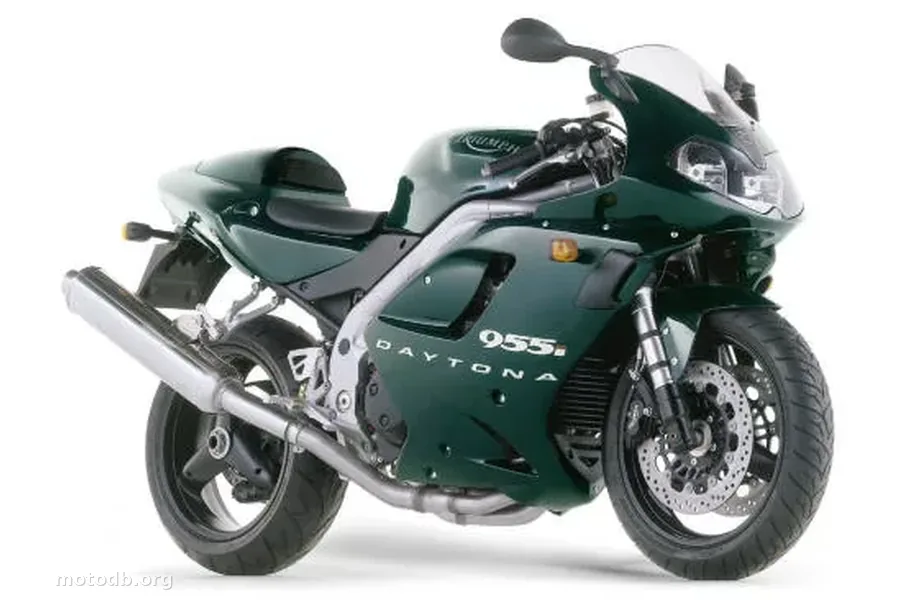
What strikes you first is the livery. A British green dubbed "Aston Green" that breaks radically from the usual color schemes of the sportbike segment. Where the Japanese competitors of the era banked on garish combinations, Triumph plays the refinement card, bordering on dandyism. The carbon accents on the mudguard, the fork head covers, and the under-tank side panels underscore this approach without ever veering into gaudiness. And then there's the return of the single-sided swingarm, an aesthetic and technical detail that the Daytona frankly should never have abandoned. This single-sided arm restores a presence that the standard versions had somewhat diluted.
Beneath this gala attire, the mechanicals remain those of the standard 955i. The inline three-cylinder, Triumph's sonic and temperamental signature, develops 149 horsepower at 10,700 rpm with 100 Nm of torque at 8,200 rpm. Figures that place it squarely in the ballpark against a Suzuki GSX-R 1000 or a Yamaha R1 of the same era, even if the triple plays a different tune. Its architecture—79 mm bore by 65 mm stroke—and its 12:1 compression ratio give it a hard-edged character in the upper rev range. One small regret, however: since the evolution from the T595 to the 955, the pursuit of power has nibbled away at some of the generous mid-range torque that was the essence of the original engine. The motor pulls hard up top but has lost a bit of that luscious smoothness that made roll-ons between 4,000 and 7,000 rpm so thrilling.
The aluminum multi-tubular frame, the 45 mm telescopic hydraulic fork, and the rear mono-shock form a sound package, unsurprising compared to the production Daytona. At 219 kg wet and with a 21-liter tank, the 2002 Triumph 955i Daytona Centenary Edition positions itself as a sport-touring machine rather than a pure track weapon. The 815 mm seat height remains accessible, the braking entrusted to twin 320 mm discs gripped by four-piston calipers inspires confidence, and the 120/70 and 190/50 tires offer a versatile compromise. Priced at 13,500 euros at launch, it was aimed at lovers of fine British engineering—those who prefer the elegance of a rolling collector's piece to lap-time wars on track.
Twenty-four years on, this limited series has appreciated in value, as does any Triumph produced in confidential numbers. For the collector or the British triple enthusiast, it's a piece of history on two wheels. Not the most radical of its era, but certainly one of the most desirable.
Practical info
- La moto est accessible aux permis : A
Indicators & positioning
Similar bikes
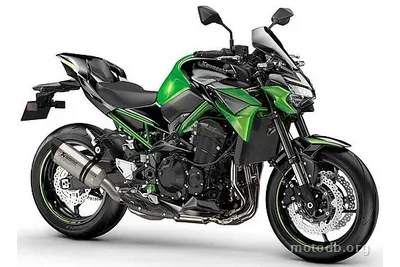
Z 900 50th Anniversary
Reviews & comments
No reviews yet. Be the first to share your opinion!