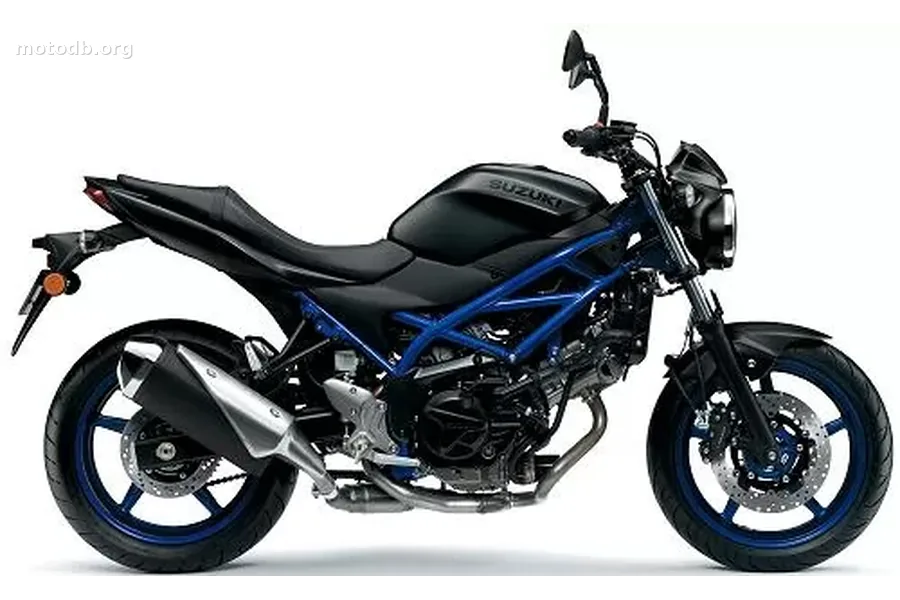
Key performance
Technical specifications
Engine
- Displacement
- 645 cc
- Power
- 73.0 ch @ 8500 tr/min (53.7 kW)
- Torque
- 64.0 Nm @ 6800 tr/min
- Engine type
- Bicylindre en L à 90°, 4 temps
- Cooling
- liquide
- Compression ratio
- 11.2 : 1
- Bore × stroke
- 81 x 62.6 mm
- Valves/cylinder
- 4
- Camshafts
- 2 ACT
- Fuel system
- Injection Ø 39 mm
- Starter
- électrique
- Euro standard
- Euro 5
Chassis
- Frame
- treillis tubulaire en acier
- Gearbox
- boîte à 6 rapports
- Final drive
- Chaîne
- Front suspension
- Fourche téléhydraulique Ø 41 mm
- Rear suspension
- Mono-amortisseur
Brakes
- Front brakes
- Freinage 2 disques Ø 290 mm, étrier 4 pistons
- Rear brakes
- Freinage 1 disque Ø 240 mm, étrier 2 pistons
- Front tyre
- 120/70-17
- Front tyre pressure
- 2.25 bar
- Rear tyre
- 160/60-17
- Rear tyre pressure
- 2.50 bar
Dimensions
- Seat height
- 785.00 mm
- Seat type
- Selle biplaces
- Fuel capacity
- 14.50 L
- Weight
- 197.00 kg
- New price
- 6 999 €
Overview
The SV 650 isn’t going much further in its career; Suzuki hasn’s validated it for Euro5+ (unlike the new SV7X). But there’s still Euro5 stock to offer it for a while yet, at a fantastic price, this good-humored, well-equipped machine.
The quintessential SV 650. Present for over two decades at Suzuki, we never tire of seeing it; even if it appears increasingly sensible compared to the competition. Its creators simply adapted it to Euro 5. This has changed nothing about its friendly face or silhouette, but concerning the engine... it was scraped on one side while smiling on the other.
The twin lost 3 horsepower in its update, roughly 2% of its power. However, it has reduced its rev range to deliver peak torque at 6,800 rpm instead of 8,100 rpm. Here’s a prolonged run for a while, for the one who sees the tempo of the cylinders and the moments of the wind smiling.
Suzuki seems unconcerned, but in reality, the SV is regularly refined. Something has changed in the response of the right-hand lever since 2019. Let’s take a closer look: the brake calipers have gone from 2 to 4 pistons. A plus for braking, a timid evolution for this friendly machine that has a tough battle to fight against the MT-07 and Z 650. However, its renewal was noticeable.
This was in 2016, the year that marked the return of the SV, after a long hiatus filled by the maligned Gladius. Yet, the excellent mid-displacement twin that has taken so many motorcyclists on SVs, SV-S, and SV-Stroma has always been exhilarating. But the setting wasn’t always up to par. Let’s forget that and see how Suzuki’s little roadster is trying to recapture the aura of its early days.
The years have passed, and the SV has calmed down. Or rather, it hasn’t followed the trend like its girlfriends. Impertinence accompanied the evolution of roadsters in the mid-range lineup. Not for the Suzuki, whose design seems to have come from a box stuck in the late 1990s. It’s not ugly, not at all. It’s even elegant, pleasant to look at, the sickly exhaust of the Gladius has finally been thrown in the trash, and the return of a round headlight is infinitely more appreciated than the strange hazelnut it replaced. Yet, the enthusiasm isn’t there. In wanting to be sensible and well-behaved, the SV 650 has become almost anonymous. But not necessarily less interesting.
Those who knew the original SV will find it here, refined, modernized, and finished off beautifully with a very GSX-R touch. And naturally, we’re going to take a close look at the chassis. That’s where we’re going to bite our teeth. We loved the aluminum frame of the first generation; for the third, it will be the steel tubular trellis frame of the Gladius. Like Ducati? Yes, without the Italian charm. As long as it does the job, we won’t hold it against it. It’s up to it to prove it.
Yesterday and tomorrow, the roadster that wrote a beautiful page in Suzuki’s history can count on its twin-cylinder. Flexible, easy, fierce, faultless, it was an engine that everyone praised. The mechanical department hasn’t let it sleep. And as if to clearly forget the Gladius episode, we claim sixty new parts in the casing. Power climbed to 76 horsepower at 8,500 rpm (re-indexed to 73 since Euro5). A benefit that the torque doesn’t know, constant but perched higher in the revs than before. Frugal, the engine would consume barely more than 4 liters per 100 km. Yeah… Surely, but at a stabilized speed in a hangar with a throttle that never moves. Does Suzuki want to play like all the other manufacturers by announcing consumption figures worthy of automotive hypocrisy!?
This hasn’t escaped you; nor the SV: the era is one of increased integration of electronics. Traction control and riding modes are flourishing everywhere. The discourse is different for the heart of the 645 cm3 twin. Suzuki has implanted the "Low RPM Assist," an assistance at low revs that facilitates evolutions when the pistons are moving moderately. Not stupid, and judicious for novices. A twin isn’t handled like a 4-cylinder hyper flexible engine. Don’t go playing on a slight throttle input under penalty of provoking a hiccup. The "Low RPM Assist" will smooth that out. The starter will, for its part, be assisted by the "Suzuki Easy Start." The GSX-S already knew it. A press of the button, no need to remain pressed, and the engine continues on its own until it coughs regularly.
With 140 new parts in total, the SV 650 has evolved considerably since the SVF. And it has lost weight: 8 kilos less. We pass under the two quintals mark, even with ABS. This little beast weighs only more than 2 kilos for a few years. Anecdote, the SV of 2016 weighs 197 kilos fully fueled when the one of 1999 only displayed 189. It’s a wonder what motorcycles eat.
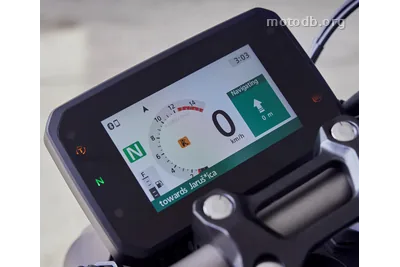
This return to basics is synonymous with simplicity. The cycle part doesn’t do anything flashy: 41 mm standard fork, square-section swingarm, axially mounted 4-piston brake calipers, few adjustments. Enough to pull prices down. The dashboard hasn’t chosen to return to needle gauges. It’s a digital window identical to that of the GSX-S. It differs only in certain indications, such as the absence of Traction Control or the lower engine speed.
The SV has returned to its origins. A real good news not enough rewarded by a too aseptic design (in our opinion). Let’s bet that a sparkling character and a pleasant ride will unlock emotions.
M.B - media constructor
Standard equipment
- Assistance au freinage : ABS
- Jantes aluminium
- Indicateur de vitesse engagée
- Aide au démarrage
- Aide à la manoeuvre
Practical info
- Véhicule accessible au permis A2 ou bridable à 47.5ch / 35 Kw
- La moto est accessible aux permis : A, A2
- Pays de fabrication : Japon
Reviews & comments
No reviews yet. Be the first to share your opinion!