Key performance
Technical specifications
Engine
- Displacement
- 1000 cc
- Power
- 195.0 ch @ 13200 tr/min (143.4 kW)
- Torque
- 110.0 Nm @ 11000 tr/min
- Engine type
- 4 cylindres en ligne, 4 temps
- Cooling
- liquide
- Compression ratio
- 13.8 : 1
- Bore × stroke
- 76 x 55.1 mm
- Valves/cylinder
- 4
- Camshafts
- 2 ACT
- Fuel system
- Injection Ø 48 mm
- Starter
- électrique
- Euro standard
- Euro 5+
Chassis
- Frame
- périmétrique en aluminium
- Gearbox
- boîte à 6 rapports
- Final drive
- Chaîne
- Front suspension
- Fourche téléhydraulique inversée BPF à cartouches Ø 43 mm
- Rear suspension
- Mono-amortisseur
Brakes
- Front brakes
- Freinage 2 disques Brembo Ø 320 mm, fixation radiale, étrier 4 pistons
- Rear brakes
- Freinage 1 disque Ø 220 mm, étrier simple piston
- Front tyre
- 120/70-17
- Rear tyre
- 190/55-17
Dimensions
- Seat height
- 825.00 mm
- Seat type
- Selle biplaces
- Fuel capacity
- 16.00 L
- Weight
- 203.00 kg
- New price
- 20 490 €
Overview
Forty years after the first GSX-R 750, is the myth still capable of sending shivers down our spines? In 2026, Suzuki revives its legend with this “40th anniversary” GSX-R1000R, a welcome return that immediately raises a burning question. In the fierce arena of hypersport bikes, where Ducati and Aprilia reign supreme and even Japanese bikes flirt with 220 horsepower, arriving with 195 ponies under the fairing is a bit like entering a fistfight with a wooden sword. The figure stings, especially when you remember the GSX-Rs of yesteryear, those terrors of the 2000s that crushed the competition with record-breaking performance. Today, it is the only one in its strict category not to exceed the psychological threshold of 200 hp. The blame lies with a draconian Euro 5+ standard that forced engineers to completely revise the cylinder head, pistons, and intake system. Torque has also taken a hit, falling to 110 Nm. Suzuki’s response? Unwavering reliability and a linear power delivery that could appeal to less experienced riders, those who prefer exploitable power rather than a constant kick in the back.
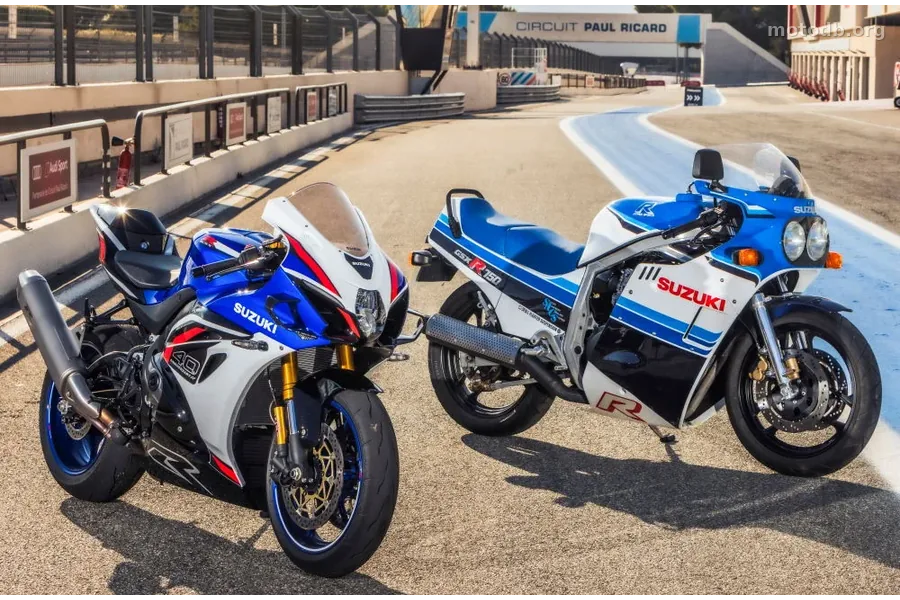
Visually, the GSX-R assumes its heritage without complex thought, perhaps even with too much restraint. The design is almost identical to that of 2017, with the only concessions to current trends being a more discreet silencer and a pair of subtle carbon winglets, inherited from the track version. For the rest, it’s the familiar silhouette, a little aging compared to the aerodynamic aggression of the Panigale or the CBR1000RR-R. The anniversary edition is adorned with three nostalgic liveries, including a superb blue and yellow evoking Alstare’s glorious Superbike days. But where is the color TFT screen? Its absence, on a motorcycle costing over 20,000 euros, is a surprising choice that makes it appear like a technological dinosaur compared to its rivals loaded with connectivity.
Where Suzuki doesn’t change a winning formula is on the chassis. The aluminum perimeter frame and reinforced swingarm are proven assets, as are the Showa BPF front and BFRC rear suspensions, standard equipment that still looks very good. The braking system, on the other hand, is starting to seriously show its age. The Brembo M4.32 calipers, while effective, are a decade old and cannot compete with the Stylema or M50s of the competition. They must contain a mass of 203 kg at full weight, an honorable weight but one that requires muscular stops. Fortunately, the Bridgestone RS11 tires offer exemplary grip and feedback, perfectly in line with the character of the bike.
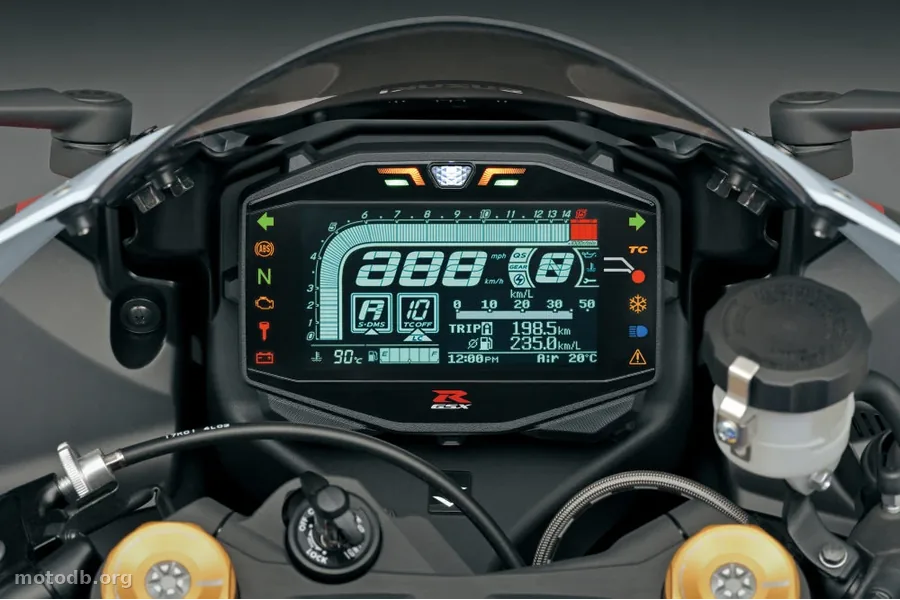
Electronics have received welcome updates, but without extravagance. The SIRS system is enriched with a wheelie control and slide control, while the cornering ABS, anti-stoppie, and bidirectional quickshifter are standard. It’s complete and effective, but lacks the sophistication and extensive customization offered by Ducati or BMW. This is the paradox of this 2026 GSX-R1000R: it is a compromise machine. It doesn't target the pure track rider looking for the latest winged machine, but rather the demanding sport touring rider, one who wants a living legend, reliable, with predictable handling and less expensive maintenance than an Italian. At 20,490 euros, it remains one of the most accessible Japanese hypersport bikes. Its return is good news, but it sounds like a swan song for a more analog approach to motorcycle sport, facing competition that has become resolutely digital and excessive. The legend is back, but the world has changed.
Standard equipment
- Assistance au freinage : ABS
- Nombre de mode de conduite : 3
- Taille de l'écran TFT couleur : 12,70 cm / 5 pouces
- ABS Cornering
- Centrale inertielle
- Aide au démarrage
- Aide à la manoeuvre
- Shifter
- Contrôle de traction
- Embrayage anti-dribble
- Winglets
- Indicateur de vitesse engagée
- Contrôle anti wheeling
- Contrôle de glisse
- Amortisseur de direction
- Aide au départ arrêté (Launch Control)
Practical info
- La moto est accessible aux permis : A
- Pays de fabrication : Japon
Indicators & positioning
Similar bikes
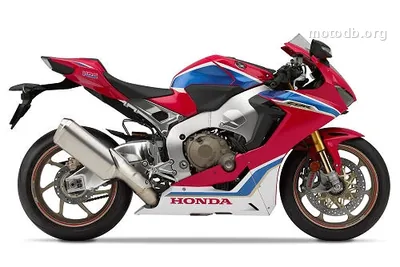
CBR 1000 RR Fireblade SP2
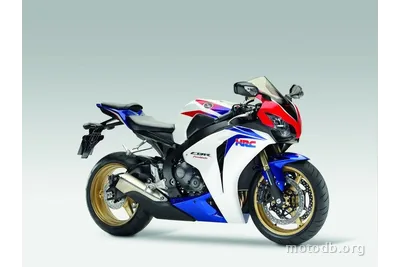
CBR 1000 RR PLAYBOY Replica
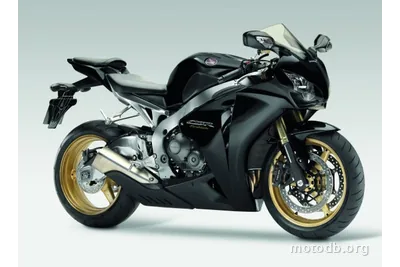
CBR 1000 RR Fireblade Limited Edition TT
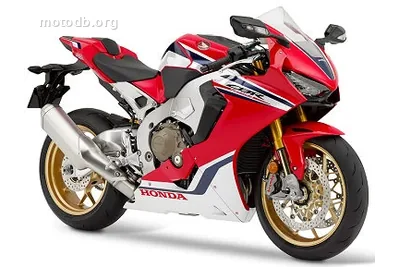
CBR 1000 RR Fireblade SP
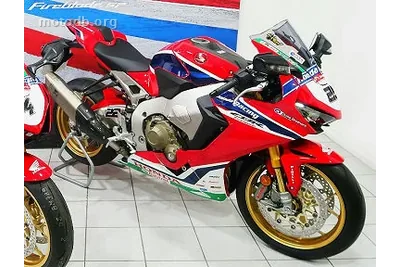
CBR 1000 RR Fireblade SP BSB replica
Reviews & comments
No reviews yet. Be the first to share your opinion!