Key performance
Technical specifications
Engine
- Displacement
- 779 cc
- Power
- 106.0 ch @ 10000 tr/min (78.0 kW)
- Torque
- 82.4 Nm @ 8000 tr/min
- Engine type
- 4 cylindres en ligne, 4 temps
- Cooling
- liquide
- Compression ratio
- 12 : 1
- Bore × stroke
- 68 x 53.6 mm
- Valves/cylinder
- 4
- Camshafts
- 2 ACT
- Fuel system
- Injection
Chassis
- Frame
- type Diamant en alu
- Gearbox
- boîte à 6 rapports
- Final drive
- Chaîne
- Front suspension
- Fourche téléhydraulique inversée Ø 43 mm, déb : 130 mm
- Rear suspension
- Mono-amortisseur Öhlins, déb : 130 mm
Brakes
- Front brakes
- Freinage 2 disques Ø 310 mm, étrier 4 pistons
- Rear brakes
- Freinage 1 disque Ø 267 mm, étrier 2 pistons
- Front tyre
- 120/70-17
- Front tyre pressure
- 2.50 bar
- Rear tyre
- 180/55-17
- Rear tyre pressure
- 2.90 bar
Dimensions
- Seat height
- 815.00 mm
- Fuel capacity
- 17.00 L
- Weight
- 211.00 kg
- New price
- 8 699 €
Overview
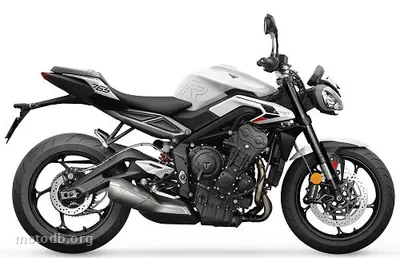
Yamaha had already exhausted the SP-R and Red Line veins before arriving at the R Line. The third special variant of the FZ8, this 2012 version looks more like a commercial styling exercise than a genuine mechanical evolution. This is not a gratuitous criticism, it is an observation: at €8,699 — €600 more than the base version — this 779 cc roadster must justify its premium one way or another.
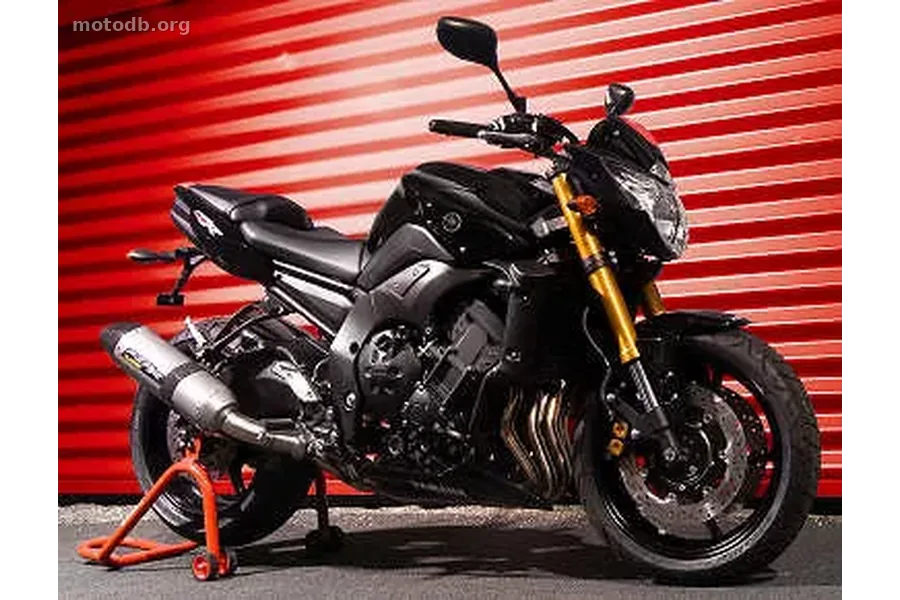
For the sonic argument, Yamaha turned to Akrapovic. The Slovenian silencer replaces the Lazer exhaust found on previous editions, and it is undoubtedly the most perceptible modification in daily use. An inline four-cylinder delivering 106 horsepower at 10,000 rpm deserves a voice to match, and Akrapovic knows how to work that material. The rest of the equipment consists of an engine belly pan, lateral crash protectors, a radiator cover, and a stripped-down license plate bracket. Useful, functional, but graphically unremarkable. No specific bodywork betrays the special edition at first glance, and that is a real shortcoming for a segment where visual identity matters as much as the spec sheet.
The real issue — the one that has sparked debate since the FZ8's launch — is the suspension. The motorcycle had been criticized from day one for dampers that were too permissive given its sporting ambitions: 106 hp, 82.4 Nm of torque at 8,000 rpm, an aluminum diamond frame, a 43 mm inverted fork, and yet dynamics that lacked precision when the machine was truly pushed. The R Line partially corrects this flaw with an Öhlins rear monoshock. It is a serious component that finally gives this roadster the mechanical coherence one expects from a sport-oriented 800 cc. The fork, however, remains stock. A shame, because completing the package with a front end to match would not have cost much more and would have made the overall proposition far more convincing.
The economic calculation is worth examining directly. The €600 surcharge corresponds roughly to the price of the shock absorber alone purchased as an aftermarket upgrade. Everything else — the belly pan, the crash protectors, the radiator cover, the Akrapovic — is therefore theoretically obtained for nothing. On that basis, the argument holds. But there is a more uncomfortable question lurking behind this reasoning: why does a motorcycle that ranked fifth in French sales in 2011 — with the production volumes that implies — only offer adequate damping on its limited editions? The Öhlins should be in the catalogue of every FZ8, not reserved for those willing to pay the surcharge.
This roadster is aimed at a rider with a few years of experience in the saddle, looking for a versatile motorcycle capable of devouring mountain roads without becoming a slab on the motorway, and who wants an engaging exhaust note without going through a custom shop. With its 211 kg fully fuelled and a seat height of 815 mm, the FZ8 R Line remains accessible to riders of average build. Facing a Kawasaki Z800 or a Suzuki GSR750, it plays in the same league. The R Line revolutionizes nothing, but it corrects what matters most.
Practical info
- La moto est accessible aux permis : A
Reviews & comments
No reviews yet. Be the first to share your opinion!