Key performance
Technical specifications
Engine
- Displacement
- 656 cc
- Power
- 85.0 ch @ 10500 tr/min (62.5 kW)
- Torque
- 61.8 Nm @ 8900 tr/min
- Engine type
- 4 cylindres en ligne, 4 temps
- Cooling
- liquide
- Compression ratio
- 11.5 : 1
- Bore × stroke
- 65.5 x 48.7 mm
- Valves/cylinder
- 4
- Camshafts
- 2 ACT
- Fuel system
- Injection
Chassis
- Frame
- Double berceau tubulaire en acier
- Gearbox
- boîte à 6 rapports
- Final drive
- Chaîne
- Front suspension
- Fourche télescopique Ø 41 mm, déb : 130 mm
- Rear suspension
- Mono-amortisseur, déb : 126 mm
Brakes
- Front brakes
- Freinage 2 disques Ø 310 mm, étrier 4 pistons
- Rear brakes
- Freinage 1 disque Ø 240 mm, étrier 2 pistons
- Front tyre
- 120/70-17
- Front tyre pressure
- 2.50 bar
- Rear tyre
- 160/60-17
- Rear tyre pressure
- 2.50 bar
Dimensions
- Seat height
- 770.00 mm
- Fuel capacity
- 19.00 L
- Weight
- 243.00 kg
- New price
- 5 749 €
Overview
Remember the mid-2000s, when versatile four-cylinder bikes filled dealer showrooms by the dozen. The Bandit S held the lead back then, and in 2009, Suzuki gave it a welcome polish without touching its DNA. The operation is more of a restyling than an overhaul, but it's enough to put the Japanese half-liter back in the running against rivals that have upped their game.
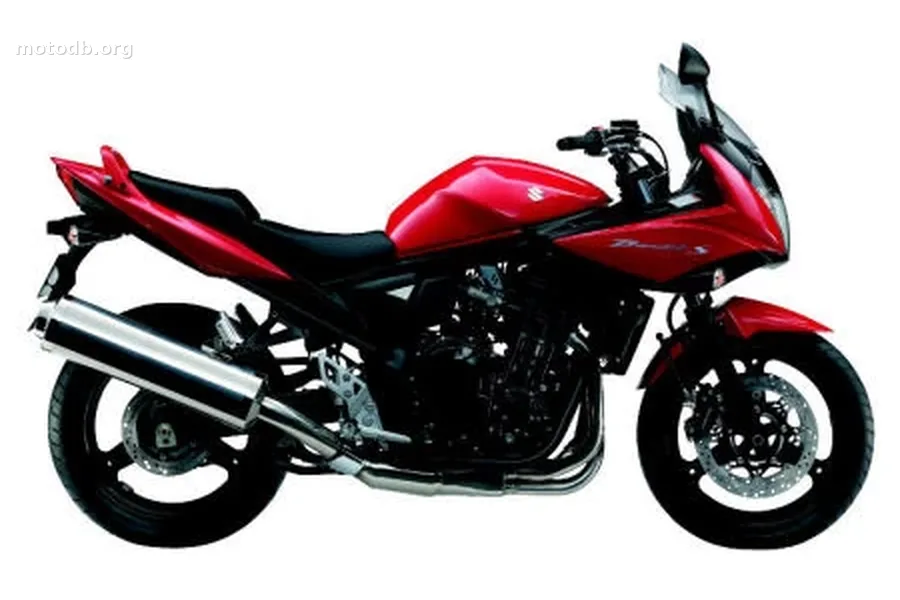
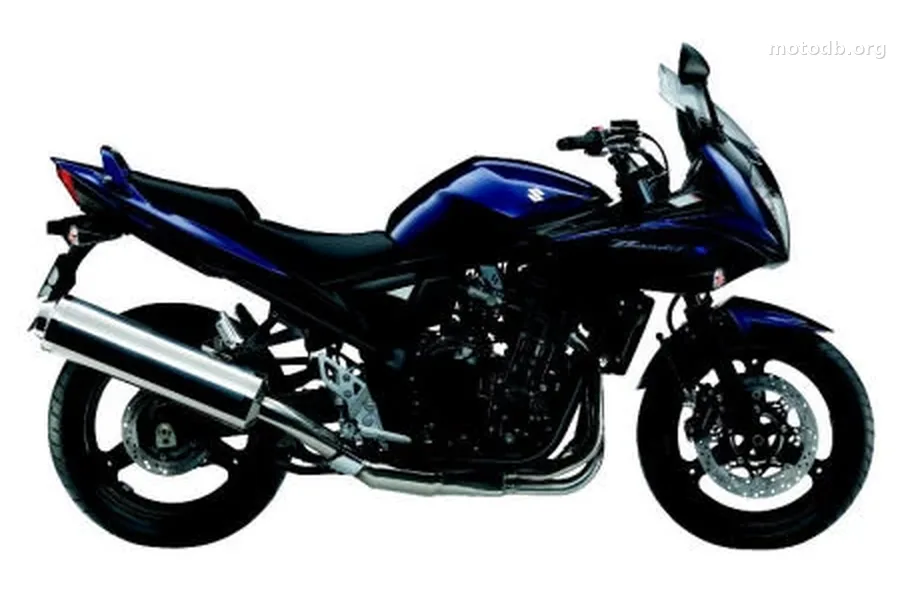
The cosmetic treatment focuses on the fork head, redesigned with a headlight borrowed from the GSX-R 1000 of the period, and on small integrated storage compartments that finally make the fairing useful day-to-day. The engine block gets a matte black finish that smooths out the somewhat rough look of previous model years, and the instrument cluster ditches its dated font in favor of a more legible display, gear position indicator included. The tank sides gain softer lines where the previous generation played the angular card. Nothing spectacular, just what was needed to stop looking outdated in the dealer's parking lot.
Beneath the fairing, no revolution to report, and that's logical. The liquid-cooled 656 cc inline-four was introduced in 2007, so there was no reason to replace it. It delivers 85 horsepower at 10,500 rpm and 61.8 Nm of torque peaking at 8,900 rpm, with an ultra-short bore and stroke of 65.5 x 48.7 mm that betrays its sporting lineage. The six-speed gearbox sends power to the rear wheel via chain, the 19-liter tank allows for genuine highway stages, and the announced top speed climbs to 210 km/h. Then there's the weight, 243 kg fully fueled, which reminds you that the Bandit remains an old-school bike, carved from solidity rather than lightness. The 41 mm telescopic fork and rear monoshock provide honest service without claiming to rival premium running gear. Under braking, the two 310 mm front discs bitten by four-piston calipers do the job, with optional ABS for those who want to sleep easy.
The question of price remains the crux of the matter in this segment. What is the price of the Suzuki GSF 650 Bandit S 2009 in France, asks the prospective buyer? The answer comes in at 5,749 euros at launch, a formidable entry ticket against a Kawasaki ER-6f that's livelier but pricier, and against the brand-new Yamaha XJ6 Diversion arriving at exactly the same moment with solid arguments. The following model year will stay on the same pricing base, and anyone wondering what the price of a Suzuki GSF 650 Bandit S 2010 in France is will find very similar valuations, a sign of a stable lineup. The Suzuki GSF 650 Bandit S 2010 benefits from exactly the same visual treatment, with no notable evolution. The Suzuki GSF 650 Bandit S 2012 will keep the recipe until its scheduled demise, and coming across a used Suzuki GSF 650 Bandit S from 2012 or a Suzuki GSF 650 Bandit S 2015 remains today a reasonable bet for anyone looking for a serious road bike without breaking the bank.
The target audience hasn't changed, and that's perhaps its greatest strength. With an accessible 770 mm seat, upright ergonomics and a torquey engine from low revs, the Bandit S speaks to the new license holder who wants a reassuring four-cylinder, to the traveler racking up kilometers without fuss, and to the veteran returning to motorcycling after a few years away. It will never thrill the track rider nor the hurried urbanite in search of lightness. But on a back road taken at a leisurely pace, with a partner on the back and panniers full, it remains one of the most rational propositions in the Japanese catalog of the era.
Standard equipment
- Assistance au freinage : ABS en option
Practical info
- Moto bridable à 34 ch pour l'ancien permis A MTT1 - pas garanti pour le permis A2
- La moto est accessible aux permis : A, A (MTT1)
Reviews & comments
No reviews yet. Be the first to share your opinion!