Key performance
Technical specifications
Engine
- Displacement
- 599 cc
- Power
- 123.0 ch @ 14000 tr/min (90.5 kW)
- Torque
- 66.7 Nm @ 12000 tr/min
- Engine type
- 4 cylindres en ligne, 4 temps
- Cooling
- liquide
- Compression ratio
- 12.9 : 1
- Bore × stroke
- 67 x 42.5 mm
- Valves/cylinder
- 4
- Camshafts
- 2 ACT
- Fuel system
- Injection Ø 38 mm
Chassis
- Frame
- périmétrique en aluminium
- Gearbox
- boîte à 6 rapports
- Final drive
- Chaîne
- Front suspension
- Fourche téléhydraulique inversée Ø 41 mm, déb : 120 mm
- Rear suspension
- Mono-amortisseur, déb : 130 mm
Brakes
- Front brakes
- Freinage 2 disques Ø 300 mm, fixation radiale, étrier 4 pistons
- Rear brakes
- Freinage 1 disque Ø 220 mm, étrier simple piston
- Front tyre
- 120/65-17
- Rear tyre
- 180/55-17
Dimensions
- Seat height
- 820.00 mm
- Fuel capacity
- 17.00 L
- Dry weight
- 164.00 kg
- New price
- 10 799 €
Overview
Do you remember the time when a 600 sportbike wasn’t just a thrill machine reserved for seasoned track riders? Kawasaki, with its first 636 in 2002, had already shown that performance and an accessible character could be combined. For 2005, the engineers at Kawasaki took this philosophy and injected it into a completely revised machine, the ZX-6R 636. The goal was clear: to create a sportbike that wouldn’t yell at you right out of the garage, but that could transform into a pure time-attack weapon as soon as the tarmac narrowed.
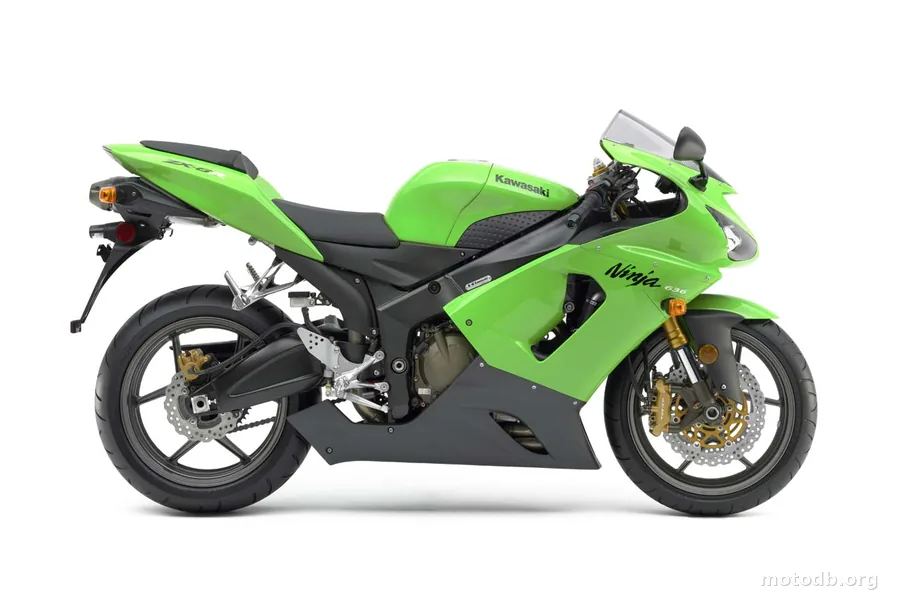
At first glance, the Ninja gained maturity. Farewell to the aggressive angles of the previous model, replaced by smoother, more elegant curves, inspired by its big sister, the formidable ZX-10R. The fairing is streamlined for aerodynamics, the rear is slimmer with its exhaust under the seat, and the whole thing exudes an impression of control and sophistication. It’s a long way from the raw and uninhibited look of before. It’s a motorcycle that wants to seduce, not just impress. With a seat height of 82 cm, it remains accessible, and the riding position, although sporty, avoids the torture of the wrist and back on long journeys. Kawasaki clearly sought to broaden its audience.
But don't be fooled, beneath this veneer of civility beats the heart of a warrior. The 636 cc engine is the house's main argument. With 130 horsepower announced, it comfortably outperforms strict 600 cc models like the RR version, which is limited to 123 hp for competition. The magic happens especially in its use. Thanks to its generous displacement and clever electronic management, it offers a rare flexibility in the low and mid-range. You negotiate a tight corner without having to play with the gear selector like a madman, which is appreciable in everyday use. But pass 10,000 rpm, and the character changes completely. The inline four-cylinder starts to howl, the power explodes and propels the motorcycle towards its final rev limit with a ferocious pull. It’s at that moment that its 164 kg dry weight is forgotten.
To handle this fury, the chassis has been redesigned. The perimeter aluminum frame is modified, the wheelbase shortened for agility, and the new swingarm seems straight out of a MotoGP stand. The 41 mm inverted fork and the single shock offer a firm, precise adjustment, which communicates every irregularity of the road without being brutal. At the braking point, the radial 4-piston calipers bite on 300 mm discs at the front with a power that can sometimes be a little abrupt, requiring delicacy. It’s a machine that forgives a lot, but still demands an attentive rider to exploit its immense potential.
So, who is this 2005 Ninja 636? It’s the intelligent sportbike. The one that understands that you don’t always live at 14,000 rpm. It is made for the rider who wants a motorcycle capable of shining on the track one weekend, without torturing him on the road to work on Monday. Faced with more radical competitors like the Honda CBR600RR or the Yamaha YZF-R6 of the time, the Kawasaki plays the card of versatility and character. It’s not the most extreme, but it’s probably the most complete and seductive of its generation. A real masterstroke that redefined what could be expected of a middle-cylinder sportbike.
Practical info
- La moto est accessible aux permis : A
Indicators & positioning
Similar bikes
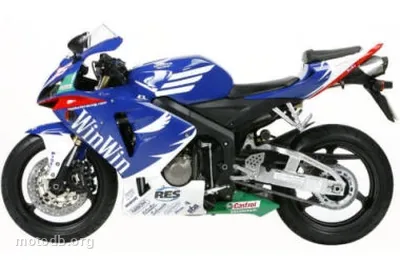
CBR 600 RR édition HANNspree Ten Kate
CBR 600 RR Replica MOVISTAR
Reviews & comments
No reviews yet. Be the first to share your opinion!