Key performance
Technical specifications
Engine
- Displacement
- 233 cc
- Power
- 18.0 ch @ 7000 tr/min (13.2 kW)
- Torque
- 18.6 Nm @ 5800 tr/min
- Engine type
- Monocylindre, 4 temps
- Cooling
- par air
- Compression ratio
- 9 : 1
- Bore × stroke
- 67 x 66 mm
- Valves/cylinder
- 2
- Camshafts
- 1 ACT
- Fuel system
- Injection Ø 32 mm
- Starter
- électrique
Chassis
- Frame
- double berceau en acier
- Gearbox
- boîte à 6 rapports
- Final drive
- Chaîne
- Front suspension
- Fourche téléhydraulique Ø 37 mm, déb : 117 mm
- Rear suspension
- 2 amortisseurs, déb : 95 mm
Brakes
- Front brakes
- Freinage 1 disque Nissin Ø 265 mm, étrier 2 pistons
- Rear brakes
- Freinage 1 disque Ø 220 mm, étrier 2 pistons
- Front tyre
- 90/90-18
- Rear tyre
- 110/90-17
Dimensions
- Seat height
- 740.00 mm
- Seat type
- Selle biplaces
- Fuel capacity
- 12.00 L
- Weight
- 133.00 kg
- Dry weight
- 133.00 kg
- New price
- 5 695 €
Overview
Meguro! A name rising under the sun. Some will readily think it’s a new Japanese player in the motorcycle world. Whereas it’s an iconic brand: nothing less than the cornerstone of Kawasaki’s first bikes.
Before that, Meguro was born in 1924 to produce transmissions. Then the company was one of the first in Japan to venture into motorcycle creation. The beginnings were with a 500 in 1937, the Z97. About thirty models followed before Kawasaki consigned all of this to the archives after absorbing the brand - in October 1964.
But in Akashi, the nostalgic spirit brought Meguro out of the boxes at the end of 2020. A K3 model cloned from the W 800 to revive the name founded by Nobuji Murata. Then a small S1 presented its wheels in 2023. A little waiting and here it is allowed to show its face here.
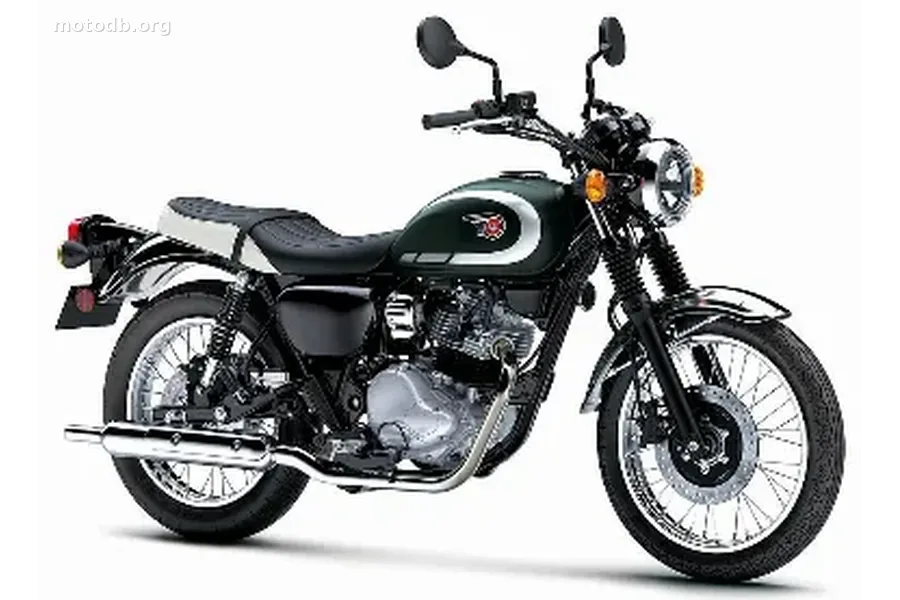
This little classic motorcycle is cute as can be, inspired by the 1964 250 SG. A true W 800 in miniature, resembling a runaway from a museum and the size of a 125. Moreover, it’s not much bigger. The Meguro S1 entrusts its work to a 233 cm3 single-cylinder engine. A displacement that is almost impossible to find around here.
With 18 horsepower and a mini torque of 1.9 mkg, the S1 claims no nervousness. It doesn’t want any, either. Look at its 1960s sweetheart look, its small air-cooled engine, with 2 valves, a compression ratio worthy of the post-war era, the single overhead camshaft, its slender exhaust line ending in a sausage shape. You’d almost want to take out a screwdriver to adjust the carb – Stop, there isn’t one, it’s fuel injection.
The Meguro is made for idling, as if time had stopped. A motorcycle on which you would put a time transporter to go and greet your great-grandparents and share a slice of chicory bread. But beneath its vintage appearance, the S1 obeys some modernism with disc brakes, ABS, and an LCD screen hidden in one of the two needle gauges.
Kawa offers its little darling a few elements to solidify the look, such as spoked wheels, the old 3D Meguro emblem on the sides of the tank, chrome trim and steel fenders. But what is this strange logo, resembling a 170? It's neither the speed nor the displacement. It is the name Meguro written in Japanese characters.
Around and underneath, the technical part is identical with the W 230. Engine, steel tube double cradle frame, 37 mm fork, double adjustable preload shocks, light weight at 143 kg and low seat height (only 740 mm) announce simplicity and lightness of driving.
Meguro was born 100 years ago; and disappeared exactly 60 years ago. History buffs have not forgotten the marriage with the compatriot. In the middle of the last century, the first Kawasakis were nothing other than slightly revised Meguros following an agreement between the two brands. Shortly after, Kawa buys Meguro and the adventure then truly begins until the successes that the brand has conquered throughout its history. Today, a volte-face: the Meguro S1 is a Kawasaki rebadged. It shares almost everything with the W 230 (little sister of the iconic classic W 800). We may not see many of them on the roads but everyone will surely stop to look at them; in dealerships or under balconies.
M.B - Manufacturer photos
Standard equipment
- Assistance au freinage : ABS
- Jantes à rayon
Practical info
- La moto est accessible aux permis : A, A2
Reviews & comments
No reviews yet. Be the first to share your opinion!