Key performance
Technical specifications
Engine
- Displacement
- 1721 cc
- Power
- 71.0 ch @ 4500 tr/min (52.2 kW)
- Torque
- 135.3 Nm @ 2400 tr/min
- Engine type
- Bicylindre en V à 45°, 4 temps
- Cooling
- par air
- Compression ratio
- 9 : 1
- Bore × stroke
- 100,73 x 107.95 mm
- Valves/cylinder
- 2
- Fuel system
- Injection
Chassis
- Frame
- simple berceau tubulaire en acier
- Gearbox
- boîte à 6 rapports
- Final drive
- Courroie
- Front suspension
- Fourche téléhydraulique Ø 41 mm, déb : 108 mm
- Rear suspension
- Mono-amortisseur, déb : 73 mm
Brakes
- Front brakes
- Freinage 2 disques Ø 292 mm, étrier 4 pistons
- Rear brakes
- Freinage 1 disque Ø 292 mm, étrier 2 pistons
- Front tyre
- 130/90-16
- Rear tyre
- 150/80-16
Dimensions
- Seat height
- 708.00 mm
- Fuel capacity
- 21.00 L
- Dry weight
- 330.20 kg
- New price
- 30 000 €
Overview
Reviving a brand is one thing. Giving it back a soul is another. Indian achieved both when it relaunched its Chief lineup in 2012, after decades of absence that had left Harley-Davidson reigning unchallenged over American custom motorcycles. The Classic, the entry-level model of this renaissance, arrives with 1720 cc beneath a 21-liter tank and a clearly stated ambition: to remind the world who invented the custom motorcycle before anyone else.
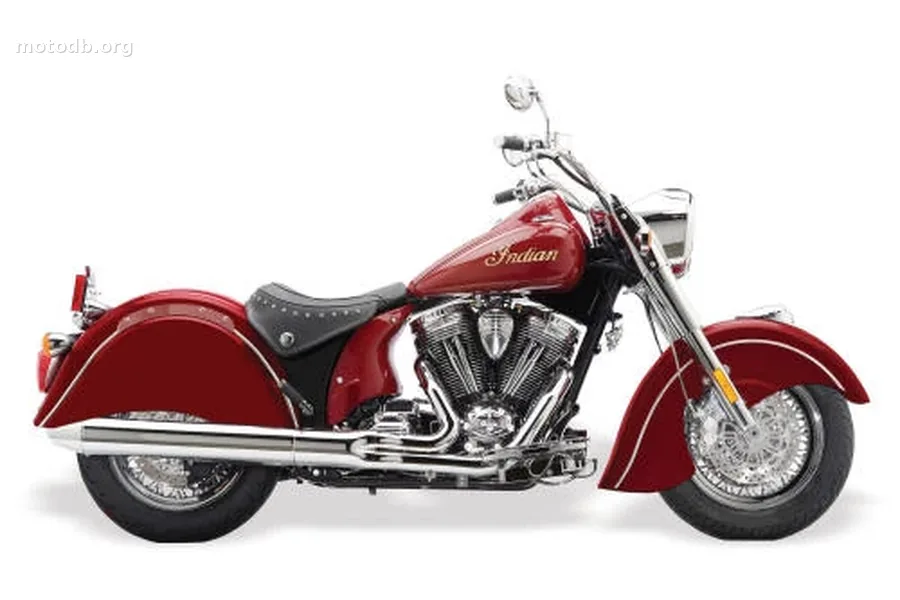
From the first glance, the machine commands attention through sheer scale. 330 kilograms dry, a low stance that hugs the asphalt, a seat height of 708 mm that invites you to settle into the scenery rather than pass through it. This isn't a motorcycle you climb onto — it's one you install yourself into. The 45-degree V-twin, named Thunderstroke in its definitive form but already just as impressive here, immediately draws the eye. The cooling fins, the visible pushrods, the carefully arranged chrome: all of it forms a unit that gives the impression of a museum engine put on open-air display, fully operational. Compared to any liquid-cooled twin, this one wins hands down on visual terms, even if its 71 horsepower at 4,500 rpm confirms that setting lap records isn't the point.
The real argument for this engine is its torque. 135 Nm available from 2,400 rpm makes itself felt before you even glance at the rev counter. You pull sixth gear early, you cruise on muscle memory, and the six-speed gearbox combined with belt drive delivers a smooth, jerk-free progression. The claimed top speed of 150 km/h means very little in this context. The intended rider has no interest in overtaking in the fast lane of a highway; he wants to feel the weight of the machine through a corner, hear the engine rumble at low revs, and own the road.
Where the Indian Chief Classic becomes harder to defend is against its price tag. Thirty thousand euros for what amounts to the entry-level model of a relaunched brand, with no particular equipment and a fit and finish that still has room to improve, gives one pause. A Harley-Davidson Softail Heritage from the same era, produced in far greater volumes, displays comparable assembly quality at a price that is often lower. The "handcrafted" and "small-batch" argument has its limits when the buyer is asked to cross that threshold without any additional tangible compensation.
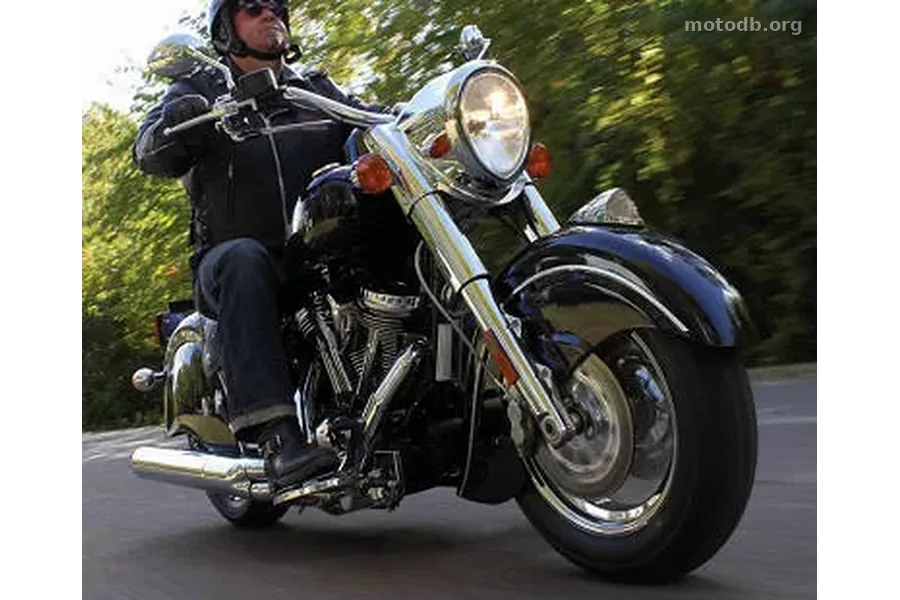
The Chief Classic speaks to a very specific profile: the rider who values the symbol as much as the machine, who wants to carry a name heavy with history and not encounter his own model at every red light. For that audience, the motorcycle delivers on its promise with a strong visual personality and a riding experience consistent with its ambitions as an authentic touring custom. For everyone else, at 30,000 euros, the gap between what you receive and what you pay leaves a considerable margin for disappointment.
Practical info
- La moto est accessible aux permis : A
Reviews & comments
No reviews yet. Be the first to share your opinion!