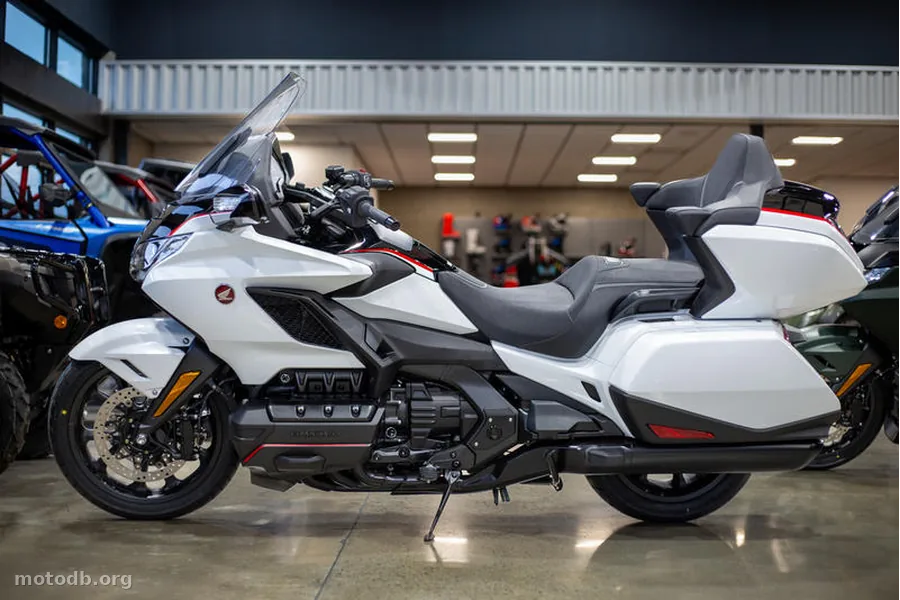
Key performance
Technical specifications
Engine
- Displacement
- 1833 cc
- Power
- 126.0 ch @ 5500 tr/min (92.7 kW)
- Torque
- 169.7 Nm @ 4500 tr/min
- Cooling
- liquide
- Compression ratio
- 10.5 : 1
- Bore × stroke
- 73 x 73 mm
- Valves/cylinder
- 4
- Camshafts
- 1 ACT
- Fuel system
- Injection Ø 50 mm
- Starter
- électrique
- Euro standard
- Euro 5+
Chassis
- Frame
- Double poutre alu, type Diamant
- Gearbox
- boîte à 7 rapports
- Final drive
- Cardan
- Front suspension
- Fourche quadrilatère double bras longitudinaux
- Rear suspension
- Mono-amortisseur
Brakes
- Front brakes
- Freinage 2 disques Ø 320 mm, fixation radiale, étrier 6 pistons
- Rear brakes
- Freinage 1 disque Ø 316 mm, étrier 3 pistons
- Front tyre
- 130/70-18
- Front tyre pressure
- 2.50 bar
- Rear tyre
- 200/55-16
- Rear tyre pressure
- 2.80 bar
Dimensions
- Seat height
- 745.00 mm
- Seat type
- Selle biplaces
- Fuel capacity
- 21.00 L
- Weight
- 393.00 kg
- New price
- 37 999 €
Overview
Imperturbable, sovereign, the Goldwing Tour soars through its career without faltering. In 2025, it had the opportunity to improve the intercom system and speakers, to interact with Apple CarPlay and Android Auto via Wi-Fi, and to pass Euro5+ with new settings in the ECU.
The Goldwing had been running for quite a few years without an automatic tire pressure monitoring system. The 2023 model year addressed this by installing it as standard. Not necessarily essential, but still mandatory given the standing of this noble vessel. The clientele is more attentive to tranquility and driving comfort, with even more comfort. It seems to be written in the Goldwing’s genetic code. The passenger will be the most satisfied with the small evolutions since 2021. With a backrest that tilts a few degrees rearward, they relax even more, in a cruising-armchair mode.
You can also stuff the trinkets you brought back from your travels, with 11 liters of additional space in the top-case. An Alcantara/synthetic leather seat complements the on-board tranquility.
Vessels traverse space and time, taking care to improve in small doses over the years. In 2020, even more comfort was added to the Goldwing. With new suspension settings, injection, and the DCT gearbox revised for smoother operation at low speed, and larger passenger grab handles, life on board tends even more towards a Pullman experience. LED fog lights are now standard, embedded in front of the cylinder banks. An additional USB port is also invited into the crew. Extra cream for this majesty, which seems to be catching up with the younger generation.
The Honda 1800 Goldwing has weathered the passage of middle age very well. After all that time gaining importance, comfort, displacement, and bulk, the sumptuous touring machine has treated itself to a touch of youthfulness. Rarely has a lady wanted to gain effort and efficiency so much. Slimmer, less imposing, more powerful, infinitely more technological, the Goldwing is setting course for a destiny worthy of it.
We have seen on the Goldwing Tour the array of (very) numerous improvements made by Honda. Namely, the more compact engine with still 6 cylinders but now 4 valves per cylinder, the gripping front double-triangle suspension, the Riding Modes, the modified cargo capacity, etc... We will return to that. But for now, let's focus on this higher-end, more senatorial version of the GL. And the touring machine reaches here the ultimate in driving comfort with the adoption of a 3rd generation DCT robotized gearbox.
This Goldwing is the result of a long development. And this has prioritized the DCT gearbox, in order to make it a perfect integration of its GT spirit. The result speaks for itself with pride. This automatic sequential gearbox has 7 ratios, while being lighter than the 5-ratio mechanical gearbox of the previous model. Let's recall that the Honda DCT has a double-clutch system: when one gear is engaged, another is already ready to be engaged. While driving, three modes are available. The most recreational but certainly the least used is manual (MT). The driver then shifts gears at will with controls on the left handlebar. Next is mode D, where the gearbox manages the transmission all by itself, purring the rhythm for an efficient pleasure/consumption ratio. The system can also "feel" variations in driving and adapts accordingly. For a bit more dynamism, mode S is a good option. It is categorized into 3 sub-modes – S1, S2, S3. The electronics then allow the engine to rev higher on acceleration and downshift to offer more engine braking. Each sub-mode acts with a more marked dynamism than the other. To be chosen according to your mood. Precision: whether in D or S mode, you can intervene whenever you want to shift gear and thus regain control of the gearbox. Just press + or -. After a certain time and an analysis by the system, the latter regains control automatically.
For this gearbox, Honda has prioritized smoothness and comfort as much as possible. You might wonder if they didn't want to imitate a flying carpet. At the mechanical level, the first gears are close together to limit jolts. The higher ratios are more spaced out to calm the engine speed. Then, the Riding Modes intervene in the management of the clutch.
- The "Tour" mode gives a direct engine response, suspensions in "Standard" mode, as well as the braking distribution and the gear shifting over a wide range of engine speed. - In "Sport" mode, it is more lively. The response to the throttle is amplified. The suspensions stiffen, the braking is more important on the rear, and the gearbox gets excited: the gear shifting is more direct, with an appetite for mid and high engine speeds. - Calm with the "Econ" mode. The suspensions and braking are in "Standard" mode, while the response to the throttle is softer. As for the transmission, it engages progressively, and more focused on the low and mid engine speeds. - Rain, drizzle, slick!? The "Rain" mode calms everything down with a throttle/engine ratio oscillating from one-third to one-half, "Standard" braking, softened damping, and a clutch set to "progressive", with gear shifts distributed between the low and high engine speeds and a selection also progressive.
And there is still a bonus. Surprising as many aspects of this Goldwing are. Unlike other versions, the DCT is equipped with the ISG (Integrated Starter Generator). Let's keep it simple: they combined the alternator and the starter into a single component. It is lighter, and thanks to the automatic engine shut-off system after a prolonged stop, it allows for limousine-like starts. Look: you are at a red light, and after 3 seconds, the 6-cylinder shuts down. An action on the throttle, it wakes up, and generates a hydraulic pressure that acts on the clutch. This reduces the time it takes for the latter to be engaged. At the same time, the ride-by-wire action is calibrated to gradually open the throttles. And that’s how you render takeoffs even smoother.
Although it has been balanced for a long time, the Goldwing must contend with a formidable adversary: weight. Well, OK, it has lost a lot since the last time. 22 kilos lighter in this version. But 383 remain on the scale. Which places it in a fairly particular category, where the K 1600 GTL, 1800 Roadmaster, 1900 Road Glide and other Limited compete: the "maneuver-this-mass-at-a-stop-good-lord-it’s-heavy". Some have a reverse gear. On the Goldwing Tour as well. On the Goldwing Tour DCT, it goes even further; there is the "Pedestrian" function. No need to engage a gear, the system handles everything. A +/- button on the left handlebar allows the machine to move at 1.8 km/h in forward gear and 1.2 km/h in reverse.
A major advancement in transmission for the 1800 Goldwing is the adoption of this DCT gearbox. Another specificity is the installation of an airbag. As before, Honda is the only motorcycle to offer this equipment. Almost all other technologies are found with the competition but that won’t spoil our pleasure. We have cited a few of them at the beginning. Let's not forget the hill start assist, the superb multi-screen dashboard including a large 7-inch color TFT screen, the Smart Key keyless start, the Apple CarPlay multimedia management, the cruise control, the traction control, the heated grips, the electrically adjustable windshield, the on-board sound system with radio and Bluetooth, the GPS, the electronically adjustable suspensions, and then, and above all, and finally...
The large 1833 cm3 with a flat-mounted 6-cylinder engine. 3 on each side to box the others, then a beautiful response, a general lightening, a reduced footprint and appetite, an optimized potential and additional watts. Particularly, roundness, melody, an inimitable presence – emotions far more important than the 126 horsepower available. The torque will also interest us more, with its imposing 17.3 mkg.
The majestic vessel of Honda catapults itself with a bolstered sovereignty thanks to a wealth of technology. The DCT perfects a cruising symphony, where kilometers cannot compete, whatever their number. Heavy-duty riders will regret the reduced capacity for luggage (121 liters today), and the protection that is announced excellent when it was imperial on the old one. The lot of arguments in favor of the new generation is more than convincing to erase the rebuffs. His Majesty Goldwing now has only one thing to fear. That the destination be of quality and retain its crew – she who aspires only to ride...
M.B - Photos manufacturer
Standard equipment
- Assistance au freinage : ABS + frein de parking
- Nombre de mode de conduite : 4
- Volume de rangement : 121 litres
- Taille de l'écran TFT couleur : 17,78 cm / 7 pouces
- Jantes aluminium
- Indicateur de vitesse engagée
- Régulateur de vitesse
- Boîte automatique
- Freinage combiné
- Radio
- Bluetooth
- GPS
- Prise USB
- Aide au démarrage en côte (Hill Hold Control)
- Marche arrière
- Démarrage sans clé
- Poignées chauffantes
- Pare brise réglable électriquement
- Suspensions réglables électroniquement
- Contrôle de couple
- Valises
- Surveillance de la pression des pneus
Practical info
- La moto est accessible aux permis : A
- Pays de fabrication : Japon
Indicators & positioning
Similar bikes
1830 Challenger Venum
1830 Roadmaster Limited / Dark Horse
1830 Challenger 125th Anniversary Edition
Reviews & comments
No reviews yet. Be the first to share your opinion!