Key performance
Technical specifications
Engine
- Displacement
- 998 cc
- Power
- 107.0 ch @ 9000 tr/min (78.7 kW)
- Torque
- 96.1 Nm @ 6500 tr/min
- Engine type
- 4 cylindres en ligne, 4 temps
- Cooling
- liquide
- Compression ratio
- 11:1
- Bore × stroke
- 75 x 56.5 mm
- Valves/cylinder
- 4
- Camshafts
- 2 ACT
- Fuel system
- Injection Ø 36 mm
Chassis
- Frame
- Mono-backbone simple poutre en acier
- Gearbox
- boîte à 6 rapports
- Final drive
- Chaîne
- Front suspension
- Fourche téléhydraulique Ø 41 mm, déb : 120 mm
- Rear suspension
- Mono-amortisseur, déb : 120 mm
Brakes
- Front brakes
- Freinage 2 disques Ø 296 mm, étrier 4 pistons
- Rear brakes
- Freinage 1 disque Ø 240 mm, étrier 2 pistons
- Front tyre
- 120/70-17
- Front tyre pressure
- 2.50 bar
- Rear tyre
- 160/60-17
- Rear tyre pressure
- 2.90 bar
Dimensions
- Seat height
- 795.00 mm
- Fuel capacity
- 19.00 L
- Weight
- 245.00 kg
- New price
- 9 790 €
Overview
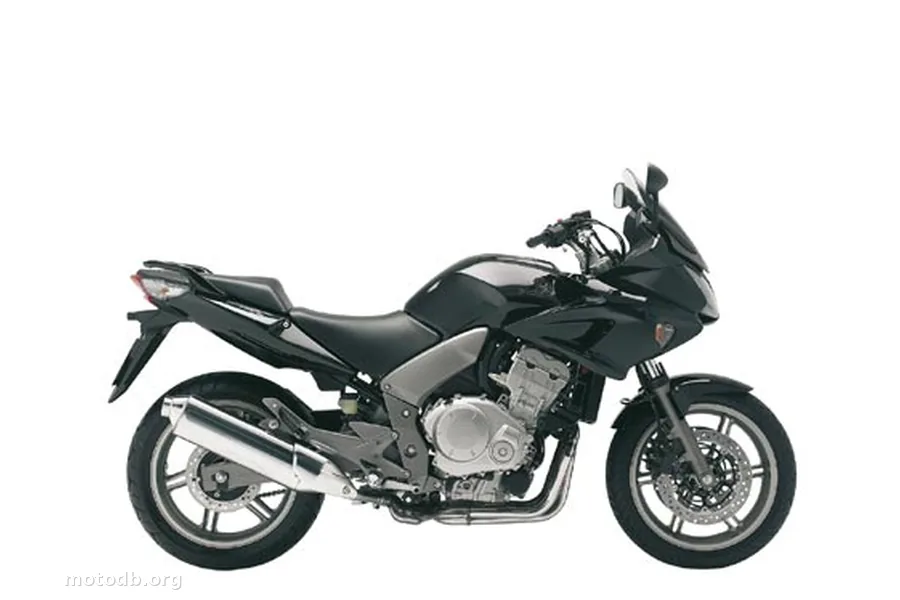
Damned! A 600-class CBF... It's reductive, but that's likely the first thought that will come to mind when discovering the 1000 CBF. And how could it be otherwise? The 1000 reprises the same concept, the same bodywork, the same look, and the same technical solutions.
With this machine, Honda navigates almost counter to the competition. Everywhere are created machines with a marked and fiery personality—BMW K 1200 R, Benelli 1130 TnT, Yamaha FZ1, Kawasaki Z 1000, Ducati S4R, MV-Agusta 910 Brutale, etc.—The winged manufacturer has chosen to "develop a simple, versatile, and accessible machine for everyone, in the image of the CBF 600"; according to the press kit. That is a good motorcycle with a large engine but not exuberant or impressive.
In this spirit, the design of the 1000 CBF is both simple and elegant, with soothing contours and somewhat mischievous eyes. Lacking sex appeal, it inspires serenity and quiet strength. Its headstock fairing, very stylistically close to the 600 version, is equipped with an adjustable bubble on 2 positions and 40 mm. Protection is announced as very high level. There is a GT feel to this roadster, which also offers an adjustable seat on 3 heights as well as a handlebar that can be positioned on more or less 10 mm.
There are no innovations in the chassis area if not that the "mono-backbone" frame type seems to be becoming the standard for roadsters at Honda. After being installed on the Hornet 600 and 900, then on the CB 500 and 600, this structure now colonizes the CBF 1000. Composed of a main steel beam to which the engine is anchored as a stiffening element, this element plays an important role in the compactness of this machine; its dimensions being very close to the CBF 600. The trend of oversized peripherals does not reach this large roadster. No 50 mm inverted fork or tires as wide as car wheels. The CBF is equipped with a conventional 41 mm fork, a steel swingarm, a pro-link H.M.A.S shock absorber, and tires of very reasonable dimensions: 120 at the front and 160 at the rear. It doesn’t throw as much, but you find agility and wallet-friendliness. The braking is also quite standard, except in the "Deluxe" version of the CBF—it is then equipped with ABS and CBS.
What kind of engine is needed to equip a roadster today? Yes, a hypersport engine. The Z 1000 borrowed the oversquare engine from the ZX-9R and produced nearly 140 hp; the Yamaha FZ1 recovered the engine from the R1 and announces 150 hp; the CBF 1000 gets the 4-cylinder from the CBR Fireblade and announces... 100 hp. Honda has chosen to heavily castrate the power (-40% of watts) to prioritize torque and sensations at low and mid-range. It's not stupid to offer only 100 horsepower, because who can boast of being able to truly exploit all the available power on today's machines... a vast debate! Will the market follow? To reduce power and make torque available earlier, numerous modifications have transformed the 998 cm3. They primarily affect the following elements: reduced diameter intake and exhaust ducts, modified ignition timing, second injector ramp removed, new air control valve... and various adjustments, which brings us to a torque of 9.8 mkg at 6,500 rpm. The CBR 1000 RR delivers its own 2,000 rpm higher; but it is 11.7 mkg... Constructed from stainless steel, the double exhaust line contains numerous anti-pollution elements that allow the CBF 1000 to pass Euro 3 standards without affecting performance.
Tactical choice or dangerous choice from Honda for its large roadster!? If many were waiting for a Hornet 1000, it is not without reason. Faced with the new FZ1 and other muscular roadsters, the solution to develop a machine "just right" turns out to be judicious. From a usage point of view, without a doubt. But we have known for a long time that motorcycles are a matter of passion, not really of reason...
M.B - photos manufacturer
Standard equipment
- Assistance au freinage : ABS de série
Practical info
- La moto est accessible aux permis : A
Reviews & comments
No reviews yet. Be the first to share your opinion!