Key performance
Technical specifications
Engine
- Displacement
- 1584 cc
- Power
- 73.0 ch @ 5300 tr/min (53.7 kW)
- Torque
- 122.6 Nm @ 3500 tr/min
- Engine type
- Bicylindre en V à 45°, 4 temps
- Cooling
- par air
- Compression ratio
- 9.2 : 1
- Bore × stroke
- 95.3 x 111.1 mm
- Valves/cylinder
- 2
- Fuel system
- Injection
Chassis
- Frame
- Double berceau tubulaire en acier
- Gearbox
- boîte à 6 rapports
- Final drive
- Courroie
- Front suspension
- Fourche telescopique Ø 41 mm, déb : 129 mm
- Rear suspension
- 2 amortisseurs sous le moteur, déb : 103 mm
Brakes
- Front brakes
- Freinage 1 disque Ø 292 mm, étrier 4 pistons
- Rear brakes
- Freinage 1 disque Ø 292 mm, étrier 2 pistons
- Front tyre
- 140/75-17
- Front tyre pressure
- 2.48 bar
- Rear tyre
- 200/55-17
- Rear tyre pressure
- 2.90 bar
Dimensions
- Seat height
- 645.00 mm
- Fuel capacity
- 18.90 L
- Weight
- 330.00 kg
- Dry weight
- 313.00 kg
- New price
- 20 795 €
Overview
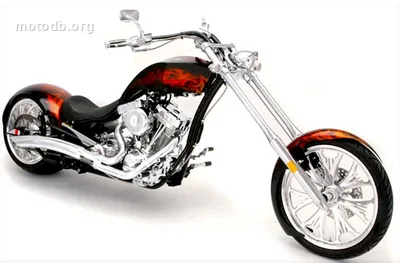
The silhouette needs no introduction. This block of chrome steel and aluminum, with its full wheels and wheelbase that would make a cruise ship blush, is undoubtedly the most recognizable motorcycle in the world. And yet, people often misjudge it. Contrary to what the heads-up display in *Terminator* shows, the motorcycle featured in the film is actually a 1991 Harley-Davidson FLSTF Fat Boy. This confusion itself is a tribute to its iconic status, a machine so ingrained in popular culture that it transcends mere mechanics.
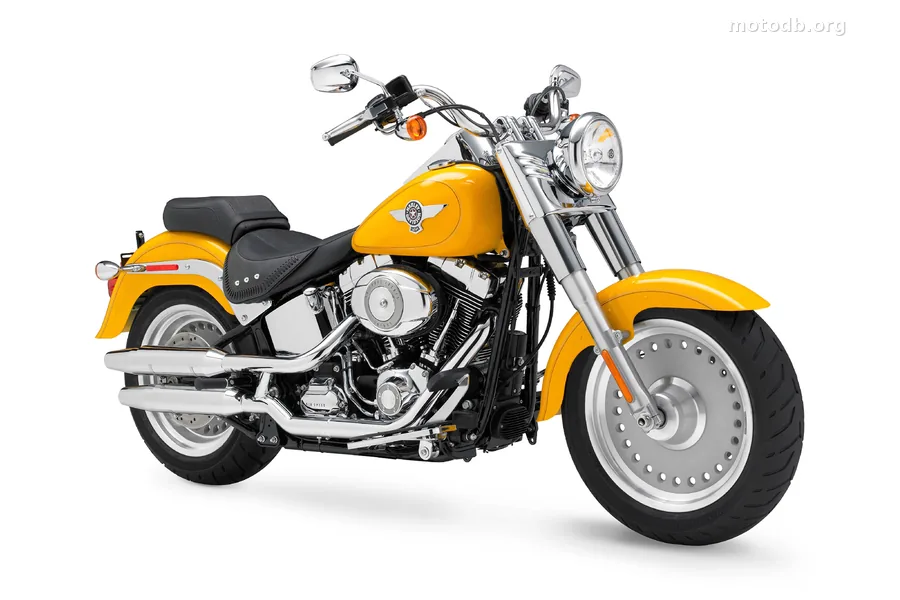
Saddling it, the paradox begins. You straddle 330 kilograms all fueled up, place your feet on footrests as wide as surfboards, and grasp a handlebar that seems sized for a semi-trailer. The seat height of 645 mm is derisively low, as if the motorcycle sinks into the pavement. Then you fire up the Twin Cam 96 of 1584 cm3, and the large 45° V-twin begins to tremble with that characteristic nonchalance. The announced power of 73 horsepower seems modest on paper, but what counts here is the torque wave. These 122.6 Nm available from 3500 rpm are the real currency of the Fat Boy. It doesn’t start, it wrenches itself free. It doesn’t accelerate, it displaces the air in front of it.
On the road, the experience is in keeping with its look: massive and theatrical. The belt drive is of exemplary smoothness, and the six-speed gearbox allows you to find a peaceful rev for swallowing up the kilometers. The handling, revised in the early 2000s, is worthy of the name for a custom of this size. It traces its straight line with the authority of a cruise ship, insensitive to gusts. But ask it to change direction with liveliness, and you will understand the meaning of the word "compromise." The 200 mm of rubber at the rear and the imposing weight make tight turns a bodybuilding exercise. The footpegs scrape with disconcerting ease, gently reminding you that this machine is made for boulevards, not hairpin mountain passes.
Compared to an Indian Chief or a Star Boulevard, the Fat Boy S, in its later versions, remains the gold standard of the heavy custom. Its flaw is its quality: it is absolutely faithful to its concept. It is a motorcycle for those seeking a presence, an atmosphere, a mechanical purr that is a sonic signature. For the globetrotter who prefers the sensation of power to the maximum speed figure (capped around 160 km/h), and for whom every trip is a small parade. It is a monument on two wheels, sometimes cumbersome, often illogical, but undeniably charismatic. You don’t buy it for its performance, but to become, for the duration of a ride, the person who goes with it.
Practical info
- La moto est accessible aux permis : A
Indicators & positioning
Similar bikes
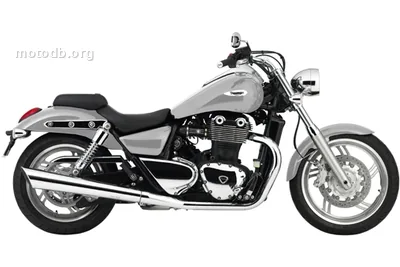
Thunderbird 1600
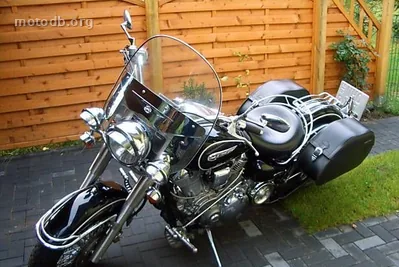
XV 1600 A Wild Star
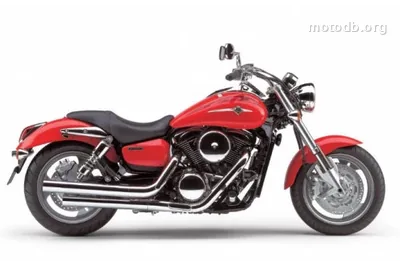
VN 1600 Mean Streak
Reviews & comments
No reviews yet. Be the first to share your opinion!