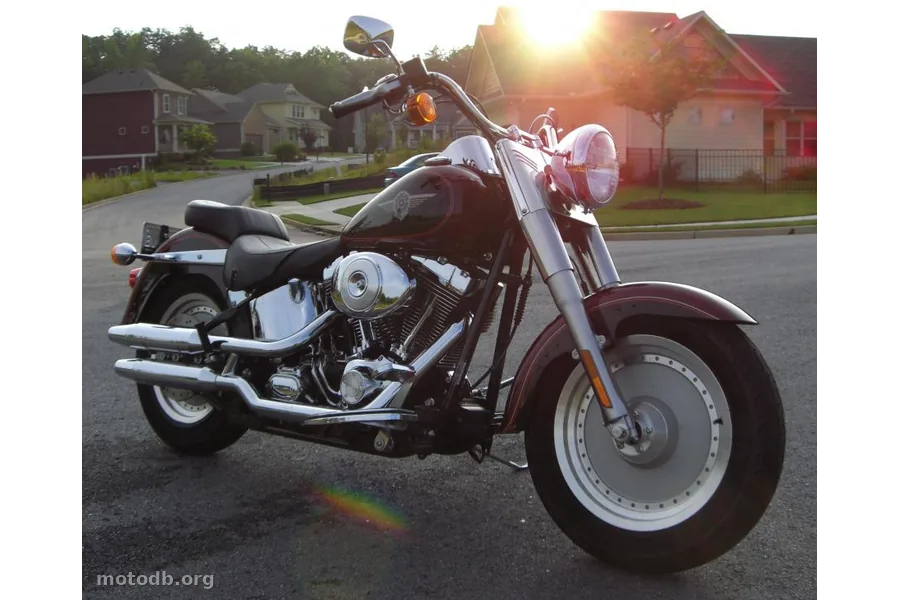
Key performance
Technical specifications
- Displacement
- 1584 cc → 1449 cc
- Power
- 73.0 ch @ 5300 tr/min (53.7 kW) → 63.0 ch @ 5200 tr/min (46.0 kW)
- Torque
- 122.6 Nm @ 3500 tr/min → 106.0 Nm @ 3500 tr/min
- Engine type
- Bicylindre en V à 45°, 4 temps → V2, four-stroke
- Cooling
- par air → Air
- Compression ratio
- 9.2 : 1 → 8.9:1
- Bore × stroke
- 95.3 x 111.1 mm → 95.3 x 101.6 mm (3.8 x 4.0 inches)
- Valves/cylinder
- 2 → 4
- Fuel system
- Injection → Carburettor
- Valve timing
- — → Overhead Valves (OHV)
- Lubrication
- — → Dry sump. Internally mounted, crank driven gerotor pressure and dual scavenge pump.
- Ignition
- — → Single-fire, non-wasted, map-controlled spark ignition
- Starter
- — → Electric
- Gearbox
- boîte à 6 rapports → 5-speed
- Final drive
- Courroie → Belt (final drive)
- Clutch
- — → Wet 9-plate
- Front suspension
- Fourche telescopique Ø 41 mm, déb : 129 mm → 41.3 mm
- Rear suspension
- 2 amortisseurs sous le moteur, déb : 103 mm → Hidden, horizontal-mounted, coil-over shock
- Front wheel travel
- — → 130 mm (5.1 inches)
- Rear wheel travel
- — → 109 mm (4.3 inches)
- Front brakes
- Freinage 1 disque Ø 292 mm, étrier 4 pistons → Single disc. Four-piston calipers.
- Rear brakes
- Freinage 1 disque Ø 292 mm, étrier 2 pistons → Single disc. Four-piston calipers.
- Front tyre
- 140/75-17 → MT90-B16
- Rear tyre
- 200/55-17 → 150/80-B16
- Seat height
- 645.00 mm → 647.00 mm
- Wheelbase
- — → 1638.00 mm
- Ground clearance
- — → 130.00 mm
- Length
- — → 2395.00 mm
- Fuel capacity
- 18.90 L → 19.00 L
- Weight
- 330.00 kg → 324.00 kg
- Dry weight
- 313.00 kg → 302.00 kg
- New price
- 20 795 € → 20 445 €
Engine
- Displacement
- 1449 cc
- Power
- 63.0 ch @ 5200 tr/min (46.0 kW)
- Torque
- 106.0 Nm @ 3500 tr/min
- Engine type
- V2, four-stroke
- Cooling
- Air
- Compression ratio
- 8.9:1
- Bore × stroke
- 95.3 x 101.6 mm (3.8 x 4.0 inches)
- Valves/cylinder
- 4
- Fuel system
- Carburettor
- Valve timing
- Overhead Valves (OHV)
- Lubrication
- Dry sump. Internally mounted, crank driven gerotor pressure and dual scavenge pump.
- Ignition
- Single-fire, non-wasted, map-controlled spark ignition
- Starter
- Electric
Chassis
- Frame
- Double berceau tubulaire en acier
- Gearbox
- 5-speed
- Final drive
- Belt (final drive)
- Clutch
- Wet 9-plate
- Front suspension
- 41.3 mm
- Rear suspension
- Hidden, horizontal-mounted, coil-over shock
- Front wheel travel
- 130 mm (5.1 inches)
- Rear wheel travel
- 109 mm (4.3 inches)
Brakes
- Front brakes
- Single disc. Four-piston calipers.
- Rear brakes
- Single disc. Four-piston calipers.
- Front tyre
- MT90-B16
- Front tyre pressure
- 2.48 bar
- Rear tyre
- 150/80-B16
- Rear tyre pressure
- 2.90 bar
Dimensions
- Seat height
- 647.00 mm
- Wheelbase
- 1638.00 mm
- Ground clearance
- 130.00 mm
- Length
- 2395.00 mm
- Fuel capacity
- 19.00 L
- Weight
- 324.00 kg
- Dry weight
- 302.00 kg
- New price
- 20 445 €
Overview
You remember the scene. Arnold Schwarzenegger, in Terminator 2, takes a motorcycle and disappears into the night. The heads-up display in the film indicates a Harley-Davidson Fat Boy, but unlike what the futuristic interface shows, the physical machine used on set was a 1991 Harley-Davidson FLSTF Fat Boy. This cinematic confusion didn't change anything, it simply cemented this massive silhouette in pop culture forever.
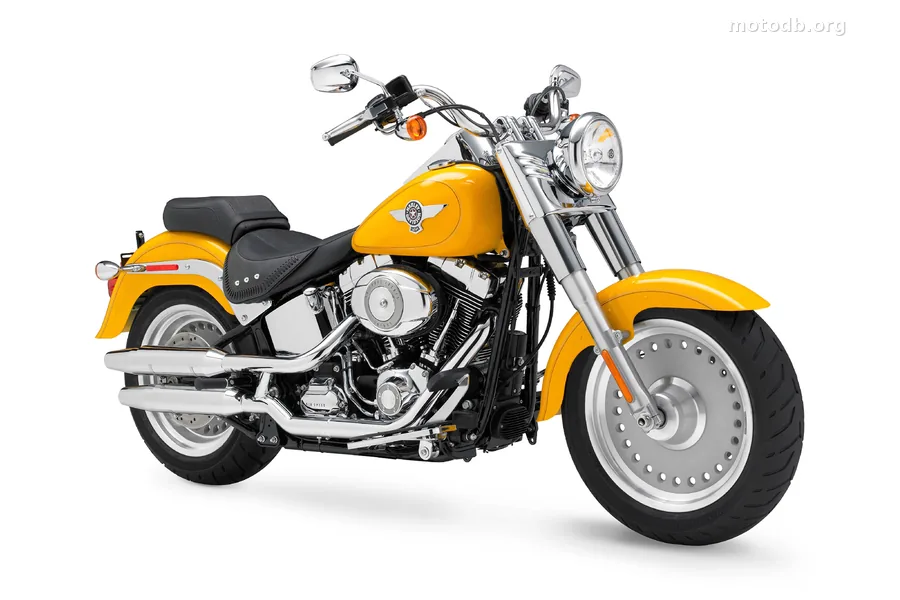
The Fat Boy, especially in its 2000 version with the Twin Cam 88, is a statement. It doesn't talk about performance, it talks about presence. With its 324 kg when fully fueled and its solid laced wheels, it establishes itself in space like a sculpted block of metal. The V2 engine of 1449 cc is not a demon of power, delivering 63 horsepower, a value that would make a modern sportbike laugh. But its torque of 106 Nm at 3500 rpm is the main argument. It doesn't propel, it pulls. It rolls with a low and rumbling authority, a sensation that figures don't capture.
Compared to Japanese cruisers of the time, often more lively and lighter, the Fat Boy plays a different game. It is a style machine, a desirable object for those who want an iconic silhouette. The Softail frame, with its faux rigid swingarm hiding the rear suspension, gives this pure and low line, with a seat height of only 647 mm. It's a physically accessible motorcycle, but intimidating by its mass. The 19-liter tank and the announced top speed of 170 km/h speak of quiet road use, not transcontinental raids.
The target audience is clear: the custom enthusiast, the fan of Harley aesthetics, the one who seeks an icon to ride, not a time trial champion. Improvements in this generation, such as dual disc brakes and reworked suspensions, are concessions to modernity, but they never transformed the Fat Boy into an agile machine. Its wheelbase of 1638 mm and its weight make it stable in a straight line, but not inclined to tight turns. The wide footpegs quickly remind you of their limits as soon as you look for a bit of lean angle.
With a price of €20,445 at the time, it was a significant investment for a specific philosophy. It is not an all-purpose motorcycle, it is a motorcycle to be. To feel, for the duration of a ride, like the protagonist of a mythical film. It remains, even today, a Harley-Davidson FLSTF Fat Boy S which symbolizes a certain idea of the road, heavy, chromed, and undeniably American.
Practical info
- La moto est accessible aux permis : A
Reviews & comments
No reviews yet. Be the first to share your opinion!