Key performance
Technical specifications
Engine
- Displacement
- 1977 cc
- Power
- 115.0 ch @ 5020 tr/min (84.6 kW)
- Torque
- 183.0 Nm @ 3500 tr/min
- Engine type
- Bicylindre en V à 45°, 4 temps
- Cooling
- combiné air / eau
- Compression ratio
- 11,4 : 1
- Bore × stroke
- 103,5 x 117,5 mm
- Valves/cylinder
- 4
- Fuel system
- injection Ø 58 mm
- Starter
- électrique
- Euro standard
- Euro 5+
Chassis
- Frame
- cadre tubulaire en acier
- Gearbox
- boîte à 6 rapports
- Final drive
- Courroie
- Front suspension
- Fourche telescopique inversée Ø 47 mm, déb : 117 mm
- Rear suspension
- 2 amortisseurs latéraux, déb : 76 mm
Brakes
- Front brakes
- Freinage 2 disques Brembo Ø 320 mm, fixation radiale, étrier 4 pistons
- Rear brakes
- Freinage 1 disque Ø 300 mm, étrier 4 pistons
- Front tyre
- 130/60-19
- Rear tyre
- 180/55-18
Dimensions
- Seat height
- 715.00 mm
- Seat type
- Selle biplaces
- Fuel capacity
- 22.70 L
- Weight
- 380.00 kg
- New price
- 54 690 €
Overview
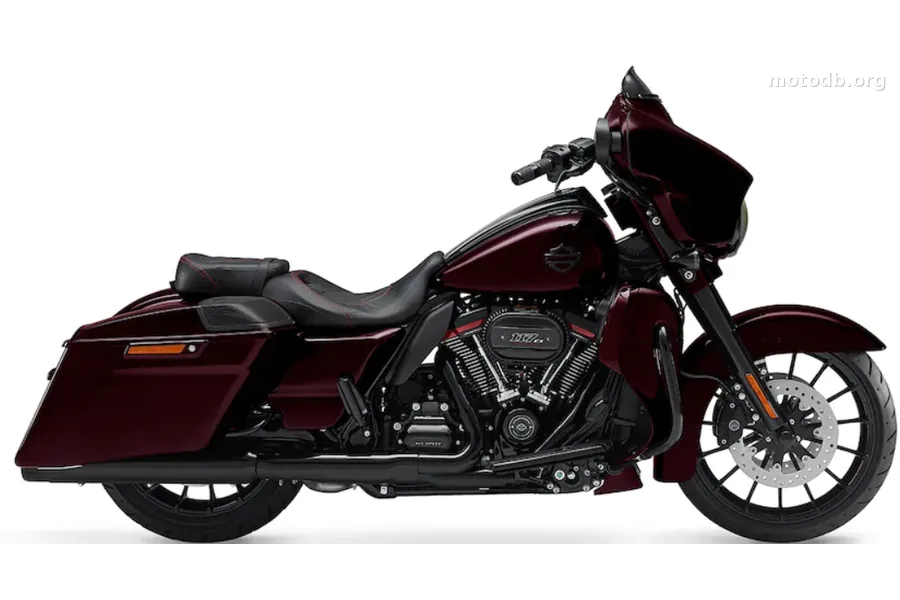
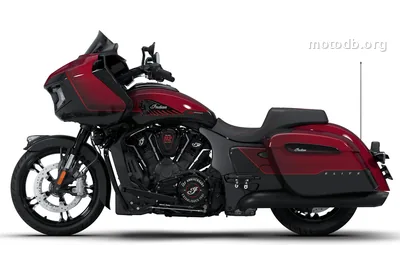
A shockwave on American roads. For Harley, Indian’s conquests on its home market are a thorn in its side. The firm reacts, sometimes gently.... or very concretely. When the CVO Street Glide 117 arrived, it was much more than just a new motorcycle. Thus dawned a new generation of machines at Harley-Davidson. A profound and intense change, as is rarely seen at the manufacturer. The last significant overhaul occurred with the Rushmore project, in 2013.
And yet........ The design had evolved subtly, so as not to shock the usual clientele. This time, it’s the leap into the 21st century. With its thoroughly revised bodywork, the Street Glide becomes a neo-classic-techno-tourer. Designers have completely remodeled the “Batwing” headstock and tossed its unchanged form since 1969. They retained only the T-shape, which disappears beneath worked lines and unprecedented structural elements.
Like the Fat Boy at the end of the last decade, the Street desacralizes the round headlight by flattening its corners. Harley calls this “Omega” lighting. Combined with the large luminous “mustaches” (integrating the turn signals), the front end is instantly more modern and engaging. The Splitstream air intake has disappeared, while a vent integrates completely into the more streamlined design. A very forward-mounted windshield takes over from the antique fairing. Without changing its capacity, the fuel tank adopts a more taut profile, topped with a new console. With this, the Harley image catches up to its future.
Let’s linger a bit on the front of this CVO Street Glide to note that the chassis also takes a leap forward. As if the chrome fork was becoming outdated, the front end now traces its path with an inverted 47 mm fork finished with Brembo radial calipers. The brake discs measure 320 mm in diameter and are clamped by 4 pistons each. Surprising for a Harley or a touring bike. The rear suspension adopts a more relaxed approach, thinking about comfort with an increase in its travel: 50% more to work and absorb road irregularities. But we want to understand why the front end is more assertive. With its muscular, borderline sporty approach... justifying the unprecedented engine block housed within?
This is one of the most striking assets of this CVO. Along with the Road Glide, it inaugurated the 121 ci 1977 cm3 twin-cylinder engine (a great 1977 year). Body-colored inserts inform of its noble lineage. The Milwaukee Eight gains even more displacement (+ 54 cm3), increases in power, especially in torque, and takes care to equip itself with variable valve timing. The Pan America is already equipped with this technology, with variable admission and exhaust valve timing. The VVT system advances or delays the camshaft timing by 40° relative to the crankshaft, or 20° of rotation in either direction. Thus, the timing allows to expand the power range and torque management. This kind of shift has spectacular effects on BMW’s 1250 Boxer; the shock is similar on the American Big Block.
Moving from 117 to 121, the M8 gains 12 horsepower. Its maximum of 115 hp is achieved 400 rpm earlier, just above 5,000 rpm. But it’s the mkg that impresses the most. At 3500 rpm, the engine of this CVO pulverizes the current range with 18.6 mkg. Huge! Enough to lift the bike as if it were pushed by a bison. For those who prefer the Nm language, the figures are even more telling: from 168 to 183 Newton-meters.
Furthermore, the test measurements carried out by the manufacturer announce it to be less thirsty and less polluting. By a small amount, but the gesture is there. This twin remains predominantly air-cooled but also a bit water-cooled, like rare variations of the Milwaukee Eight. For the 121, Harley has revised the cooling circuit as well as the intake circuit, implemented a new airbox, changed the camshaft, increased the compression ratio, revised the diameter of the exhaust pipes, pushed the alternator power up by 21%, improved the speed change drum. As for the overall Street Glide, it has lost 14 kg. Everyone worked at Harley, and it seems that someone was hired for dietetics.
The Rushmore project we spoke of a few paragraphs ago also propelled H-D into the infotainment world with the Boom Box, its TFT screen and its entire multimedia universe. With the CVO 121 Street Glide, the interface takes a new step forward with a much larger screen (90% gain in diagonal). Its name is equivocal: Skyline! Its dimensions are impressive: 31.2 cm - its omnipresence marks a revolution for Harley touring bikes: no more dials, no more needles, no more analog instrumentation... just the screen and its beautiful graphics, comprising 3 display themes (Cruise - Sport - Tour). Let’s start by putting the smartphone in the glove box located under the screen. A USB-C port awaits inside. But the Skyline also manages Bluetooth and WiFi. The Apple CarPlay service is installed but for Android systems, you will have to settle for simplified management, with music and call management. Skynet.... oops, pardon. Skyline also contains a GPS navigator, voice recognition, radio, music playback from various supports you connect to it, a 7-band equalizer to shape the sound, an intercom... Enough to keep the crew occupied for a moment while they do something other than the enormous living block under the tank.
Riding electronics will not be left behind: the manufacturer has discovered the joys of driving assistance. As a CVO, it deserves to have many as standard. Let’s list: an ABS cornering, traction control, an inertial sensor, the hill start assist, torque feedback control, tire pressure monitoring, but also 5 Riding Modes* and linked braking.
Besides these internal evolutions, synonymous with revolutions for the Milwaukee firm, this motorcycle from the Custom Vehicle Operation does not fail to swing into luxury, with a choice of two high-end paint schemes, special equipment, a 4 x 125 watt Rockford Fosgate Stage II rock-crushing sound system, beautifully crafted accessories from the Adversary collection, and limited availability. A new era for CVOs, with the future of Harley-Davidson in the background.
M.B - Photos manufacturer
The different Riding Modes of the Harley-Davidson CVO 121 Street Glide:
-Road Mode: Designed for everyday use, the "Road" mode offers balanced performance. This mode offers less aggressive throttle response and less engine power in the mid-range than the "Sport" mode, with a higher C-ABS and C-TCS intervention level. -Sport Mode: The Sport mode can maximize the rider's connection to the motorcycle. It can experience the full performance potential of the motorcycle directly and precisely, with full power and the fastest throttle response. The C-TCS is set to its lowest intervention level and engine braking is increased. -Rain Mode: Throttle response and power output are programmed to significantly limit the rate of acceleration, engine braking is limited and the highest levels of C-ABS and C-TCS intervention are selected. -Custom Modes: To create a custom mode, the rider uses the touchscreen to select their combined preferences for engine torque distribution characteristics, engine braking, throttle response, and C-TCS and C-ABS intervention in specific ranges.
Standard equipment
- Assistance au freinage : ABS
- Nombre de mode de conduite : 5
- Volume de rangement : 62 litres
- Taille de l'écran TFT couleur : 16,00 cm / 6.3 pouces
- ABS Cornering
- Jantes aluminium
- Indicateur de vitesse engagée
- Régulateur de vitesse
- Freinage combiné
- Radio
- Bluetooth
- GPS
- Prise USB
- Aide au démarrage en côte (Hill Hold Control)
- Démarrage sans clé
- Contrôle de traction
- Poignées chauffantes
- Valises
- Crash Bars / Top Blocks
- Contrôle du frein moteur
- Surveillance de la pression des pneus
Practical info
- La moto est accessible aux permis : A
- Pays de fabrication : Etats-Unis
Indicators & positioning
Similar bikes
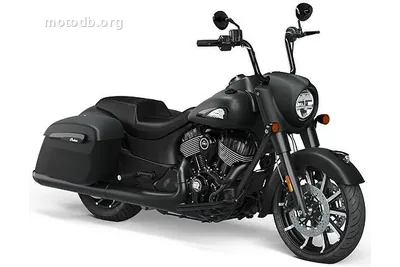
Springfield Dark Horse
Reviews & comments
No reviews yet. Be the first to share your opinion!