Key performance
Technical specifications
- Starter
- électrique → —
- Seat type
- Selle biplaces → —
- Weight
- 210.00 kg → 223.00 kg
- Dry weight
- — → 202.00 kg
Engine
- Displacement
- 937 cc
- Power
- 110.0 ch @ 9250 tr/min (80.9 kW)
- Torque
- 92.2 Nm @ 6500 tr/min
- Engine type
- Bicylindre en L à 90°, 4 temps
- Cooling
- liquide
- Compression ratio
- 13.3 : 1
- Bore × stroke
- 94 x 67,5 mm
- Valves/cylinder
- 4
- Camshafts
- 2 ACT
- Fuel system
- injection Ø 53 mm
Chassis
- Frame
- Treillis tubulaire en acier
- Gearbox
- boîte à 6 rapports
- Final drive
- Chaîne
- Front suspension
- Fourche téléhydraulique inversée Ø 46 mm, déb : 230 mm
- Rear suspension
- Mono-amortisseur, déb : 220 mm
Brakes
- Front brakes
- Freinage 2 disques Brembo Ø 320 mm, fixation radiale, étrier 4 pistons
- Rear brakes
- Freinage 1 disque Ø 265 mm, étrier 2 pistons
- Front tyre
- 90/90-21
- Front tyre pressure
- 2.00 bar
- Rear tyre
- 150/70-18
- Rear tyre pressure
- 2.20 bar
Dimensions
- Seat height
- 875.00 mm
- Fuel capacity
- 21.00 L
- Weight
- 223.00 kg
- Dry weight
- 202.00 kg
- New price
- 17 490 €
Overview
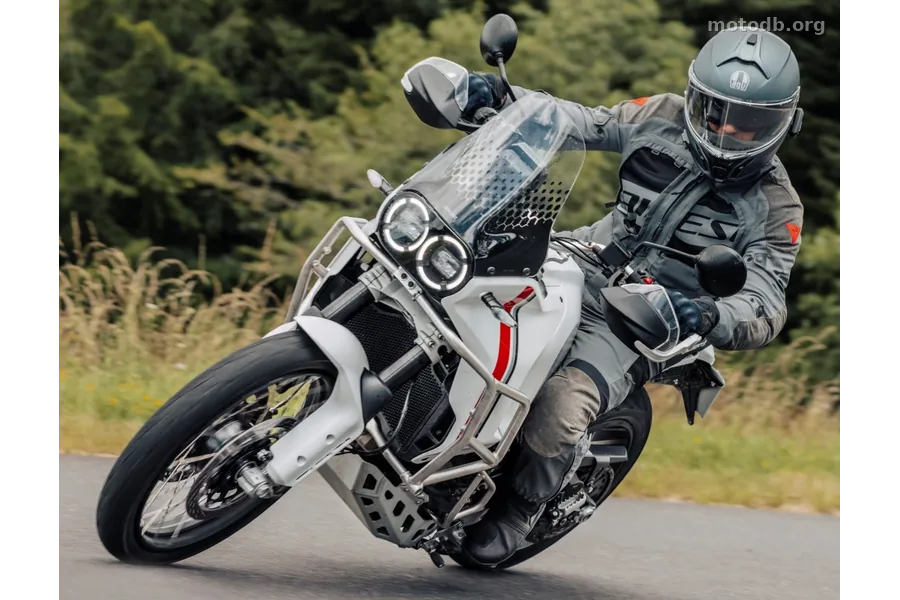
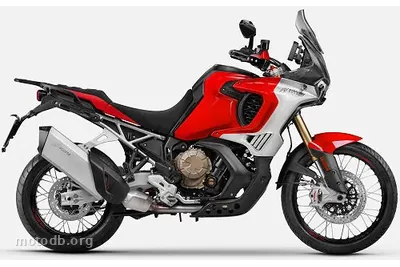
When Ducati decides to get its boots dirty, it doesn't go unnoticed. The Bologna manufacturer, builder of thoroughbred sportbikes and punchy roadsters, had never really put its wheels in the dirt. Not seriously, at least. The Multistradas played at being adventurers with their road tires and their bulk, the Scrambler Desert Sleds had the look without the substance. With the Ducati DesertX 937, it's a different story. Bologna finally claims an adventure bike designed from the outset to leave the tarmac, with 21- and 18-inch wheels, 230 mm of suspension travel up front and 220 mm at the rear, and ground clearance built to swallow rocky trails. All wrapped in an unapologetic tribute to the Cagiva Elefant 900, the machine that carried Edi Orioli to victory at the Paris-Dakar in 1990. The twin round headlights, the tall silhouette, the stripes on the white livery: every design cue summons the glory days of rally-raid.
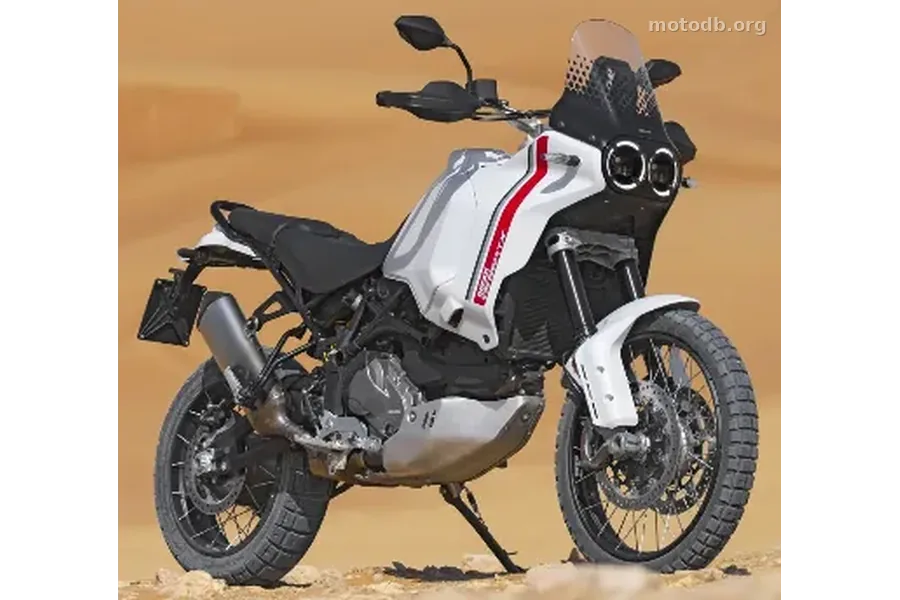
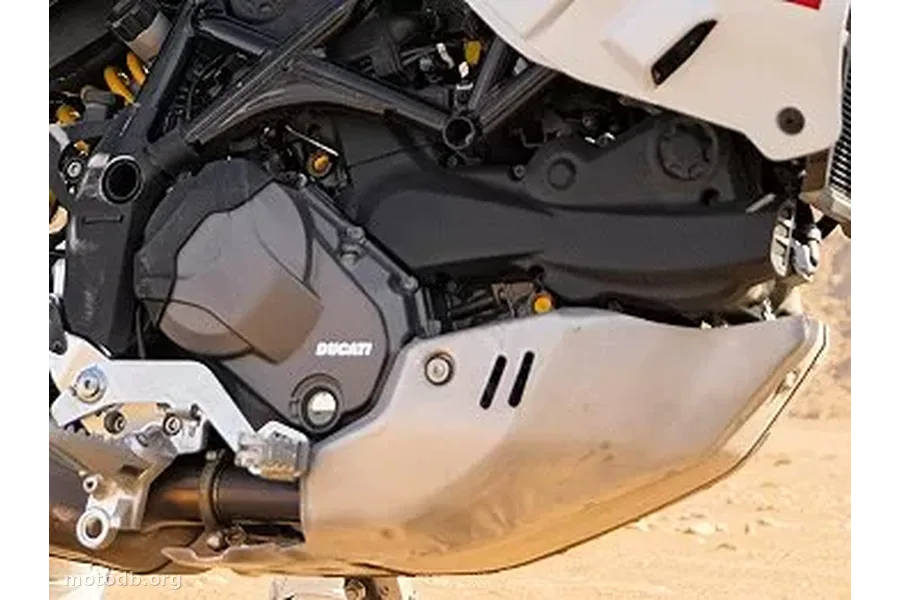
Beneath the tubular steel trellis frame beats the 937 cc Testastretta 11° desmodromic V-twin, the same engine found in the Multistrada V2 and the Monster. The result: 110 hp at 9,250 rpm and 92.2 Nm of torque at 6,500 rpm. That's considerably more muscular than the Yamaha Ténéré 700 and its 73 hp, its natural rival in the mid-size off-road-oriented adventure segment. But that power comes at a cost in kilograms. At 223 kg wet versus 204 kg for the Japanese bike, the Ducati DesertX 937 carries extra weight that will make itself felt when the sand turns soft or the trail narrows. Ducati had the good sense to shorten the first two ratios in the 6-speed gearbox for better traction at low speeds off-road, while keeping sixth gear long enough for highway cruising. The standard up & down quickshifter rounds out the package and makes life easier when conditions get tough.
Six riding modes dress up this powertrain. Sport, Touring, Urban, and Wet for the road; Enduro and Rally for the dirt. Enduro mode restricts power to 75 hp with a crisp throttle response — a clever setting for those discovering off-road riding on such a powerful machine. Rally mode unleashes the full 110 hp and allows complete disconnection of the cornering ABS, reserved for riders who know what they're doing. The Brembo braking system, with its twin radially mounted 320 mm discs up front and a 265 mm disc at the rear, inspires confidence. The fully adjustable 46 mm inverted fork soaks up hard landings. Antoine Méo, five-time enduro world champion, proved it in the Saudi Arabian dunes by stringing together jumps that few production adventure bikes could survive.
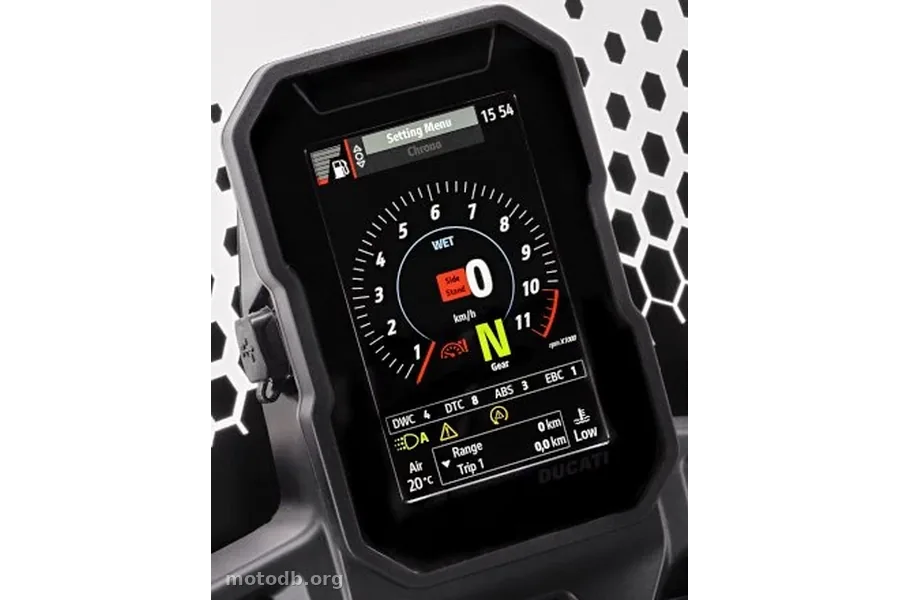
The vertical dashboard, mounted roadbook-style like on the Ténéré, features a 5-inch TFT screen far more comprehensive than the Japanese bike's. Traction control, anti-wheelie, engine braking management — everything is configurable from this screen. The 21-liter tank provides decent range, but the most tempting option in the catalog remains the 8-liter auxiliary rear tank, bringing total capacity to 29 liters. Enough to rival the BMW R 1250 GS Adventure and Triumph Tiger 1200 Explorer with their 30 liters. The only downside: the aluminum luggage developed by Ducati appears to be incompatible with this additional tank. A regrettable oversight for a machine with globetrotting ambitions.
At €17,490, the Ducati DesertX 937 sits above the Ténéré 700 but justifies the gap with its power, sophisticated electronics, and equipment. It targets experienced riders who want an adventure bike capable of performing on dirt and road alike, with the Italian signature as a bonus. The competition is shaping up to be fierce: Aprilia Tuareg 660, Husqvarna Norden 901, not to mention MV Agusta's upcoming projects. But with its seat perched at 875 mm and its volcanic character, the DesertX isn't trying to please everyone. It wants to win over those who still dream of the Dakar. And on that terrain, Bologna is playing on home turf.
Standard equipment
- Assistance au freinage : ABS en curvas
- Nombre de mode de conduite : 6
- Taille de l'écran TFT couleur : 12,70 cm / 5 pouces
- Shifter
- Amortisseur de direction
- Indicateur de vitesse engagée
- Régulateur de vitesse
- Prise USB
- Contrôle de traction
- Poignées chauffantes
- Contrôle anti wheeling
- Contrôle du frein moteur
Practical info
- Véhicule accessible au permis A2 ou bridable à 47.5ch / 35 Kw
- La moto est accessible aux permis : A, A2
Reviews & comments
No reviews yet. Be the first to share your opinion!