Key performance
Technical specifications
- New price
- 17 490 € → 17 390 €
Engine
- Displacement
- 937 cc
- Power
- 110.0 ch @ 9250 tr/min (80.9 kW)
- Torque
- 92.2 Nm @ 6500 tr/min
- Engine type
- Bicylindre en L à 90°, 4 temps
- Cooling
- liquide
- Compression ratio
- 13.3 : 1
- Bore × stroke
- 94 x 67,5 mm
- Valves/cylinder
- 4
- Camshafts
- 2 ACT
- Fuel system
- injection Ø 53 mm
Chassis
- Frame
- Treillis tubulaire en acier
- Gearbox
- boîte à 6 rapports
- Final drive
- Chaîne
- Front suspension
- Fourche téléhydraulique inversée Ø 46 mm, déb : 230 mm
- Rear suspension
- Mono-amortisseur, déb : 220 mm
Brakes
- Front brakes
- Freinage 2 disques Brembo Ø 320 mm, fixation radiale, étrier 4 pistons
- Rear brakes
- Freinage 1 disque Ø 265 mm, étrier 2 pistons
- Front tyre
- 90/90-21
- Front tyre pressure
- 2.00 bar
- Rear tyre
- 150/70-18
- Rear tyre pressure
- 2.20 bar
Dimensions
- Seat height
- 875.00 mm
- Fuel capacity
- 21.00 L
- Weight
- 223.00 kg
- Dry weight
- 202.00 kg
- New price
- 17 390 €
Overview
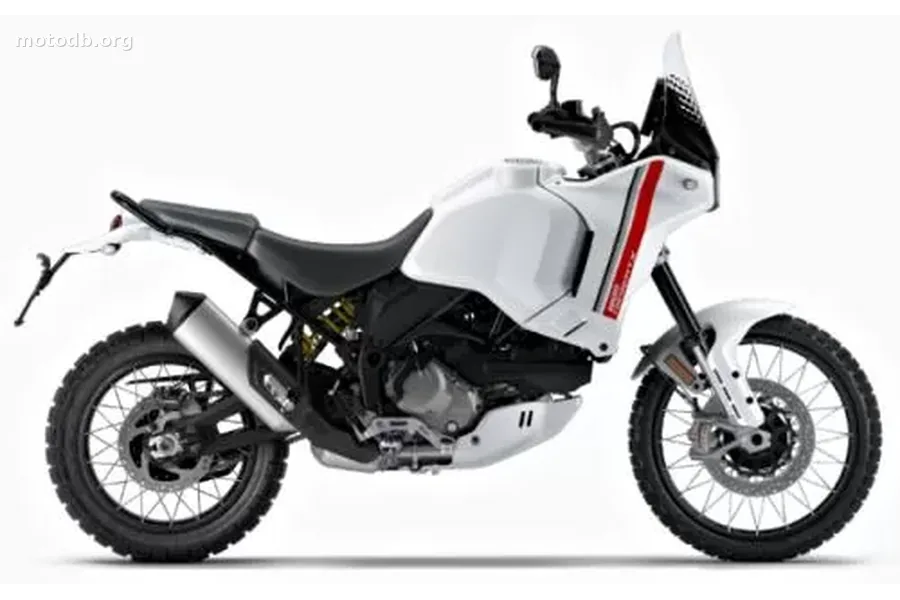
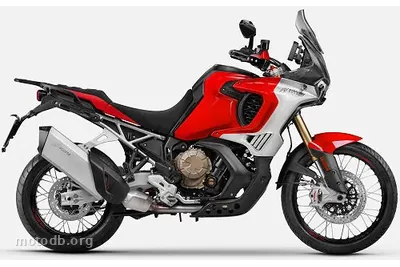
When Ducati decides to put its wheels in the sand, it never does things halfway. The Ducati DesertX 937 was born from a legacy that the Bologna manufacturer shares almost reluctantly with Cagiva: that of the Elefant 900, victorious at the 1990 Paris-Dakar in Lucky Strike livery, already powered by an Italian L-twin. Thirty years later, the lineage is unmistakable. The twin round headlights, the tall and narrow silhouette, the generous 21-liter tank: everything recalls the African rally prototypes. Except that beneath this neo-retro bodywork lies electronics worthy of a modern sportbike and a 937 cc Testastretta 11° Desmodromic engine pumping out 110 hp at 9,250 rpm and 92.2 Nm of torque at 6,500 rpm. The kind of firepower that turns any trail into a playground.
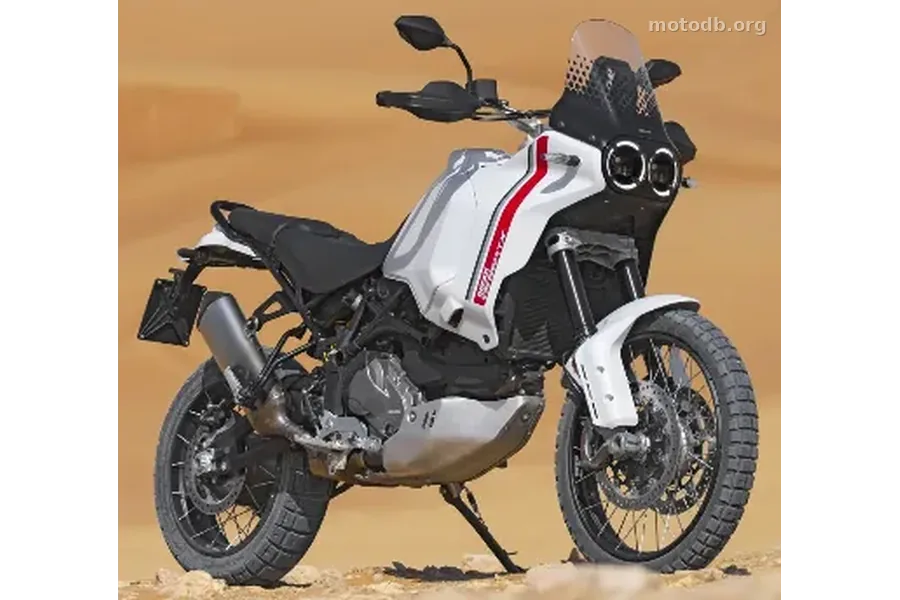
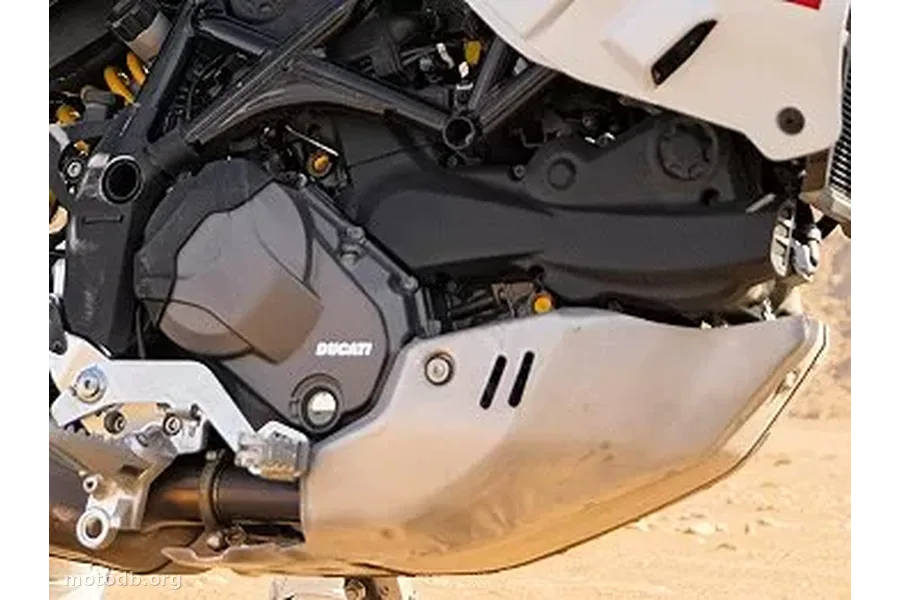
The real gamble with this Ducati DesertX 937 is proving that Bologna can build something other than machines bred for tarmac. The Multistrada Enduro and various Scrambler Desert Sled models had ventured into adventure territory, but their DNA remained firmly road-oriented. Here, the chassis was designed from the outset for off-road use: a tubular steel trellis frame, a 46 mm inverted fork with 230 mm of travel, a rear monoshock offering 220 mm of travel, a 21-inch front wheel and 18-inch rear. The Kayaba suspension is fully adjustable, and the radially mounted Brembo brakes with 320 mm discs inspire confidence. Ground clearance is generous, with the seat perched at 875 mm. This is clearly an adventure bike that embraces its off-road calling, not a disguised roadster.
Compared to the Yamaha Ténéré 700, the bike that revived this segment of mid-size adventure bikes built for trail riding, the comparison is inevitable. The Japanese machine tips the scales at 204 kg wet versus 223 kg for the Italian. Nearly twenty kilos of difference takes its toll when the terrain gets rough and arms start to tire. But the DesertX compensates with a considerable power advantage: 110 hp versus 73 for the Ténéré. Ducati also revised the ratios of its six-speed gearbox, shortening the first two gears for better traction at low speed while keeping a tall sixth for highway cruising without blowing up fuel consumption. The standard bidirectional quickshifter adds welcome convenience. On the electronics front, six riding modes allow you to tailor the engine response: Rally mode unleashes full power with a sharp throttle response for experienced riders, while Enduro mode limits output to 75 hp to tame the beast off tarmac. The cornering ABS can be fully deactivated in both modes — a bold and sensible choice.
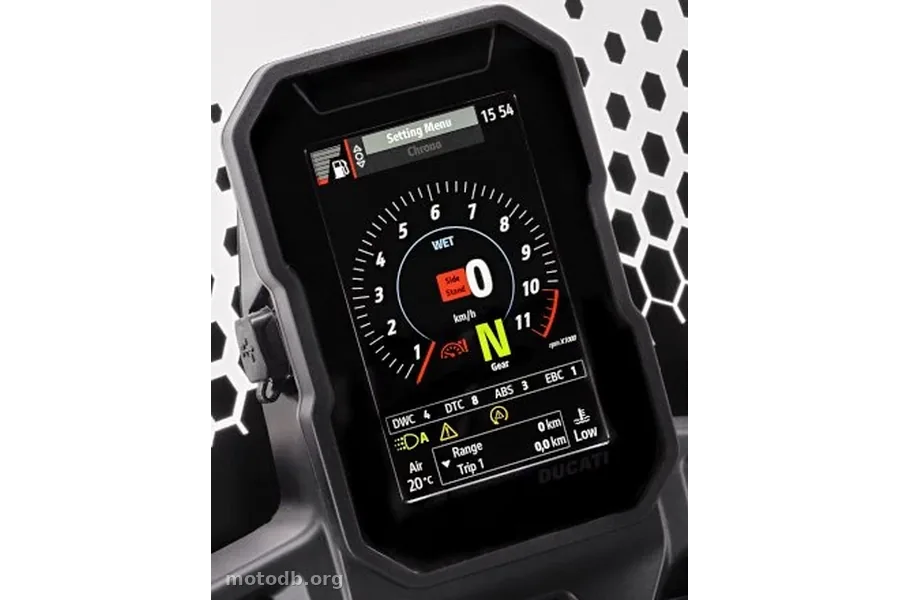
The 5-inch TFT display, mounted vertically like a rally road-book, stands in stark contrast to the Ténéré's minimalist instrument cluster. Traction control, anti-wheelie, engine brake management: everything is adjustable from the dashboard. The accessories catalog is extensive, with one clever highlight: an 8-liter auxiliary rear tank, managed by a dedicated pump and controlled from the instrument panel. Enough to bring total capacity to 29 liters and rival the BMW R 1250 GS Adventure or Triumph Tiger 1200 Explorer and their 30-liter tanks. The only drawback is that Ducati's luggage system appears incompatible with this auxiliary tank. An oversight that's frustrating on a motorcycle priced at 17,390 euros.
The competition isn't standing still. The Aprilia Tuareg 660, the Husqvarna Norden 901, and MV Agusta's Lucky Explorer projects are all shaking up this rapidly growing segment. The Ducati DesertX 937 positions itself as the most powerful and most technologically advanced of the bunch, but also the heaviest and most expensive. It will appeal to experienced riders who want an adventure bike capable of devouring miles of tarmac without boredom before veering onto a trail with genuine off-road potential. Hardcore overlanders, those who count every gram, may look elsewhere. But for anyone seeking a versatile machine with character, style, and a heritage that carries weight, the DesertX delivers on its promise.
Standard equipment
- Assistance au freinage : ABS in curves
- Poignées chauffantes
Practical info
- Véhicule accessible au permis A2 ou bridable à 47.5ch / 35 Kw
- La moto est accessible aux permis : A, A2
Reviews & comments
No reviews yet. Be the first to share your opinion!