Key performance
Technical specifications
Engine
- Displacement
- 955 cc
- Power
- 157.0 ch @ 10500 tr/min (115.5 kW)
- Torque
- 106.9 Nm @ 9000 tr/min
- Engine type
- Bicylindre en L à 90°, 4 temps
- Cooling
- liquide
- Compression ratio
- 12.5 : 1
- Bore × stroke
- 100 x 60.8 mm
- Valves/cylinder
- 4
- Camshafts
- 2 ACT
- Fuel system
- Injection Ø 62 mm
Chassis
- Frame
- monocoque en aluminium
- Gearbox
- boîte à 6 rapports
- Final drive
- Chaîne
- Front suspension
- Fourche téléhydraulique inversée Showa BPF Ø 43 mm, déb : 120 mm
- Rear suspension
- Mono-amortisseur Sachs, déb : 130 mm
Brakes
- Front brakes
- Freinage 2 disques Brembo Ø 320 mm, fixation radiale, étrier 4 pistons
- Rear brakes
- Freinage 1 disque Ø 245 mm, étrier 2 pistons
- Front tyre
- 120/70-17
- Front tyre pressure
- 2.50 bar
- Rear tyre
- 180/60-17
- Rear tyre pressure
- 2.50 bar
Dimensions
- Seat height
- 830.00 mm
- Fuel capacity
- 17.00 L
- Weight
- 200.00 kg
- Dry weight
- 176.00 kg
- New price
- 16 990 €
Overview
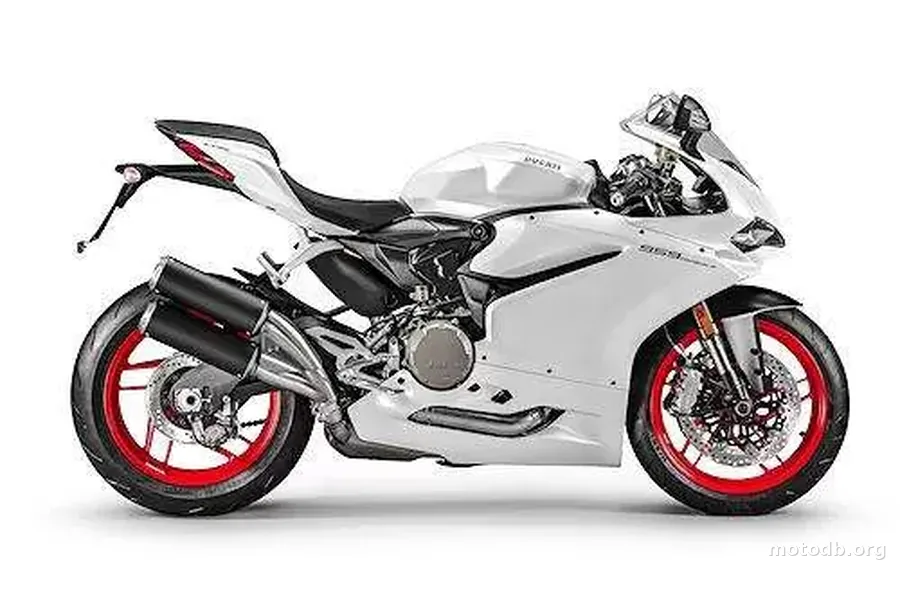
With the arrival of the V4 Panigale, the 959 asserts its differences. Frame coque, reasonable power, L-twin, and marked design—everything that shook the fans of the Panigale V2 generation is here. It’s no longer Bologna’s “small” Superbike but a more defined choice. Charging into the sport, with an Italian flair overflowing on the main course, the Ducati 959 Panigale continues a chapter full of spirit and passion. But...
748, 749, 848, 899, 959—in just a few generations, the small Bolognese sportbike has become almost as large as a Japanese hypersport. Within its innards, the Superquadro flexes its muscles. But externally, nothing appears to show. The Panigale remains a machine of small stature, with a compactness that is still striking. It’s hard to imagine how the engineers can fit so much into so little space. It’s almost as if a surgical procedure and laparoscopic instruments would be needed to perform servicing. With its sculpted silhouette, we’re on familiar ground. Following the tradition that each Ducati Superbike copies its elder, we instantly recognize its markings. Slight refinements to the fork head with a slight improvement in protection, a taut fairing designed to turn heads. It’s on the rear that everything is played out in terms of design. The firm from Bologna continues to refrain from reintroducing the monobrach, a divergence that each will judge as they see fit. Let's move on; that’s not the main problem. Fans of clean lines will choke at the sight of the 959 Panigale’s double lateral exhaust outlet. Argghh!!! Finished are the eruptions under the engine. Two tubes in the style of a Monster come to massacre the line, initially finely drawn with a scalpel. Euro4 standards have passed through; and to breathe "politically correct," these two unsightly appendages come to spoil the style. Well, anyway, it will be necessary to get used to it... The positive aspect of this standard is that Ducati can land on the territory with all its watts without getting a headache. And there are powerful engines, even more so.
If the 899 became a 959, it’s not to mimic the fable of the frog and the bull. Since the twin is even more castrated by Euro4, offering it more displacement allows it to retain grunt and responsiveness. Then, by working well in the engineering department, even more horsepower can be squeezed in. The 959 Panigale sends no less than 157 horsepower. That’s 9 units gained over the previous version. Precisely cubing 955 cm3, this Ducati would almost be a wink to a pure factory machine: it displays the same displacement and almost the same power as the WSBK 916 Corsa, derived from the 916 SP3 of 1996. Let the 916 live its legend and let's go back to the Superquadro engine. Its increase in volume at explosion is achieved through an increase in the stroke of 3.6 mm. It is thus established at 60.8 mm, with a very generous bore of 100 mm for company. Improved lubrication, new valves, modifications to the crankshaft, cylinders, camshafts, cylinder heads, a second set of injectors to feed the engine from 8500 rpm; the unseen evolutions are numerous. In addition to the power increase, torque also benefits from this inflation and reaches almost 11 mkg - 107.4 Nm to be precise. Flute, the transmission has been lengthened, to please the bureaucrats. Well, you’ll have to think about finding a sprocket or crown that fits to enjoy beautiful acceleration (on the track, of course!!!). Because under the Desmo distribution, we didn’t seek to soften things.
Powerful twin! But between it and the road, we find a crowd of intermediaries. Which will delight the tuners. The clutch now integrates a double function, anti-dribble and assistance. Enough to reduce lever effort and digest muscular downshifts. Then, it’s the electronics that keep an eye on things. Three riding modes are on the menu, each having predefined settings on the various onboard safeguards. Race, Sport, or Rain, the Panigale adjusts to the mood of the moment. The right hand moves, the silicon chips act. The traction control DTC acts on 8 levels of intervention, the engine brake EBC on 3, the ABS Bosch 9MP is also governed according to 3 modes, and the dashboard display evolves according to the Riding Mode chosen. To perfect your style or your level of requirement, these can be fine-tuned by the user. Note that the available power differs depending on the modes: 157 horsepower for Race and Sport, 115 for Rain mode. The 959 Panigale retains the DQS quickshifter, usable on the upshift but not yet on the downshift. Only the different versions of the big Panigale (1299-1299 S-R) have the privilege in Bologna. As an option, the DDA+ allows you to rack your brains after a session with a good salad of telemetry with GPS.
Since the 899 Panigale, the 959 has gained heart... and weight. 7 kilos, that’s not nothing. But where does this fat come from, in a category where weight reduction is a priority? The double silencer is already responsible for a good portion. Not enough to noticeably change the behavior or liveliness of the machine. And then, 200 kilos full, we’ve seen worse. Regarding the chassis and peripherals, the essentials do not change. Around the singular aluminum frame coque, a Showa BPF 43 mm large-piston inverted fork and a Sachs damper in a lateral position are fixed. The elements are of course fully adjustable. The changes made are to the wheelbase, increased by 5 mm (1426 -> 1431), and the swingarm mounting point, lowered by 4 mm. These modifications should optimize traction and stability of the Panigale. However, combined with the weight gain of the machine, the rider will have to provide more effort to engage the machine. The braking is also completely taken over from the 899. 320 mm discs and Brembo M4.32 4-piston calipers for the front, a 245 mm disc and a 2-piston caliper at the rear. Serious kit, however a small notch below what the larger Ducati cylinders can offer. Not yet an M50 for the small... uh, the medium Panigale; a minor drawback, as the kit already does a heck of a job.
It’s time to put on the boots, and notice that the footrests now offer more grip; sticky pads right to the end of the protrusions. Still as sporty and even more powerful, the youngest of the Panigale is more like an 899 Evo than a totally new machine. However, the significant increase in displacement justifies a new name. Racée, technological, exciting, it is refused a few exclusivities to contain its price and preserve the prestige of the range's hypersportives. No monobrach, no up/down quickshifter, no UMI inertial platform, no wheelie control and no TFT color dashboard... and almost 5,000 euros less. It also allows you to appropriate the Panigale fantasy without going through the lumberjack box that the 1299 demanded. Less missile, sportingly speaking, it allows you to ride fast without being overwhelmed all the time.
M.B - Photos constructeur
Standard equipment
- Assistance au freinage : ABS de série
Practical info
- La moto est accessible aux permis : A
Reviews & comments
No reviews yet. Be the first to share your opinion!