Key performance
Technical specifications
Engine
- Displacement
- 618 cc
- Power
- 60.0 ch @ 9500 tr/min (44.1 kW)
- Torque
- 53.0 Nm @ 6750 tr/min
- Engine type
- Bicylindre en V, 4 temps
- Cooling
- combiné air / huile
- Compression ratio
- 10.5:1
- Bore × stroke
- 80 x 61.5 mm
- Valves/cylinder
- 2
- Camshafts
- 1 ACT
- Fuel system
- Injection Ø 45 mm
Chassis
- Frame
- Treillis tubulaire en acier
- Gearbox
- boîte à 5 rapports
- Final drive
- Chaîne
- Front suspension
- Fourche téléhydraulique inversée Ø 43 mm, déb : 130 mm
- Rear suspension
- Mono-amortisseur, déb : 148 mm
Brakes
- Front brakes
- Freinage 2 disques Ø 320 mm, étrier 4 pistons
- Rear brakes
- Freinage 1 disque Ø 245 mm, étrier 2 pistons
- Front tyre
- 120/60-17
- Front tyre pressure
- 2.10 bar
- Rear tyre
- 160/60-17
- Rear tyre pressure
- 2.20 bar
Dimensions
- Seat height
- 770.00 mm
- Fuel capacity
- 15.00 L
- Weight
- 193.00 kg
- Dry weight
- 177.00 kg
- New price
- 8 495 €
Overview
When a manufacturer decides to celebrate the exploits of its star rider by dressing up one of its most popular machines, the result often wavers between an easy marketing ploy and a sincere tribute. With the 2004 Monster 620 S Capirex, Ducati clearly leans the right way. We're in 2003, Bologna has just landed in MotoGP with the Desmocedici, and Loris Capirossi is posting results that silence the skeptics. To mark the occasion, the Italian factory grafts the rider's number 65 onto the tail and flyscreen of a Monster 620 S, adds a white stripe in S4R fashion, a "Capirex" logo on the windscreen, and that's that. Except this special edition isn't limited to a simple sticker job.
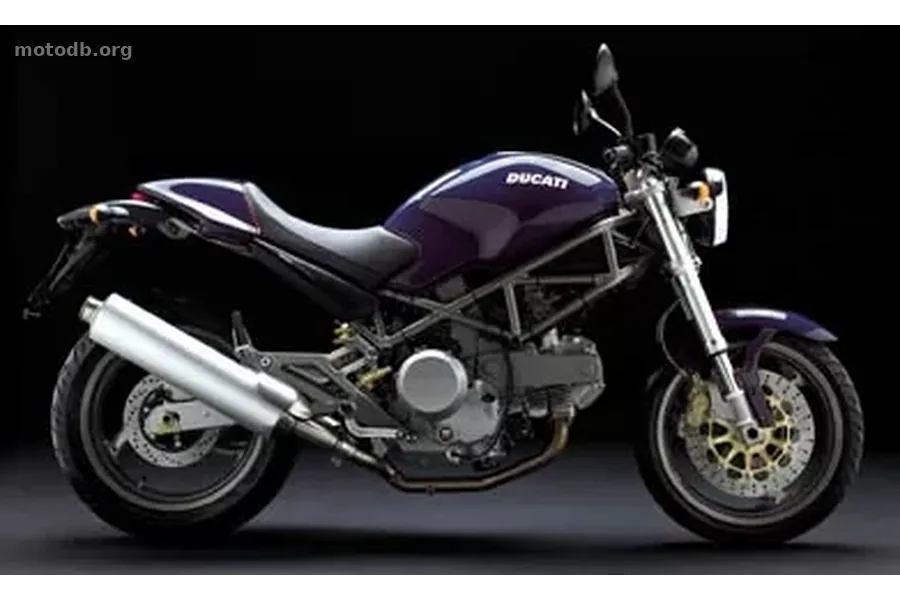
The swingarm switches to aluminum and the front fender trades plastic for carbon fiber. These aren't trivial details: these choices lighten the chassis and bring a touch of mechanical nobility to a machine that, let's remember, remains positioned as an entry-level offering at Ducati. The tubular steel trellis frame retains the Monster DNA, while the 43 mm inverted fork and rear monoshock offer reasonable travel of 130 and 148 mm. Nothing extremely sporty, but rigorous enough for mixed city-road use where the Monster has always excelled. The seat perched at just 770 mm reassures smaller riders, and the 193 kg wet weight remains contained for a roadster of that era.
Beneath the trellis beats Ducati's 618 cc V-twin, two valves per cylinder — a simple and robust mill. The 60 horsepower at 9,500 rpm and 53 Nm of torque at 6,750 rpm won't make any sportbike tremble, but that's not the point. This engine lives in the midrange, pulls strongly between 4,000 and 7,000 rpm, and proves expressive enough to remind you with every twist of the throttle that you're riding an Italian twin. The five-speed gearbox betrays the platform's age — a sixth gear would have been welcome to settle the engine down on the highway. The top speed of 186 km/h confirms that this Monster doesn't play in the big-bore league. The real technical asset of this S version lies in the APTC clutch, a slipper system patented by Ducati that reduces lever effort by 40% and prevents the rear wheel from hopping under hard braking. In the city and on twisty roads alike, it's a comfort that standard Monster owners envy.
Braking relies on two 320 mm discs gripped by four-piston calipers up front, and a single 245 mm disc at the rear. Serious hardware for a 620, placing this Capirex above many equivalent Japanese roadsters in terms of lever feel. The 120/60 and 160/60 tires on 17-inch wheels remain conventional, no surprises there. At €8,495 at the time of release, Ducati was asking a significant premium over the base Monster 620. The surcharge is justified by the carbon parts, aluminum swingarm, APTC clutch, and the prestige of the Capirex badge. For a Loris fan or an Italian limited-edition enthusiast, the price tag is acceptable. For a pragmatic rider, a standard 620 S did the same job for less.
With over 130,000 Monsters produced in ten years by that point, Ducati had proven that the stripped-down Italian roadster concept had found its audience. The Capirex remains today a modest collector's piece, a nod to an era when Bologna set out to conquer MotoGP with its trademark audacity. It appeals to brand enthusiasts, special-edition collectors, or simply those looking for a light, punchy, character-filled roadster to tackle the daily commute with a sly grin.
Practical info
- Moto bridable à 34 ch pour l'ancien permis A MTT1 - pas garanti pour le permis A2
- La moto est accessible aux permis : A, A (MTT1)
Reviews & comments
No reviews yet. Be the first to share your opinion!