Key performance
Technical specifications
- New price
- 17 990 € → 17 890 €
Engine
- Displacement
- 1198 cc
- Power
- 160.0 ch @ 9500 tr/min (117.7 kW)
- Torque
- 136.3 Nm @ 7500 tr/min
- Engine type
- Bicylindre en L à 90°, 4 temps
- Cooling
- liquide
- Compression ratio
- 12.5 : 1
- Bore × stroke
- 106 x 67.9 mm
- Valves/cylinder
- 4
- Camshafts
- 2 ACT
- Fuel system
- Injection Ø 56 mm
Chassis
- Frame
- Treillis en tubes d'acier
- Gearbox
- boîte à 6 rapports
- Final drive
- Chaîne
- Front suspension
- Fourche téléhydraulique inversée Ø 48 mm, déb : 170 mm
- Rear suspension
- Mono-amortisseur, déb : 170 mm
Brakes
- Front brakes
- Freinage 2 disques Ø 320 mm, fixation radiale, étrier 4 pistons
- Rear brakes
- Freinage 1 disque Ø 265 mm, étrier 2 pistons
- Front tyre
- 120/70-17
- Front tyre pressure
- 2.50 bar
- Rear tyre
- 190/55-17
- Rear tyre pressure
- 2.50 bar
Dimensions
- Seat height
- 825.00 mm
- Fuel capacity
- 20.00 L
- Weight
- 232.00 kg
- Dry weight
- 209.00 kg
- New price
- 17 890 €
Overview
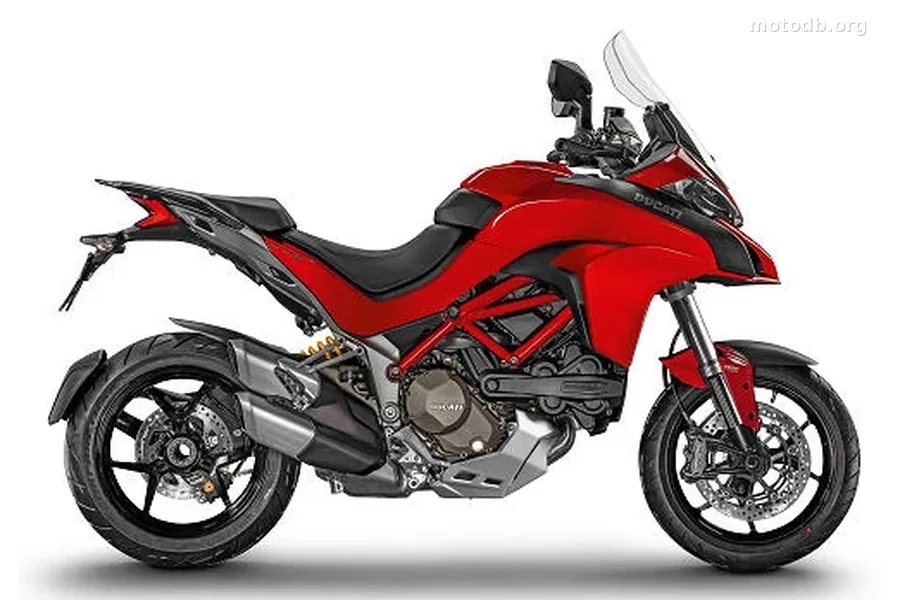
When Borgo Panigale decides to tackle the adventure segment, they don't do things by halves. The third generation of the Multistrada 1200 DVT confirms this unambiguously: this machine is a declaration of intent, not a catalogue of compromises.
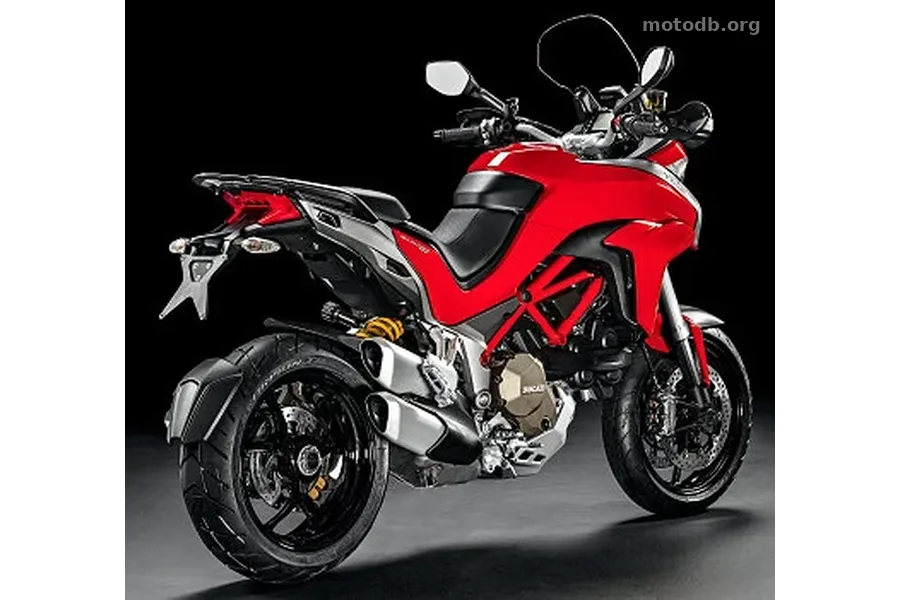
The face says it all. Where a BMW R 1200 GS presents its round, reassuring snout, where a KTM 1290 Super Adventure plays the card of unabashed frontal aggression, the Multistrada imposes a raptor-like profile. The range's characteristic beak has been refined, the headlights stretch wider, the flanks have gained muscle. The lineage is recognizable at first glance, but this 2016 version has added something tenser, more ready to pounce. This is not an adventure bike for a Sunday morning ride in search of an open bakery.
The major innovation of this generation lies in the engine. The Testastretta 1198 cc receives the DVT, Desmodromic Variable Timing — the ability to hydraulically phase-shift the intake and exhaust camshafts according to engine speed. This has been common in automobiles for a long time, but is extremely rare on motorcycles. The Honda VFR 800 has been attempting something in this vein since 2002, and the Kawasaki GTR 1400 played with it on the intake side only. Ducati goes further by acting on both shafts simultaneously, allowing it to reconcile what fixed valve timing forces you to choose between: usable torque from low revs and strong top-end power. At 3,500 rpm, 80 Nm is already available at the right hand. The curve stays above 100 Nm between 5,750 and 9,000 rpm, peaking at 136.3 Nm at 7,500 rpm. All of this is pushed to 160 horsepower at 9,500 rpm. Ten horsepower more than the previous version, with fuel consumption reportedly down 8%. Valve service intervals are pushed back to 30,000 km. On paper, this represents serious progress on every front.
The chassis follows the same logic of rigorous development. The steel tubular trellis frame has been redesigned and stiffened, ground clearance gains 20 mm to reach 180 mm — which remains in the territory of road-oriented adventure rather than true off-road. The 48 mm inverted fork and monoshock each offer 170 mm of travel, fully adjustable on this standard version. The S version receives Skyhook semi-active suspension, but the base version is already well equipped. The Brembo brakes with twin 320 mm front discs do their job with conviction, assisted by ABS coupled to an IMU inertial measurement unit. This setup allows the anti-lock system to remain active while cornering, modulating braking force according to lean angle and speed. It's the kind of safety net you only fully appreciate in limit situations — which is precisely when it needs to work.
The onboard equipment matches what one expects from a machine listed at €17,890 in France. For those wondering about the price of a Ducati 1200 Multistrada DVT in France, this pricing places it slightly above a base GS Adventure but within the same customer category: experienced riders, often urban commuters or long-distance tourers, who want a do-it-all machine without compromising on dynamics. The seat adjustable to 825 or 845 mm, keyless ignition, cruise control, and 12V outlets confirm this grand touring orientation. But 232 kg fully fuelled is 8 kg more than the previous generation. This weight gain is justified by the onboard electronics and new technologies, but it deserves a mention — especially for smaller-statured riders.
The four optional packs — Touring, Sport, Urban, and Enduro — allow precise customization according to intended use. It's an intelligent approach that replaces the old fixed variants. The Enduro pack, developed with Touratech, gives the Multistrada relative off-road credibility, with engine guards and specific footpegs. Relative, because with 232 kg on the scales and a frame offering 180 mm of ground clearance, no one should seriously venture off the beaten track. The target audience remains the demanding tourer who wants character, not the adventurer seeking a true off-road machine. That's an acknowledged position, and a consistent one.
Standard equipment
- Assistance au freinage : ABS in curves
Practical info
- La moto est accessible aux permis : A
Indicators & positioning
Similar bikes
Dorsoduro 1200
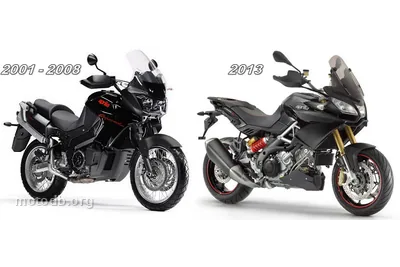
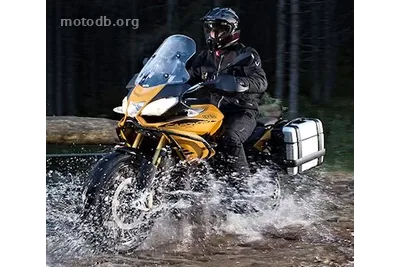
Caponord 1200 Travel Pack
Reviews & comments
No reviews yet. Be the first to share your opinion!