Key performance
Technical specifications
Engine
- Displacement
- 973 cc
- Power
- 76.0 ch @ 6700 tr/min (55.5 kW)
- Engine type
- V2, four-stroke
- Cooling
- Air
- Compression ratio
- 9.3:1
- Bore × stroke
- 88.0 x 80.0 mm (3.5 x 3.1 inches)
- Valves/cylinder
- 2
- Valve timing
- Desmodromic valve control
Chassis
- Gearbox
- 5-speed
- Final drive
- Chain (final drive)
Brakes
- Front brakes
- Dual disc
- Rear brakes
- Single disc
- Front tyre
- 100/90-18
- Rear tyre
- 130/80-18
Dimensions
- Fuel capacity
- 18.00 L
- Weight
- 230.00 kg
Overview
In 1986, while Japanese manufacturers refined their fuel injection technology and Italian thoroughbreds began to tremble under integrated fairings, Ducati released a pocket knife. The 1000 S 2 doesn't seek a head-on assault against the CBR 1000 or GSX-R of the time; it offers an alternative, a classic sportiness, raw and charismatic. With its 973 cm3 air-cooled V-twin, its stripped-down appearance, and its declared 76 horsepower, it is aimed at the rider who believes that sensation begins where the fairing ends.
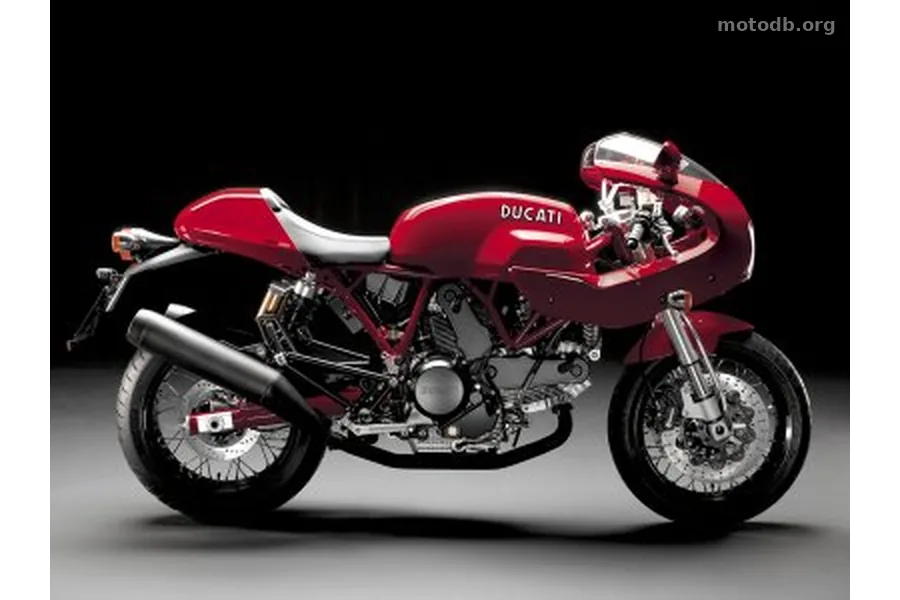
The engine is the main character in this play. This 90° V2, with its bore of 88 mm and stroke of 80 mm, breathes the heritage of bevel drives and the first Pantahs. A compression ratio of 9.3:1 suggests a mechanical system that doesn't need to rev at stratospheric speeds to exist. The 76 hp at 6700 rpm is a modest figure compared to the rising power of four-cylinder engines, but it masks a more subtle reality: the thrust must be linear, the torque present from low rpm, and the sound, that deep and syncopated rumble, is an integral part of the riding experience. Reaching 220 km/h with this engine was an exercise in patience and mastery, far more engaging than simply opening the throttle on a hyper-reactive motorcycle.
With a wet weight of 230 kg and tires in 100/90 at the front and 130/80 at the rear mounted on 18-inch rims, the 1000 S 2 displays its roots. The geometry, inherited from an era when corners were taken with a little slide and a lot of feeling, promises direct sensations, perhaps less precise than those of a brand new GSX-R 750, but probably more communicative. Braking, with two discs at the front and one at the rear, was considered solid for the time, even if it required a firm grip. Final transmission by chain and a five-speed gearbox complete a resolutely mechanical picture, without electronic embellishments, where every intervention by the rider is a direct conversation with the machine.
Riding a Ducati 1000 S 2 today means accepting a pact. You renounce absolute performance, the aggressiveness of a modern track bike, clinical efficiency. In return, you get a motorcycle that has a voice, a character, a palpable history in every vibration of its frame. It is the ideal mount for those who understand that pleasure is not measured only by the stopwatch or the power figure, but by the purity of the dialogue between man and machine. Faced with the overpowered sportbikes of its time, it played the role of a single-edged sword, against laser swords: less technological, but infinitely more noble in its gesture.
Reviews & comments
No reviews yet. Be the first to share your opinion!