Key performance
Technical specifications
Engine
- Displacement
- 1190 cc
- Power
- 185.0 ch @ 10600 tr/min (136.1 kW)
- Torque
- 138.3 Nm @ 8200 tr/min
- Engine type
- Bicylindre en V à 72°, 4 temps
- Cooling
- liquide
- Compression ratio
- 13.4:1
- Bore × stroke
- 106 x 67.5 mm
- Valves/cylinder
- 4
- Camshafts
- 2 ACT
- Fuel system
- Injection
Chassis
- Frame
- périmétrique en aluminium
- Gearbox
- boîte à 6 rapports
- Final drive
- Chaîne
- Front suspension
- Fourche téléhydraulique inversée Ø nc
- Rear suspension
- Mono-amortisseur
Brakes
- Front brakes
- Freinage
- Rear brakes
- Freinage 1 disque
- Front tyre pressure
- 2.50 bar
- Rear tyre pressure
- 2.90 bar
Dimensions
- Dry weight
- 190.00 kg
- New price
- 16 590 €
Overview
How many times can a brand die and be reborn before no one believes in it anymore? Buell closed its doors in 2009, resurfaced under the EBR acronym, sank again, and now Erik Buell is back with his original name. The Hammerhead 1190 RX is the spearhead of this comeback, a machine directly inherited from the ex-1190 RX cataloged under the EBR banner. The name has changed, the missile remains intact.
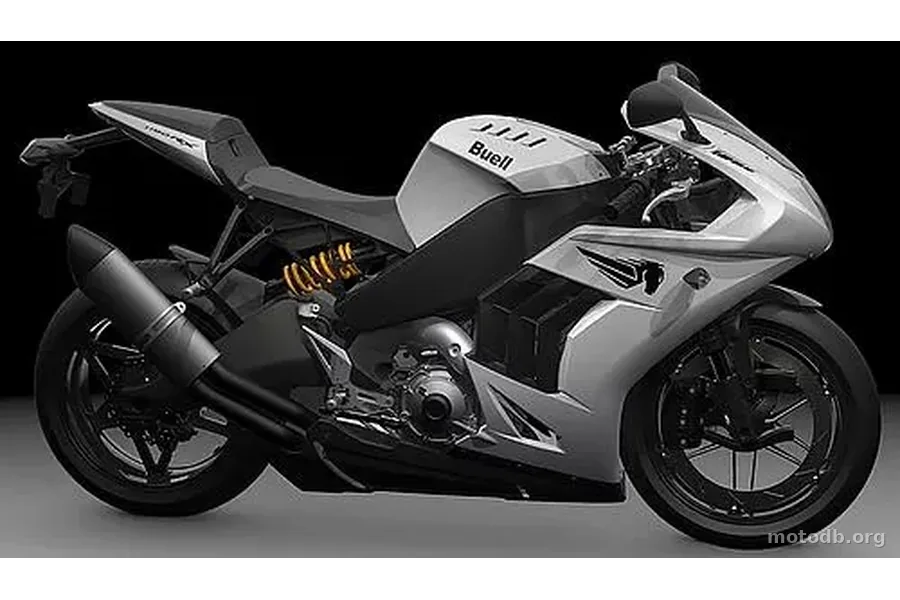
And what a missile. In a hypersport segment dominated for years by Japanese and Italian four-cylinder engines, the Hammerhead plays a solitary part: it is now the only high-end sportbike to feature a large V-twin engine. Those familiar with the era will remember the VTR SP-1, the KTM RC8-R, or the Aprilia RSV-R that vibrated the paddocks with their angry twins. This lineage has died out, and Buell is its last living representative. The engine is a 72° V of 1190 cm3, originally developed by Rotax, producing 185 horsepower at 10,600 rpm for a torque of 138.3 Nm available from 8,200 rpm. With only 190 kg dry weight and a stated top speed of 280 km/h, the technical specifications speak for themselves.
What strikes more, however, is what Buell has not done. Between the 1190 RX EBR and the 2022 Hammerhead, the figures are identical, line for line. The renaissance has focused on the bodywork: new aerodynamic vents, additional colors, carbon option for the fairing. It's cosmetic, assumed, and leaves intact all the mechanical folklore inherited from Erik Buell himself. The perimeter aluminum frame with oversized spars serves as a fuel tank, the perimeter front brake disc receives an air-cooled eight-piston caliper. Solutions that no one else uses, and which give the machine an immediately recognizable visual identity.
The target audience for this Hammerhead is clearly American, in the literal sense of the term. Offered at 16,590 euros in import, it is aimed at track riders and sensation seekers who want something different from Panigales or CBRs, a motorcycle that looks like nothing else in a garage. It is not for beginners, nor for those seeking the latest electronic refinement. It is for those who know what a large twin can do in the lower back at mid-range, and who accept the compromises in exchange for total singularity.
The real problem with the Hammerhead is not technical, it is geographical. Buell still struggles to structure a serious distribution network outside the United States, and Europe remains a peripheral market for the brand. Buying such a machine in France means accepting uncertain parts availability and a quasi-inexistent network. For a collector or enthusiast capable of carrying out their own maintenance, it is feasible. For the rest, it is a risky bet on a brand that is rebuilding its credibility brick by brick.
Practical info
- La moto est accessible aux permis : A
Indicators & positioning
Similar bikes
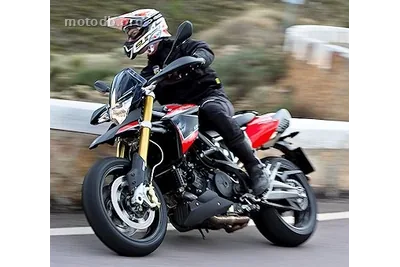
DORSODURO 1200 1.2
Reviews & comments
No reviews yet. Be the first to share your opinion!