Key performance
Technical specifications
Engine
- Displacement
- 999 cc
- Power
- 193.0 ch @ 13000 tr/min (142.0 kW)
- Torque
- 111.8 Nm @ 9750 tr/min
- Engine type
- 4 cylindres en ligne, 4 temps
- Cooling
- liquide
- Compression ratio
- 13:1
- Bore × stroke
- 80 x 49.7 mm
- Valves/cylinder
- 4
- Camshafts
- 2 ACT
- Fuel system
- Injection Ø 48 mm
Chassis
- Frame
- double poutre en alu
- Gearbox
- boîte à 6 rapports
- Final drive
- Chaîne
- Front suspension
- Fourche téléhydraulique inversée Ø 46 mm, déb : 120 mm
- Rear suspension
- Mono-amortisseur, déb : 130 mm
Brakes
- Front brakes
- Freinage 2 disques Ø 320 mm, étrier 4 pistons
- Rear brakes
- Freinage 1 disque Ø 220 mm, étrier simple piston
- Front tyre
- 120/70-17
- Front tyre pressure
- 2.50 bar
- Rear tyre
- 200/55-17
- Rear tyre pressure
- 2.90 bar
Dimensions
- Seat height
- 820.00 mm
- Fuel capacity
- 17.50 L
- Weight
- 199.00 kg
- Dry weight
- 169.00 kg
- New price
- 20 990 €
Overview
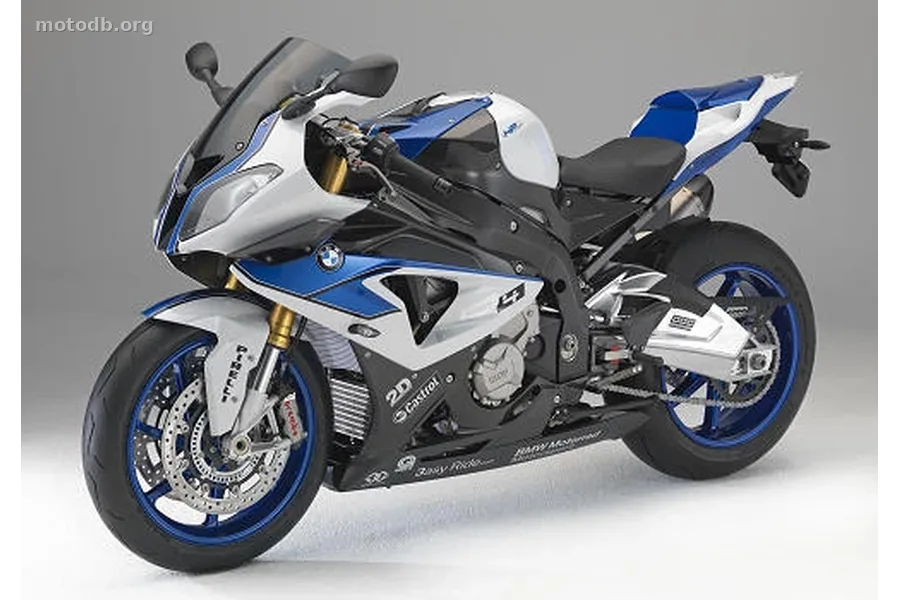
When BMW decides to unleash the engineers from the HP department on an already formidable S 1000 RR, the result can only be a machine built for the stopwatch. The 2013 HP4 is the no-compromise version of the Bavarian hypersport. The kind of machine that turns a good rider into a precise track rider, and a precise track rider into a tenths-of-a-second hunter. With 193 horsepower drawn from a 999 cc inline four-cylinder at 13,000 rpm and 111.8 Nm of torque peaking at 9,750 rpm, the engine wants for nothing. BMW didn't bother trying to inflate raw power. The work was focused elsewhere — on the torque curve between 6,000 and 9,750 rpm, made more generous to deliver better drive out of corners. The Akrapovic titanium exhaust system frees up the engine's breathing while shaving 4.5 kg off the scales. Add forged aluminum wheels that shed another 2.4 kg, carbon fiber elements scattered throughout, and the HP4 drops to 199 kg wet. Compared to over 206 kg for the standard S 1000 RR. Seven kilos, on track, is a chasm.
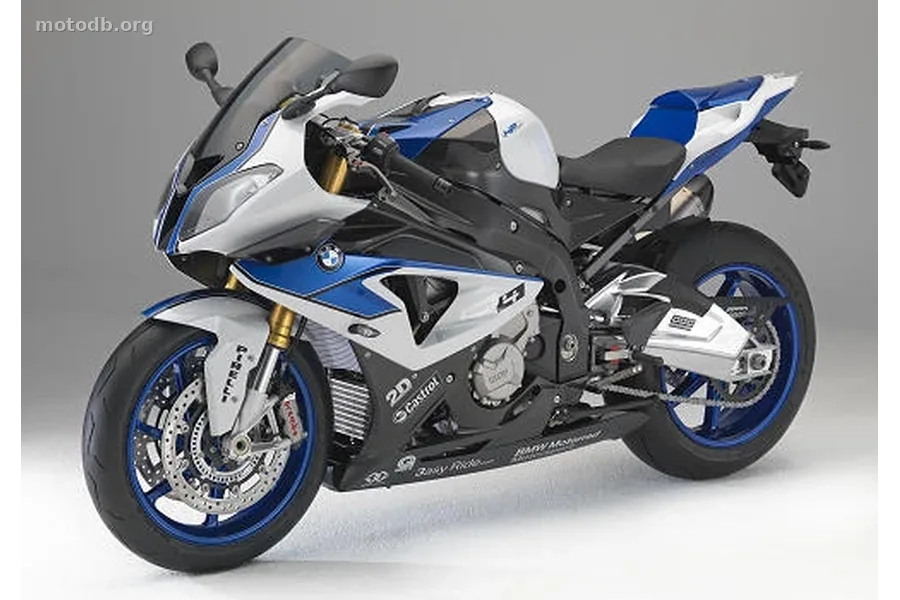
But the real stroke of genius on this HP4 is the chassis. BMW introduced DDC — Dynamic Damping Control — a semi-active suspension system that adjusts damping in real time. The 46 mm inverted fork and rear monoshock continuously receive data from speed, lean angle, and suspension travel sensors. Within milliseconds, the hydraulics recalibrate. In Rain or Sport mode, the settings stay soft to absorb road irregularities. Switch to Race or Slick, and everything firms up to stick to the circuit tarmac. This technology put the HP4 ahead of its direct competition at the time. Neither the Kawasaki ZX-10R nor the Yamaha YZF-R1 offered such a level of automatic adaptation in 2013.
Braking is also among the upgraded areas. Brembo radial monoblock calipers clamp two 320 mm floating discs up front, backed by a RaceABS system calibrated using feedback from the German IDM championship. Bite is immediate, progressivity is spot-on. At the rear, a single 220 mm disc is enough to stabilize the machine under braking. The standard-issue quickshifter lets you bang through all six gears without closing the throttle — a clear advantage coming out of straights when every millisecond counts against the clock. BMW also fitted a Launch Control system that manages torque delivered to the rear wheel at takeoff, limiting revs to 8,000 rpm in first gear up to 60 km/h, then recalibrating power in second. The system cuts out in third gear or as soon as lean angle exceeds 30 degrees. The DTC traction control, adjustable from -7 to +7 on the fly via the left switchgear, rounds out the electronic arsenal.
What's the price of a BMW S 1000 RR HP4? At launch, the bill came to €20,990 — a steep price tag but a coherent one for a limited series where each unit bears a laser-engraved number on the triple clamp. Delivered stock in single-seat configuration with a smoked windscreen and LED indicators, the HP4 fully embraced its status as an exclusive track weapon. A Competition package added extra carbon fiber parts, adjustable footpegs, folding levers, and racing blue wheels for those who wanted to push things even further. For anyone looking for a German sportbike of that era on the used market, the HP4 remains a safe bet — provided you accept a thoroughbred ergonomic setup designed for the track far more than for daily commuting. Its aluminum twin-spar frame, 820 mm seat height, and 17.5-liter tank are intended for experienced riders capable of exploiting its full potential. A connoisseur's machine, not a motorcycle of compromise.
Standard equipment
- Assistance au freinage : ABS deportivo
Practical info
- La moto est accessible aux permis : A
Reviews & comments
No reviews yet. Be the first to share your opinion!