Key performance
Technical specifications
Engine
- Displacement
- 1300 cc
- Power
- 145.0 ch @ 7750 tr/min (106.6 kW)
- Torque
- 149.0 Nm @ 6500 tr/min
- Engine type
- Bicylindre à plat, 4 temps
- Cooling
- liquide
- Compression ratio
- 13.3 : 1
- Bore × stroke
- 106.5 x 73 mm
- Valves/cylinder
- 4
- Camshafts
- 2 ACT
- Fuel system
- Injection Ø 52 mm
- Starter
- électrique
- Euro standard
- Euro 5+
Chassis
- Frame
- Structure en profilés d'acier
- Gearbox
- boîte à 6 rapports
- Final drive
- Cardan
- Front suspension
- Fourche téléhydraulique inversée Ø 47 mm, déb : 140 mm
- Rear suspension
- Mono-amortisseur et monobras EVO Paralever, déb : 130 mm
Brakes
- Front brakes
- Freinage 2 disques Ø 310 mm, fixation radiale, étrier 4 pistons
- Rear brakes
- Freinage 1 disque Ø 285 mm, étrier 2 pistons
- Front tyre
- 120/70-17
- Rear tyre
- 190/55-17
Dimensions
- Seat type
- Selle biplaces
- Fuel capacity
- 17.00 L
- Weight
- 239.00 kg
- Dry weight
- 227.00 kg
- New price
- 17 000 €
Overview
Wow, quite a bombshell this Germanic newcomer! When the editor-in-chief gave me the specs to write this review, I couldn't believe my eyes…
But where did the old-fashioned bike go? The flamboyant fifty-year-old will have to shave his mustache, dye his hair, and ditch the modular helmet for a good sporty integral. Because that's precisely the program for this German revolution. We're moving from a versatile, all-rounder to a bike capable of everything: from spirited riding to touring. What a program! A 145 horsepower Teutonic roadster, does that tempt you?
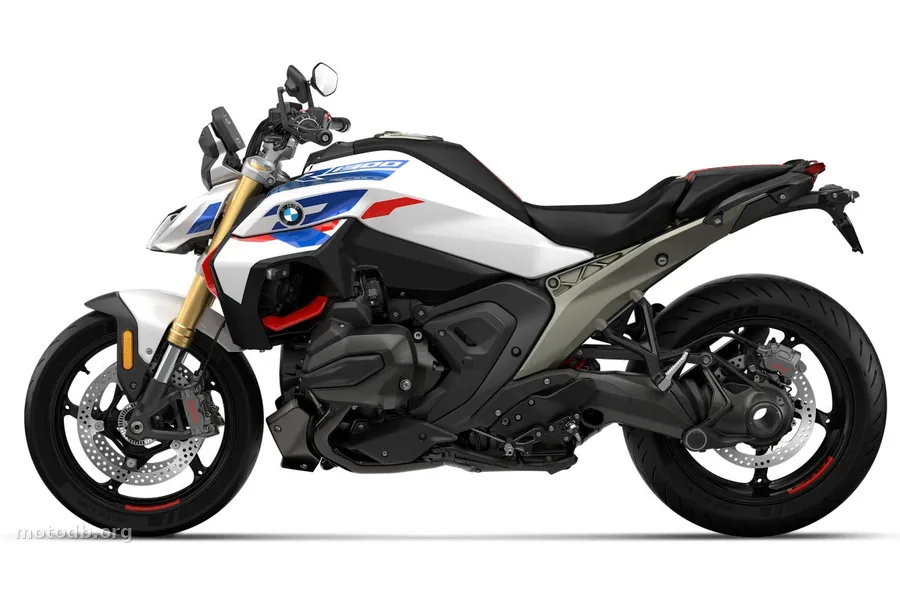
We’d always had this image of a fifty-year-old on his classic BMW roadster. You could say that for 2025, BMW is finally entering a new millennium with a roadster with a modern, even sporty look. This big flat-twin is a head-turner when parked and makes you want to ride it, no doubt about that. The front end is in the style of the F 900 R and borders on the streetfighter category with its pointed headlight.
We’re now accustomed to TFT screens positioned above, receiving a light trim and an "R" logo like the S 1000 R that Greg tested, all serving as a partial windscreen! The rest of the hardware is generous. It's a very faired roadster on its flanks. Thus the tank, which appears rather long, is itself attached to the fairings. The shapes aren’t convoluted; it’s sporty “elegant,” at least it looks that way in pictures. From a three-quarter rear view, you notice better the style contrasting with the shapes retained to give a new image to this R 1300 R. The cylinders of the flat-twin engine are black and almost hide their particularity. Still from a technical point of view, which contributes to the aesthetics: we are once again pleased with the presence of a single-sided swingarm (cardan drive) and the short exhaust pipe that reveals the beautiful rim.
The rear of the bike is almost more conventional without any particularity. It places the hierarchy within BMW’s roadster lineup. The S 1000 R’s looks spartan compared to the R 1300 R’s, which seems much more welcoming for a passenger. Dynamism isn’t forgotten with a stylized rear light completing the fairing. The practical side is also present with two beautiful grab handles for the sandbag. Clever! Note that the seat height is 790 mm for the rider.
Although it’s a clearly sportier roadster, it still retains practicality. True to BMW’s DNA, the bike can be equipped with a new system of cases and case supports from the range of original accessories. With capacities of 26 (on the exhaust side) and 29 liters, both are electrified and can be unlocked using the central locking system. The cases also have interior lighting, and the left case includes a USB-C charging port. A tank bag is also available with a unique ring-mounting system. The personalization of the "SA" R 1300 R can go very far since, for example, BMW offers no less than 7 saddles (sport, heated, comfort, etc.) to personalize your on-board experience.
The chassis of the new BMW R 1300 R has been completely redesigned compared to the R 1250 R. The centerpiece is the new steel sheet frame, which offers higher rigidity levels than the previous model. During the redesign, the rear frame loop was also completely reworked. It is made of tubular aluminum die-cast, not steel.
This new chassis, according to BMW, contributes to a better centralization of masses for even greater agility. It relies on a new 47 mm diameter telescopic inverted fork and EVO Paralever rear suspension. The front tubes slide on 140 mm. As for the rear, its anchoring is more rigid in the frame; the travel is announced at 130 mm.
Of course, as we are at BMW, these elements can benefit from electronic suspension control (DSA). This system allows, among other things, dynamic adjustment of the front and rear dampers with a corresponding adjustment of the spring stiffness, depending on the selected riding mode, driving conditions and maneuvers. The new BMW R 1300 R thus becomes the first series motorcycle to be equipped with an inverted telescopic fork allowing spring stiffness adjustment. Automatic load compensation is ensured by the adjustable spring support.
The new R 1300 R is also equipped with new 17-inch hollow-spoke cast aluminum wheels. In total, they weigh more than 1.4 kg less than the existing wheels. Reducing unsprung masses like wheels allows for better handling but also better braking. The German engineer’s eye lingered there, and that’s a good thing.
To stop, the R 1300 R relies on proven and worthy elements. It is equipped with a 310 mm double disc brake with two radially mounted four-piston calipers at the front and a single disc brake with a two-piston floating caliper at the rear. This braking system benefits from series ABS Pro. The new BMW R 1300 R can be equipped with the optional sport braking system. In addition to a sportier look and colored brake calipers, it slightly improves braking performance, according to BMW.
Although known since the R 1300 GS, the boxer engine of the new BMW R 1300 R deserves attention given the large gap from the 1250. It has a displacement of precisely 1,300 cm³, thanks to a bore stroke ratio of 106.5 to 73 mm (predecessor: 102.5 to 76 mm). This increase in displacement is achieved by an enlarged cylinder bore and a new reduced-stroke crankshaft. The engine develops a power of 107 kW (145 hp) (predecessor: 100 kW (136 hp)), still at 7,750 rpm, and develops a maximum torque of 149 Nm at 6,500 rpm (predecessor: 143 Nm at 6,250 rpm). It is thus the most powerful BMW series boxer engine ever produced. Its maximum engine speed is 9,000 rpm. ShiftCam The boxer engine of the new BMW R 1300 R is also equipped with BMW ShiftCam technology to vary the timing and lift of the admission valves on the side of the intake. At the heart of this technology is a camshaft with several profiles of cams – one at partial load and one at full load for each valve to be actuated, each with a different geometry. While the partial-load cam has been configured to ensure fuel consumption optimization, the full-load cam is designed for optimized power. The admission valve cams at partial load differ in their stroke and angular position. This phasing means that the two admission valves are moved, which allows for a more efficient combustion process.
Three riding modes are included as standard, allowing you to adapt your riding to your mood! In standard version, the new R 1300 R has the “Rain” and “Road” modes plus an “Eco” mode. The bike can be equipped with the “Pro Riding Modes” when ordering: these include the additional riding modes “Dynamic” and “Dynamic Pro.”
The engine is also equipped with engine torque control (MSR), even in standard version. In difficult driving conditions or in sporty use, this assistance keeps an eye on things to avoid torque return in the transmission shaft, with additional management and anticipation of the motorcycle's inclination.
The 6-speed gearbox and clutch are also integrated into the engine casing of the new BMW R 1300 R. However, the gearbox is no longer located behind the engine, but underneath. The particular advantages of this new arrangement lie in a reduced overall length and a better weight balance, as it was possible to shorten the transmission shafts.
Compared to the powertrain of previous models, a weight saving of no less than 3.9 kg on the base engine and 6.5 kg on the entire powertrain was made possible. At the same time, a greater concentration of mass towards the overall center of gravity ensures increased agility.
With the automated gear change assistant (ASA), BMW Motorrad is following the trend of manufacturers wanting to automate gearboxes. Yffic talked to you about this with Yamaha's vision during his test of the MT-09 Y-AMTet we can't wait to test this technology at BMW.
The operation of the clutch and gear changes further enhance the driving experience without sacrificing the dynamics of the gear changing process.
When can we test it?
I'm an enthusiast of atypical engines, and I admit that seeing a BMW roadster as sharp with the Boxer excites me, and I don't think I'm the only one. This BM is shaping up to be a success but will undoubtedly always be reserved for the "premium" clientele who push the door of BMW dealerships. The starting price is 16,600 euros, just above the R 1250 R.
Vincent Beaucousin - Manufacturer photos
Standard equipment
- Assistance au freinage : ABS
- Nombre de mode de conduite : 3
- Taille de l'écran TFT couleur : 16,51 cm / 6.5 pouces
- ABS Cornering
- Indicateur de vitesse engagée
- Régulateur de vitesse
- Bluetooth
- Prise USB
- Démarrage sans clé
- Contrôle de traction
- ABS déconnectable
- Embrayage anti-dribble
- Contrôle du frein moteur
- Surveillance de la pression des pneus
Practical info
- La moto est accessible aux permis : A
Reviews & comments
No reviews yet. Be the first to share your opinion!