Key performance
Technical specifications
Engine
- Displacement
- 689 cc
- Power
- 73.4 ch @ 8750 tr/min (54.0 kW)
- Torque
- 68.0 Nm @ 6500 tr/min
- Engine type
- Bicylindre en ligne, parallèle, 4 temps, calé à 270°
- Cooling
- liquide
- Compression ratio
- 11.5 : 1
- Bore × stroke
- 80 x 68.6 mm
- Valves/cylinder
- 4
- Camshafts
- 2 ACT
- Fuel system
- Injection Ø nc
- Starter
- électrique
- Euro standard
- Euro 5+
Chassis
- Frame
- type diamant en acier
- Gearbox
- boîte à 6 rapports
- Final drive
- Chaîne
- Front suspension
- Fourche téléhydraulique inversée Ø 41 mm, déb : 120 mm
- Rear suspension
- Mono-amortisseur, déb : 121 mm
Brakes
- Front brakes
- Freinage 2 disques Advics Ø 298 mm, fixation radiale, étrier 4 pistons
- Rear brakes
- Freinage 1 disque Advics Ø 245 mm, étrier simple piston
- Front tyre
- 120/70-17
- Rear tyre
- 180/55-17
Dimensions
- Seat height
- 830.00 mm
- Seat type
- Selle biplaces
- Fuel capacity
- 14.00 L
- Weight
- 189.00 kg
- New price
- 10 499 €
Overview
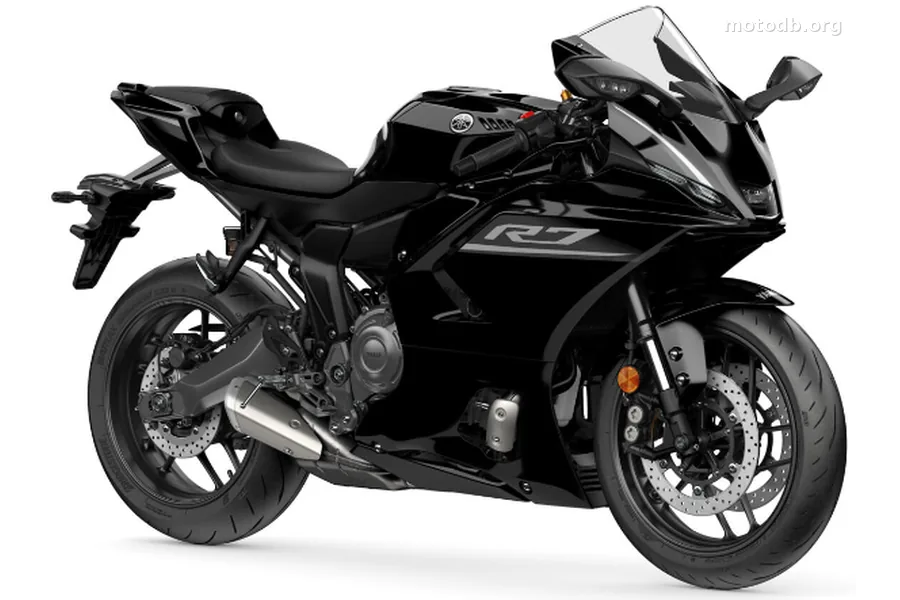
Arrival in 2021, the R7 quickly became the sport school at Yamaha. Its R1-inspired face, sporty riding position, and more agile chassis than the MT-07 (from which it derives) opened it up to a clientele seeking trajectories; without the thrill of a frantic cavalry charge. With 73 horsepower, the engine lacks the adrenaline of a 600 R6. Recent improvements to the CP2 engine family allow this gentle track bike to increase its performance. For greater efficiency? Above all, more control.
The new R7 dynamizes its style with caution but sufficiently to give itself a little more distinction. With its double-pupil eyes and, above all, the better-integrated central headlight (we won’re regret the monocle in the center of the air intake), it is more assertive, more incisive. This face and the appearance of turn signals in the mirrors are the most distinctive features of this evolution. Yet, the entire bodywork changes; timidly so that everyone can retain their markings. Surfaces lose curves and detours for straighter, more taut lines – and without unsightly wings that would serve no purpose anyway.
The first iteration of the R7 (the one with the 700 twin – we’re not talking about the ’99 750 Superbike) engaged the rider in a sporty, very sporty position. The new one repositions its handlebar risers to relieve the posture somewhat while remaining engaged. Add to that R1 footrests, a trimmed and lowered seat by 5 mm, a modified tank, and you get improved mobility to be more reactive during riding phases.
That’s where it wants to get to: riding! Better! A whole series of modifications follow on the chassis: reinforced and more rigid frame without weight gain, modified swingarm, redesigned upper fork clamp, aluminum piston rods in the fork instead of steel, and more responsive wheels. Yamaha offers it SpinForged rims, lighter and reducing inertia. The tire fit remains faithful to the S series from Bridgestone but evolves from S22 to S23. Here it is, ready to generate more agility and rigor in the curves.
This is a domain where it must imperatively enter and exit quickly. Because even if the twin is lively, pleasant and responsive, it remains an engine that is not very powerful for a 189 kg sportbike. It’s impossible to pull out of a corner quickly if you haven’t kept some velocity. By passing Euro5+, the twin has not lost watts or horsepower. It has simply left behind some sensations. Its behavior will be smoother, with a more regular distribution of torque. The 73.4 horsepower and 6.9 kg-m package is nevertheless perceived in a different way... in different ways, in the plural.
Suddenly, the R7 phase II switches to electronics. Before, there was nothing. You welded and that was it. Today, electronics of the level of the R9 reflects on the output of watts, and even before. Ride-by-wire will begin to manage the level of throttle opening, in correlation with the three power modes. Then, the 6-axis IMU will locate the motorcycle and its movements in space to inform traction control and other interveners. This is just the beginning. We will present an overview of all the riding assistance available on the R7:
A real overdose, for a motorcycle that is 1/3 less powerful than an R9. Fortunately, all these aids can be switched off to restore freedom to the experienced rider. The latter can, as an option, take advantage of the Y-TRAC REV app to record, analyze and compare their data (lap times, by sector, lean angle, engine speed, gear position, speed, throttle position, level of electronic assists).
The R7 has also abandoned its LCD screen to equip itself like almost all other Yamahas with a 5-inch color TFT screen. A serious visual leap forward, with beautiful graphics distributed according to 4 display themes. Smartphone pairing allows the screen to inform you, in addition to onboard data, calls, texts, weather, a GPS navigation (via the Garmin StreetCross app); and to modify the parameters of the electronic assists remotely in the YRC menu.
The 2026 R7 seems to have shopped at the ferocious sportbikes of the range for its electronics. This is not the case for the brakes – no Brembo here, but it would not really need them. The work will be done very convincingly with 4-piston radial calipers from Advics to bite the 298 mm discs. The rear has a 245 mm disc. Before adjusting the multiple possibilities of the techno-digital controls, a chassis adaptation will gain seconds. For this, the 41 mm inverted fork and the shock absorber are adjustable in every way.
Let’s take a few lines to specify that the R7 receives new switches, turn signals that switch off automatically and the emergency stop signal (ESS) function - lighting the hazard lights when braking hard or suddenly.
The Yamaha R7 has leveled up. To the level of modernity and a refined management of its dynamics. A little less demanding, more technological, more racy (and not racing), this motorcycle wants circuit without the fury. When you know how to trajectory, it can offer the means to enjoy yourself.
The entire R family is available in a 70th anniversary color scheme. The R7 is too, which allows it to look like.... the YZF-R7 mentioned at the beginning. A superb decoration that it will not be able to retain its pride.
M.B. - Photo manufacturer
Standard equipment
- Assistance au freinage : ABS cornering
- Nombre de mode de conduite : 5
- Taille de l'écran TFT couleur : 12,70 cm / 5 pouces
- Jantes forgées
- Indicateur de vitesse engagée
- Shifter
- Centrale inertielle
- Contrôle de traction
- Centrale inertielle
- Contrôle anti wheeling
- Aide au départ arrêté (Launch Control)
- Jantes aluminium
- ABS Cornering
- Bluetooth
Practical info
- Véhicule accessible au permis A2 ou bridable à 47.5ch / 35 Kw
- La moto est accessible aux permis : A, A2
Reviews & comments
No reviews yet. Be the first to share your opinion!