Key performance
Technical specifications
Engine
- Displacement
- 599 cc
- Power
- 120.0 ch @ 13000 tr/min (88.3 kW)
- Torque
- 68.5 Nm @ 12000 tr/min
- Engine type
- 4 cylindres en ligne, 4 temps
- Cooling
- liquide
- Compression ratio
- 12.4:1
- Bore × stroke
- 65,5 x 44,5 mm
- Valves/cylinder
- 4
- Camshafts
- 2 ACT
- Fuel system
- Injection Ø 38 mm
Chassis
- Frame
- deltabox en alu double longerons
- Gearbox
- boîte à 6 rapports
- Final drive
- Chaîne
- Front suspension
- fourche téléhydraulique inversée Ø 41 mm, déb : 120 mm
- Rear suspension
- Mono-amortisseur, déb : 120 mm
Brakes
- Front brakes
- Freinage 2 disques Ø 310 mm, fixation radiale, étrier 4 pistons
- Rear brakes
- Freinage 1 disque Ø 220 mm, étrier 2 pistons
- Front tyre
- 120/70-17
- Rear tyre
- 180/55-17
Dimensions
- Seat height
- 830.00 mm
- Fuel capacity
- 17.00 L
- Weight
- 191.00 kg
- Dry weight
- 163.00 kg
- New price
- 7 199 €
Overview
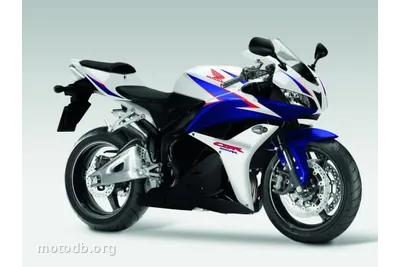
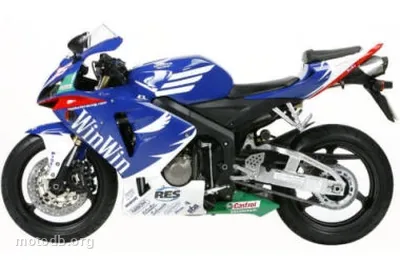
Do you still think a modern sport 600 is inevitably a sanitized Swiss Army knife? Take a trip back to 2005, and take a look at this Yamaha YZF-R46. This wasn't just a standard R6, but a limited edition signed by Drudi, the famous designer of Valentino Rossi's helmets. One fairing was sunshine yellow, the other moonlight black, with the Doctor's signature on the tank and a Termignoni carbon exhaust replacing the original muffler. At the time, it was the machine of the elite, the Holy Grail for any fan of number 46. Beneath the embellishments, beat the heart of one of the most formidable sportbikes of its generation, a stinging response to the Suzuki GSX-R 600 and the Kawasaki ZX-6RR that were beginning to encroach on its territory.
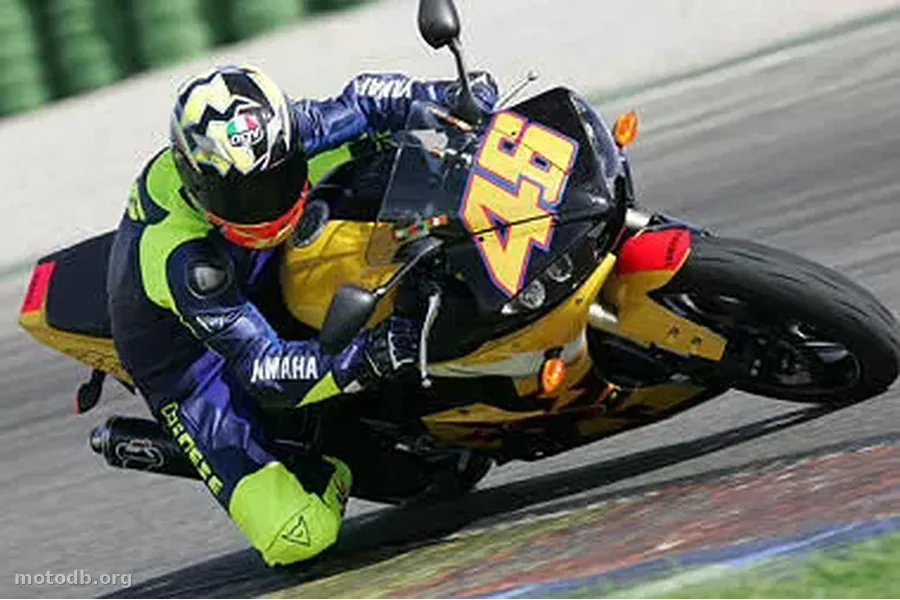
The real revolution that year wasn't visible at first glance, but was felt with the first pull of the lever. Yamaha completely revised the front suspension, with a radial braking system of monstrous efficiency. Two 310 mm discs, four-piston calipers: the braking power was phenomenal, but it was the feel, this progression and surgical precision, that marked people's minds. Paired with a stiffer inverted fork and a front tire with a modified profile, the R46 dove less into corners. It gained stability without sacrificing its legendary agility, despite a slightly extended wheelbase. On the track, it was intimidatingly precise, planted like a nail, even when you sent it into tight chicanes.
However, we must talk about its engine, this 599 cm3 inline four-cylinder delivering 120 horsepower at 13,000 rpm. This is where the character of a true 2000s 600 was expressed unfiltered. Below 8,000 rpm, it was polished, almost civilized, sufficient for the road. But to make it sing, you had to torture it. The explosive power zone really began beyond 10,000 rpm, forcing you to keep the revs in the red to extract the slightest significant acceleration. On the track, it was an exhilarating game. On the road, it could be frustrating. Its 17-liter tank and 83 cm high seat made it a demanding machine, far from the comfort of today's sportbikes.
So, who was this R46 for? For the hardcore track rider, the one who seeks the precision of a competition instrument and accepts to play with the tachometer like a pianist with his keyboard. For the collector or unconditional Rossi fan, seduced by its unique livery. At nearly 7200 euros new, it cost a fortune, but it embodied the pinnacle of mid-range sport technology at the time. Today, it remains an icon, a motorcycle that reminds us that track pleasure also lies in mechanical demands and in this raw dialogue between the rider and a machine that forgives no mistakes. Faced with the adjustable smoothness of the moderns, it has the austere and exciting charm of a thoroughbred.
Practical info
- La moto est accessible aux permis : A
Indicators & positioning
Similar bikes
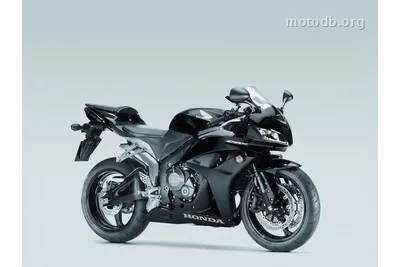
CBR 600 RR édition HANNspree Ten Kate
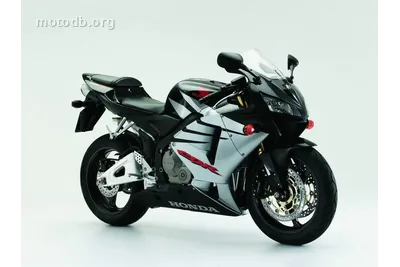
CBR 600 RR Replica MOVISTAR
Reviews & comments
No reviews yet. Be the first to share your opinion!