Key performance
Technical specifications
- Power
- 228.0 ch @ 15000 tr/min (167.7 kW) → 215.0 ch @ 14000 tr/min (158.1 kW)
- Compression ratio
- 14.5 : 1 → 12.7:1
- Front suspension
- Fourche téléhydraulique inversée Öhlins TTR Ø 43 mm, déb : 120 mm → Fourche téléhydraulique inversée Öhlins TTX36 Ø 43 mm, déb : 120 mm
- Rear suspension
- Monoamortisseur Öhlins RSP40, déb : 120 mm → Monoamortisseur Öhlins TTX25, déb : 120 mm
- Front brakes
- Freinage 2 disques Ø 316 mm, fixation radiale, étrier 4 pistons → Freinage 2 disques Ø 320 mm, fixation radiale, étrier 4 pistons
- Rear brakes
- Freinage 1 disque Ø 218 mm, étrier 2 pistons → Freinage 1 disque Ø 203 mm, étrier simple piston
- Front tyre
- 120/75-17 → 120/70-17
- Dry weight
- 159.00 kg → 162.00 kg
Engine
- Displacement
- 998 cc
- Power
- 215.0 ch @ 14000 tr/min (158.1 kW)
- Engine type
- 4 cylindres en ligne, 4 temps
- Cooling
- liquide
- Compression ratio
- 12.7:1
- Bore × stroke
- 78 x 52.2 mm
- Valves/cylinder
- 4
- Camshafts
- 2 ACT
- Fuel system
- Injection Ø 45 mm
Chassis
- Frame
- Deltabox en aluminium
- Gearbox
- boîte à 6 rapports
- Final drive
- Chaîne
- Front suspension
- Fourche téléhydraulique inversée Öhlins TTX36 Ø 43 mm, déb : 120 mm
- Rear suspension
- Monoamortisseur Öhlins TTX25, déb : 120 mm
Brakes
- Front brakes
- Freinage 2 disques Ø 320 mm, fixation radiale, étrier 4 pistons
- Rear brakes
- Freinage 1 disque Ø 203 mm, étrier simple piston
- Front tyre
- 120/70-17
- Rear tyre
- 190/65-17
Dimensions
- Fuel capacity
- 23.00 L
- Dry weight
- 162.00 kg
- New price
- 100 000 €
Overview
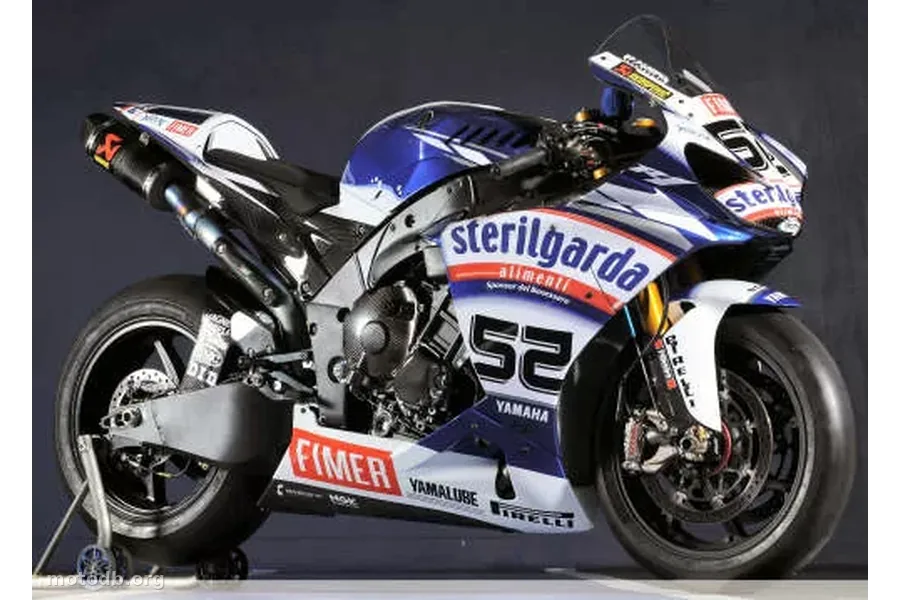
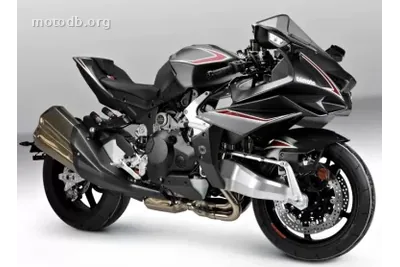
Do you remember that sound? That hoarse rumble, that unbalanced buzz that tore across the straights of racetracks in 2009? It wasn’t just the sound of a new motorcycle; it was the announcement of a mechanical revolution. The Yamaha YZF-R1 Factory of that year wasn't a simple evolution; it was a war machine disguised as a limited series, a direct bridge between the showroom and the starting grid of the World Superbike Championship. And to be honest, it made the factory machines of the time jealous.
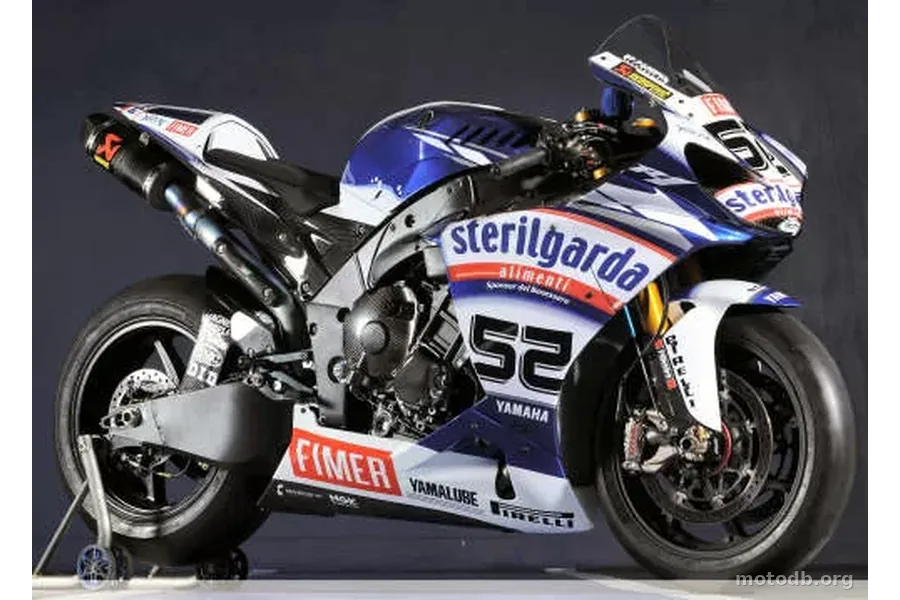
The secret lay under the carbon fiber fairing, a material omnipresent from the mudguard to the oversized airbox. Yamaha had rethought everything, even moving the fuel tank under the seat to refine the center of gravity. But the real genius was invisible, lurking in a nest of cables and sensors. The electronics of this Factory were of an unheard-of complexity for the time, with a traction control system and engine maps that the rider could adjust on the fly, or that modified automatically via GPS according to the corner approached. This was far from a simple switch. This forest of printed circuits, housed in the space freed up by the fuel tank, made it a prototype in its own right.
And then, there was that engine. The famous crossplane crankshaft, inherited from MotoGP, gave it a unique voice and a more linear, more reassuring torque delivery for early throttle opening in corners. It came standard with 182 horsepower. Here, after meticulous work on the camshafts and intake, it produced 215 at 14,000 rpm, drawn in by a Magnetti Marelli injection system and exhaling through a titanium/carbon Akrapovic with a deliciously brutal sound. A power that demanded a monstrous radiator, the price of which alone could have bought you a used sportbike. It may not have been the strongest against the surprising Aprilia RSV4 of the time, but it had remarkable effectiveness.
The chassis, for its part, was a haute couture exercise around the ultimate constraint: the original Deltabox frame, the only element imposed by the regulations. All around, Yamaha Racing built a work of art. 15% stiffer swingarm, Öhlins TTX suspensions directly from Rossi’s M1, radial Brembo monoblock calipers on machined supports. Every part was optimized, down to the 16.5-inch magnesium wheels that could be lifted with a finger. Result: a dry weight of 162 kg, a wasp-like aggressiveness. The detail that kills? It was the only one on the grid to retain an electric starter, a small thumb to the nose at the ruthless weight-saving hunt.
At €100,000, this R1 Factory was obviously not a motorcycle for the average person. It was the ultimate tool for a rider competing in a championship, a dealer machine in soul but track in blood. It symbolized a pivotal era when electronics became a rider in their own right, without stifling the wild character of an exceptional four-cylinder engine. Proof that, sometimes, the factory sells its secrets, for the greatest happiness of those who have the wallet and the talent to tame them.
Reviews & comments
No reviews yet. Be the first to share your opinion!