Key performance
Technical specifications
Engine
- Displacement
- 749 cc
- Power
- 160.0 ch @ 11000 tr/min (117.7 kW)
- Torque
- 72.6 Nm @ 9000 tr/min
- Engine type
- 4 cylindres en ligne, 4 temps
- Cooling
- liquide
- Compression ratio
- 11.4 : 1
- Bore × stroke
- 72 x 46 mm
- Valves/cylinder
- 5
- Camshafts
- 2 ACT
- Fuel system
- Injection
Chassis
- Frame
- deltabox II en aluminium
- Gearbox
- boîte à 6 rapports
- Final drive
- Chaîne
- Front suspension
- Fourche téléhydraulique inversée Öhlins Ø 43 mm, déb : 120 mm
- Rear suspension
- Mono-amortisseur Öhlins, déb : 138 mm
Brakes
- Front brakes
- Freinage 2 disques Ø 320 mm, étrier 4 pistons
- Rear brakes
- Freinage 1 disque Ø 245 mm, étrier 2 pistons
- Front tyre
- 120/70-17
- Front tyre pressure
- 2.50 bar
- Rear tyre
- 180/55-17
- Rear tyre pressure
- 2.50 bar
Dimensions
- Seat height
- 840.00 mm
- Fuel capacity
- 24.00 L
- Dry weight
- 175.00 kg
- New price
- 27 440 €
Overview
You’ve likely heard of the standard Yamaha YZF-R7, that legendary machine reserved for race circuits and wealthy riders. But there’s an even more mythical version, almost sacred to endurance enthusiasts: the R7 OW-02 Bol d’Or replica. Only twenty examples were created to celebrate Yamaha’s victory at the 2000 Bol d’Or in Magny-Cours. It’s not just a motorcycle; it’s a trophy, a piece of living history that originally cost 179,980 francs, or approximately 27,440 euros today.
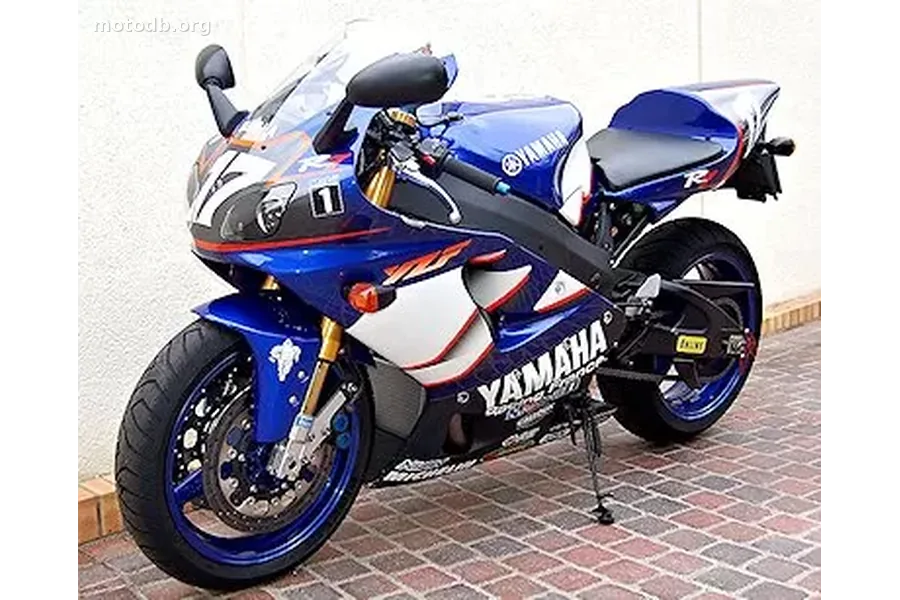
Imagine the scene. A French circuit in September 2000, the rumble of Honda RC45s and Suzuki GSX-Rs in the background. And there, the official R7 from Yamaha Motor France, ridden by Jean-Marc Delétang, Fabien Foret, and Mark Willis, dominates the race. To immortalize this triumph, Yamaha decided to produce an ultra-limited series. These replicas received the exact livery of the victorious motorcycle, a titanium Akrapovic silencer, quick-release wheelie control levers, and an Ermax racing screen. Each example was identified by a gold inscription on the right side of the Deltabox II aluminum frame, rather than a simple numbered plate. Delivery was an event in itself; owners had to go to MG Compétition, Martial Garcia’s workshop in Haute-Savoie, where the official endurance Yamaha motorcycles were prepared.
Technically, this R7 replica shared the same radical base as the race version. Its 749 cm³ four-cylinder engine, with its titanium connecting rods and twenty valves, was a mechanical work of art. In civilised form, it delivered 106 horsepower, but the race kit unleashed its true nature: 160 horsepower at 11,000 rpm and a torque of 72.6 Nm at 9,000 rpm. The chassis was just as race-oriented, with a 43 mm Öhlins inverted fork, a single Öhlins shock absorber, and a swingarm inspired by Grand Prix motorcycles. The 24-liter fuel tank was endurance-type, with locations for Zenith valves. It was a machine that demanded respect, designed for those who understood its language.
Today, finding one of these twenty replicas is a quest for collectors. Hubert Rigal, a former rider turned specialist in exceptional motorcycles, is a source for these rare parts. Machines like this Bol d’Or R7, or gems like a Bimota YB3 or an MV Agusta 850 Monza, sometimes pass through his network. Compared to modern superbikes, the R7 may seem less powerful or less electronically sophisticated. But its charm lies in its purity, its direct connection to a historic victory, and its status as a quasi-sacred object. It doesn’t speak to everyone; it addresses the historian, the collector, the enthusiast who sees in a motorcycle a narrative and a heritage. It’s less a vehicle than an artifact, a fragment of passion that continues to burn.
Practical info
- La moto est accessible aux permis : A
Reviews & comments
No reviews yet. Be the first to share your opinion!